
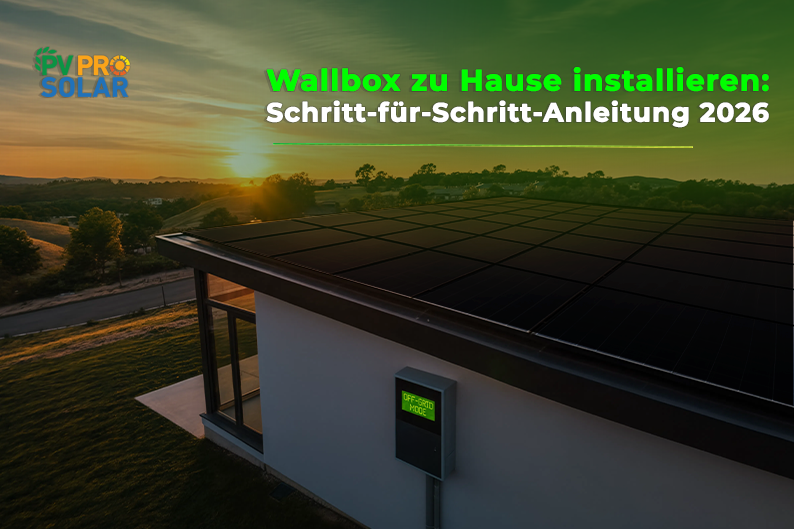
Home Wallbox Installation: A Complete Guide for 2026

If you own an electric vehicle, convenient and cost-effective charging starts at home. Installing a wallbox eliminates the need to rely on crowded public charging stations and helps reduce charging expenses over time. But what does the installation process involve, how much does it cost, and what incentives are available in 2026?
This guide explains everything you need to know, from technical requirements and installation steps to integrating your wallbox with a solar energy system and taking advantage of available funding opportunities.
PVPro Solar GmbH
In 3 Schritten zur PV-Anfrage
Bedarf klären · Daten senden · Angebot erhalten
Jetzt Anfrage sendenBedarf klären
Schritt 1
Daten senden
Schritt 2
Angebot erhalten
Schritt 3
Why Install a Wallbox at Home?
Public charging stations can be expensive, occupied, or inconveniently located. A home wallbox provides a reliable and efficient charging solution, allowing you to charge your vehicle whenever it suits you.
A private charging station offers several benefits:
- Charge your vehicle overnight and start each day with a full battery.
- Lower charging costs compared to many public charging networks.
- Faster charging than a standard household outlet.
- Improved safety and energy efficiency.
- Seamless integration with a photovoltaic system for solar powered charging.
If you already have a solar system installed, charging your electric vehicle with self-generated electricity can significantly reduce operating costs and increase energy independence.
What Is a Wallbox?
A wallbox is a wall mounted charging unit designed specifically for electric vehicles. Unlike a standard household socket, it provides higher charging power, typically 11 kW or 22 kW, and includes advanced safety features that make charging faster, safer, and more efficient.
As electricity prices continue to rise and renewable energy adoption increases, a home wallbox has become an essential component of modern electric mobility.
What Are the Requirements for Installing a Wallbox?
Before installing a wallbox, several technical and legal requirements should be reviewed. A qualified electrician can usually assess these conditions during an initial site visit.
Key Requirements
- Sufficient electrical capacity: Most modern single family homes can support an 11 kW wallbox without major upgrades. Higher charging capacities may require additional approval from the local grid operator.
- Three phase power connection: A three phase electrical supply is required for wallboxes rated at 11 kW and above.
- Suitable installation location: The wallbox is typically installed in a garage, carport, or driveway area with a practical cable route to the electrical distribution panel.
- Residual current protection: A Type B residual current device is required for a compliant wallbox installation in Germany.
- Grid operator notification or approval: Charging systems above 12 kW must be registered with the local grid operator according to applicable regulations.
Rights for Apartment Owners and Tenants
German legislation gives apartment owners the legal right to install electric vehicle charging infrastructure, even in shared residential developments, subject to applicable procedures and requirements.
How Does Wallbox Installation Work?
Professional installation follows a structured process to ensure compliance, safety, and reliable operation.
Step 1: Site Inspection and Consultation
An electrician evaluates the property’s electrical infrastructure, available power capacity, and the preferred installation location.
Step 2: Choosing the Right Wallbox
The wallbox is selected based on:
- Vehicle type
- Daily driving habits
- Desired charging speed
- Solar system integration requirements
- Future energy management plans
Step 3: Registration with the Grid Operator
Where required, the installer handles communication and registration with the local electricity network operator.
Step 4: Cable Installation
Power cables are routed from the distribution board to the wallbox location. Cable sizing and protective conduits are selected according to technical requirements.
Step 5: Mounting the Wallbox
The charging unit is securely installed, connected, and configured.
Step 6: Electrical Protection Installation
Required safety components, including residual current protection and circuit breakers, are installed.
Step 7: Testing and Commissioning
The system undergoes a complete functionality and safety check, including a test charging session.
Step 8: Documentation and Handover
The homeowner receives all required documentation, including installation records and test certificates.
In most cases, installation can be completed within half a day to one full working day.
Which Wallbox Is Best for Your Home?
Different wallboxes are designed for different applications.
| Feature | Basic Wallbox | Smart Wallbox | Bidirectional Wallbox |
| Charging power | 11 kW | 11 kW | Up to 22 kW |
| Solar integration | Limited | Yes | Yes |
| Load management | No | Yes | Yes |
| Remote access | No | App and WiFi | Yes |
| RFID access control | Optional | Optional | Optional |
| Best suited for | Standard charging | Solar integration and advanced control | Energy storage applications |
| Typical price range | €300 to €600 | €600 to €1,200 | €1,500 to €3,000 |
For most homeowners, a smart 11 kW wallbox offers the best combination of performance, flexibility, and future readiness.
What Does a Wallbox Cost in 2026?
The total cost depends on both equipment and installation requirements.
Typical Cost Breakdown
| Item | Estimated Cost |
| Wallbox unit | €300 to €1,500 |
| Installation | €500 to €1,200 |
| Additional cabling or ground work | €300 to €800 |
| Total investment | €800 to €2,500 |
The final price depends on factors such as cable length, installation complexity, and the chosen wallbox model.
Compared with public fast charging rates, home charging often delivers significant savings. Households with solar systems can reduce charging costs even further by using self generated electricity.
For many drivers, the investment pays for itself within two to four years.
Combining a Wallbox with a Solar System
One of the most attractive options for homeowners is integrating a wallbox with a photovoltaic system.
When your solar panels generate more electricity than your household currently consumes, the excess energy can be used to charge your electric vehicle.
Modern smart wallboxes communicate with energy management systems through technologies such as EEBUS and other compatible platforms. This allows charging to automatically occur when solar production is highest.
Benefits include:
- Lower charging costs
- Increased self consumption of solar energy
- Reduced dependence on the public grid
- Greater overall energy efficiency
Adding battery storage further enhances flexibility by allowing surplus solar power to be stored and used later.
How Does Solar Powered EV Charging Work?
Solar powered vehicle charging is based on real time energy monitoring.
An energy management system continuously tracks:
- Current solar generation
- Household electricity consumption
- Available surplus energy
When excess solar power becomes available, the system automatically directs it to the wallbox.
Recommended Components
- Photovoltaic system with inverter
- Smart wallbox with energy management integration
- Battery storage system (optional)
- Compatible energy management platform
For example, a household driving between 12,000 and 15,000 kilometers annually typically requires approximately 2,400 to 3,000 kWh of electricity for vehicle charging. An 8 kWp solar system can often generate enough energy to cover a large portion of this demand.
Available Incentives and Regulations in 2026
Although previous wallbox subsidy programs have ended, several support options remain available.
KfW Program 442
This program supports the combined installation of:
- Solar panels
- Battery storage systems
- Wallboxes
Eligible homeowners may receive grants of up to €10,200, subject to program requirements.
Regional Incentives
Many municipalities and federal states continue to offer financial support for charging infrastructure projects.
Employer Supported Installation
Employers may provide wallbox installations under favorable tax conditions, depending on the applicable legal framework.
Tax Advantages
When a wallbox is used for business purposes, installation and equipment costs may be deductible as business expenses.
Regulatory Requirements
Charging systems above 12 kW generally require registration with the local grid operator.
Installation must always be performed by a qualified electrician in accordance with applicable electrical standards.
Why Choose Professional Installation?
Working with an experienced regional installer provides several advantages:
- Faster response times
- Knowledge of local utility requirements
- Professional project management
- Ongoing support and maintenance
- Safe and compliant installation
Companies specializing in both solar energy and electric mobility can deliver a complete solution, ensuring all system components work together efficiently.
Conclusion
Installing a wallbox at home is one of the smartest investments electric vehicle owners can make in 2026. It reduces charging costs, improves convenience, and provides the foundation for a modern home energy system.
When combined with a solar installation and battery storage, a wallbox helps maximize energy independence and long term savings.
By choosing a qualified installation partner, homeowners benefit from professional planning, compliant installation, complete documentation, and expert support throughout the entire process.
If you are considering a home wallbox installation, now is an excellent time to explore your options and take advantage of available incentives.
Can I install a wallbox myself?
No. Wallbox installation must be performed by a qualified electrician to ensure compliance with safety regulations and electrical standards.
How much does a wallbox cost including installation?
In most cases, the total investment ranges from €800 to €2,500, depending on equipment selection and site conditions.
Do I need approval to install a wallbox?
Requirements vary based on charging capacity. Higher power installations typically require notification or approval from the local grid operator.
Is a wallbox worthwhile without solar panels?
Yes. Even without a solar system, a wallbox offers faster, safer, and more cost effective charging than a standard household outlet.
Will my electric vehicle work with a wallbox?
Almost all modern electric vehicles in Europe use the Type 2 charging standard and are compatible with most wallboxes on the market.
Can I connect a battery storage system to my wallbox?
Yes. Many smart wallboxes can be integrated with battery storage and energy management systems, allowing greater use of self generated solar electricity.
PVPro Solar GmbH
In 3 Schritten zur PV-Anfrage
Bedarf klären · Daten senden · Angebot erhalten
Jetzt Anfrage sendenBedarf klären
Schritt 1
Daten senden
Schritt 2
Angebot erhalten
Schritt 3