
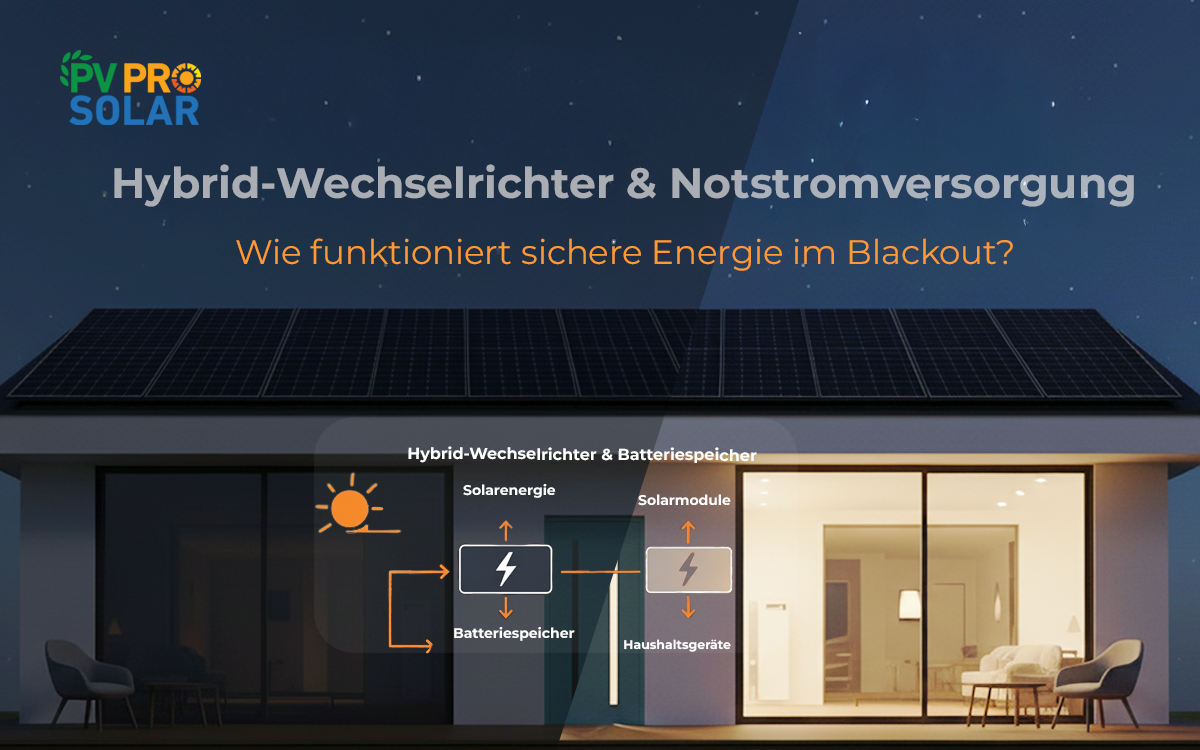
Hybrid Inverter Emergency Power Supply: How Does Reliable Energy Work During a Blackout?

A hybrid inverter emergency power supply has become a crucial element for many homeowners who want protection against power outages and full use of their self-generated solar energy at any time. It links the PV system, battery storage, and backup switching into an autonomous energy system — without requiring extensive additional technology.
However, Backup is not always real backup. For emergency power to work properly when it counts, you need proper system planning, suitable hardware components, and compliance with technical regulations.
What Is the Difference Between Emergency Power, EPS, and a True Backup Solution?
Hybrid inverters are often marketed as automatic emergency power systems — but many devices only offer an EPS (Emergency Power Supply) function.
In practice, there are three types:
| Mode of Operation | Features | Advantages | Limitations | Typical Uses |
| EPS / Partial Backup | Fast switching (model-dependent, a few ms) | Easy integration | Only selected sockets/circuits | Refrigerator, router, lighting |
| Full Backup (4-pole ATS) | The entire house can be supplied | Maximum resilience | More complex protection technology | Outages lasting hours/days |
| UPS per IEC 62040 | 0 ms switchover (no interruption) | Ideal for sensitive loads | Not suitable for entire household loads | Servers, medical equipment |
A hybrid inverter emergency power system is not automatically a UPS — this must be clearly communicated to customers.
Which Components Are Required for a Hybrid Inverter Emergency Power System?
A reliable blackout solution is typically built as follows:
System architecture (compliant with German, Austrian, and Swiss standards) PV strings → Hybrid inverter → Battery → Backup sub-distribution → Critical loads with a 4-pole Automatic Transfer Switch (ATS) that cleanly switches L1/L2/L3/N
→ Prevents feed-back into the public grid → Defines neutral conductor during island operation
This topology is the standard recommendation for full-backup systems according to technical guidelines.
Standards & Grid Connection Rules in Germany, Austria & Switzerland
Emergency power systems must always be designed in accordance with applicable standards and manufacturer specifications.
Germany
- VDE-AR-N 4105:2018-11 – Grid connection for generating plants
- VDE-AR-N 4100:2019-04 – Requirements for meter cabinet/house connection
- Local utility operator TAB specifications
- MaStR registration for PV and storage units
Austria
- TOR Erzeuger Type A v1.3 (10.06.2024)
- OVE E 8101
Switzerland
- NIN SN 411000 (2025)
- VSE NA/EEA-NE7
Non-compliance can result in:
- No grid approval
- loss of warranty
- safety deficiencies
Why Is a 4-Pole Transfer Switch (ATS) Essential?
For a safe hybrid inverter emergency supply, the neutral conductor (N) must be defined during island mode.
A 4-pole ATS switches L1 / L2 / L3 / N, ensuring:
- no back-feeding into the public grid
- proper formation of a new neutral reference point
- correct operation of protection systems
This requirement is anchored in standards such as DIN EN 60947-6-1.
How Should the System Be Properly Sized?
Emergency power design follows different principles from normal grid-connected planning:
Inverter Output Power
Motor loads (heat pumps, fridge compressors, etc.) draw 2–3× higher inrush current: ➡ EPS output is often insufficient ➡ Full backup requires phase planning and load prioritization
Tip: Cleanly separate critical and non-critical loads.
Battery Capacity
Rule of thumb:
Autonomy / (DoD × η)
Example:
7 kWh usable capacity typically covers 6–12 hours of household base consumption.
Transfer Times
- EPS: usually < 10 ms → most household devices tolerate this
- ATS full-backup: 100 ms to several seconds
- For zero-downtime loads → separate UPS required
Protection & Safety: What Must Be Considered?
Hybrid inverter emergency power systems must meet higher protection requirements:
| Protection Measure | Regulation | Purpose |
| AC/DC surge protection | DIN VDE 0100-443/534/712 | Protection against lightning & grid faults |
| Proper RCD selection | DIN VDE 0100-420 | Residual-current safety |
| Battery safety | VDE-AR-E 2510-2 | Fire safety & installation |
| Documentation/testing | DIN VDE 0100-600 + FNN Annex E forms | Certified handover & approval |
➡ Many existing homes require meter cabinet upgrades per VDE-AR-N 4100.
Which Manufacturer Solutions Are Common in D-A-CH?
- SMA AC-Backup – robust full-backup integration
- Fronius GEN24 Plus – PV Point (EPS) + full-backup option
- Huawei Backup Box – 1-/3-phase, paired with SUN2000
- GoodWe ET-Series – fast EPS switching
Important: Always follow the manufacturer’s installation documentation.
Checklist: When Is EPS Enough & When Do You Need Full-Backup?
| Requirement | Recommendation |
| Router, lighting, laptop, fridge | EPS is sufficient |
| Heat pump, cooking appliances, whole house | Full-backup necessary |
| IT/medical equipment | Additional UPS required |
| A utility requires a defined islanding | 4-pole ATS mandatory |
In short:
If comfort and independence are priorities → choose a real backup solution.
Planning Mistakes Installers Must Avoid
- Undefined neutral conductor in emergency mode → protection devices fail
- Too many loads on backup circuit → battery overload → shutdown
- Missing documentation → no approval by the grid operator
- No surge protection → warranty issues & increased risk
A hybrid inverter emergency power supply is not plug-and-play — expert planning is essential.
A hybrid inverter emergency power system enables true energy independence:
➡ Power supply continues during outages ➡ Higher safety and comfort ➡ Solar production remains available even when the grid fails
Anyone who wants to ensure full compliance with regulations, safety engineering, and system planning should rely on experienced local professionals.
PVPro Solar GmbH plans & installs hybrid backup systems in full compliance with all D-A-CH regulations. → Request expert consultation now: PVPro Solar GmbH
Do I need a UPS for zero-downtime loads?
Yes — hybrid inverters do not meet the UPS standard IEC 62040.
Can the entire house be powered during an outage?
Only with full-backup systems using a proper 4-pole ATS.
Can the battery feed into the grid while grid power is present?
Yes — if VDE-AR-N 4105 and manufacturer rules are followed.
How long will the battery last during an outage?
Typically 6–12 hours, depending on consumption and battery size.
Must storage systems be registered in MaStR?
Yes — separately from the PV system.