
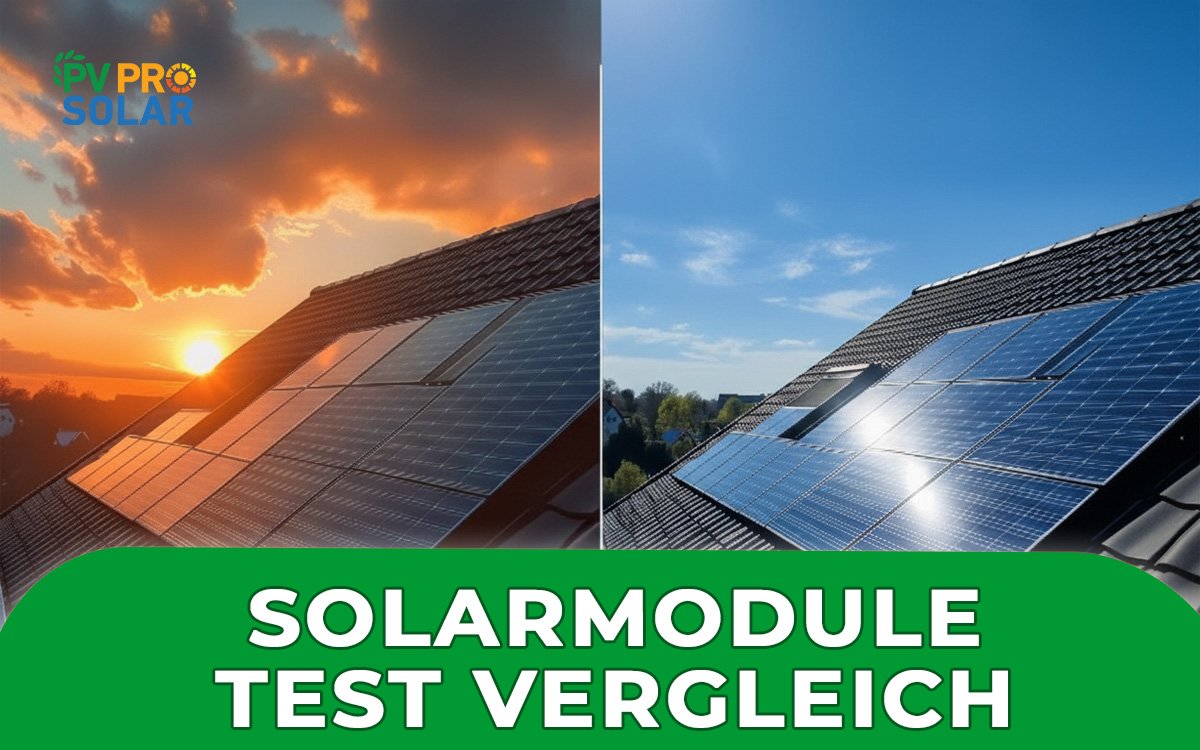
How Meaningful Is a Modern Solar Panel Test Comparison Really?

A well-founded solar panel test comparison today determines far more than the wattage listed on a data sheet. It influences profitability, self-consumption rates, and long-term returns. Anyone planning a photovoltaic system in 2026 quickly realizes that a superficial solar panel test comparison is not enough to identify the best solar panels for their own roof in Hanover, Bremen, or Wolfsburg.
A professional solar panel test comparison evaluates not only laboratory data, but also real-world yields under northern German weather conditions. In Lower Saxony, where diffuse light is common, module performance under partial shading is particularly critical.
So what distinguishes an informative solar panel test comparison from a purely marketing-driven ranking?
Which Criteria Truly Matter in a Well-Founded Solar Panel Test Comparison?
A credible solar panel test comparison assesses multiple performance parameters simultaneously, including:
- Efficiency
- Temperature coefficient
- Annual degradation rate
- PID resistance
- Warranty terms
Module performance plays a central role. It is not just about peak output under Standard Test Conditions (STC), but about actual yields in heat, cold, and cloudy weather.
A comprehensive solar panel test also measures mechanical resilience against snow loads and wind pressure, especially relevant in northern Germany. For this reason, any meaningful comparison must account for regional requirements.
How Does a Large-Scale Solar Panel Test Differ from a Traditional PV Module Comparison?
A large-scale solar panel test is typically conducted by independent certification institutes and analyzes:
- Long-term degradation
- Low-light performance
- Temperature stability
- Safety standards
A conventional PV module comparison, on the other hand, often ranks models by price, efficiency, or brand recognition. Both approaches are valuable—but only when combined in a thorough solar panel test comparison does a complete picture emerge.
The comparison becomes particularly interesting when glass-glass modules compete with glass-backsheet (glass-foil) modules. Here, clear differences in durability and warranty coverage become apparent.
What Role Do Major Manufacturers Play in a Solar Panel Test Comparison?
The largest manufacturers invest heavily in research and quality assurance. Companies such as:
- LONGi Green Energy
- JinkoSolar
- Trina Solar
- Canadian Solar
regularly appear in large-scale solar panel tests.
However, size alone does not guarantee a top ranking. Some mid-sized premium manufacturers achieve better results in temperature coefficients or long-term module performance over 25 years.
This is why comparing different solar modules is more important than relying solely on brand reputation.
Which Main Technologies Perform Best in 2026 Solar Panel Tests?
In current solar panel test comparisons, three leading technologies dominate:
- TOPCon (N-type)
- HJT (Heterojunction)
- Advanced PERC
TOPCon modules demonstrate particularly stable yields at high temperatures in large-scale tests. HJT stands out for its exceptionally low degradation rates.
A direct PV module comparison shows that the main technological differences lie less in initial efficiency and more in long-term performance.
Why Is a Simple Solar Panel Test Not Enough?
A basic solar panel test measures performance under controlled conditions. However, real roof conditions in Hanover or Bremen often differ significantly.
A holistic solar panel test comparison considers:
- Roof pitch
- Orientation
- Shading from dormers or trees
- Grid connection requirements
It becomes clear that products ranked highest in general lists are not automatically the best choice for every individual project.
How Does Module Performance Influence Return on Investment?
Module performance directly determines:
- Self-consumption rates
- Payback period
- Storage efficiency
- Grid feed-in revenue
A modern solar panel test comparison, therefore, analyzes not only watts per module, but also performance loss at 45°C module temperature.
Two visually identical modules may deliver different real-world yields, differences that become visible only in a detailed PV module comparison.
What Differences Appear Under Partial Shading?
Partial shading is one of the biggest yield reducers. A high-quality solar panel test comparison evaluates how individual cell strings respond to shading.
Modules with half-cell designs perform better in this regard. Large-scale solar panel tests show yield differences of up to 8% despite identical nominal power ratings.
Comparing different solar modules also reveals that optimized bypass diodes can significantly improve module performance.
How Can You Identify the Best Solar Panels in a Regional Context?
In Lower Saxony, key factors include:
- Strong low-light performance
- Resistance to moisture
- Stability under temperature fluctuations
A specialized solar panel test comparison for northern Germany places greater emphasis on these aspects than tests conducted primarily under southern European conditions.
As a result, the best solar panels for Wolfsburg may differ from recommendations in southern Germany.
Which Economic Factors Are Included in a Professional Comparison?
Beyond technical specifications, financial aspects also matter:
- Price per watt
- Warranty duration
- Insurance costs
- Bankability
A comprehensive solar panel test comparison demonstrates that cheaper modules may become more expensive over time if their performance declines more rapidly.
The best products are not necessarily the most expensive, but those offering the optimal balance between investment cost and long-term yield.
How Important Is a PV Module Comparison When Combined with Storage?
With the growing adoption of battery storage, PV module comparison becomes more complex. Modules with stable voltage curves integrate more effectively with hybrid inverters.
A detailed solar panel test comparison, therefore, also evaluates:
- MPP voltage range
- System compatibility
- Scalability
Only this approach ensures a financially stable overall solution.
What Role Does Service Life Play in Solar Panel Test Comparisons?
Service life influences actual returns more strongly than initial efficiency.
Large-scale solar panel tests often simulate 25- or 30-year performance cycles. High-quality modules show significantly lower power loss over time.
A precise solar panel test comparison differentiates between linear and stepped degradation models.
Why Is an Individualized Solar Panel Test Comparison Essential for Your Roof?
Online rankings provide general guidance. However, only a project-specific assessment takes into account:
- Consumption profile
- Plans (Wallbox, heat pump)
- Roof area
- Structural conditions
A personalized solar panel test comparison combines technical PV module evaluation with economic profitability analysis.
This is where real decision-making clarity emerges, far beyond marketing promises.
Which Trends Are Shaping Solar Panel Testing in 2026?
Current trends in solar panel test comparisons include:
- Glass-glass modules are becoming standard
- N-type technology is gradually replacing PERC
- Bifacial designs increase yields
- Extended product warranties
In addition, sustainability factors are gaining importance in large-scale solar panel tests, including carbon footprint, recyclability, and supply chain transparency.
How Can You Secure the Best Products Long Term?
The best solar panels are not created in laboratories alone, but through:
- Rigorous quality control
- Reputable installation partners
- Precise system planning
A professional solar panel test comparison, therefore, does not end with module rankings, but with optimal system integration.
What Are the Next Steps?
If you want to determine which solar panels are best suited for your single-family home or commercial property in Hanover, Bremen, or Lower Saxony, a generic solar panel test is not enough.
Visit PVPro Solar GmbH and have your roof analyzed individually.
Start your free project evaluation today and receive a tailored solar panel test comparison for your property.
At least once per year. Technologies and leading manufacturers continuously develop their product lines, which can significantly affect rankings and performance assessments.
No. A detailed comparison of different solar modules often shows that mid-range models offer better overall profitability in a PV module comparison than premium modules with only marginally higher efficiency. How often should a solar panel test comparison be updated?
Are the most expensive modules automatically the best products?