
Buying Complete Solar Systems – What Do You Really Need to Know?

Purchasing a complete solar system is a crucial step for many homeowners and businesses on their path toward the energy transition and long-term energy independence. Yet despite growing interest, many people feel overwhelmed when entering the world of photovoltaics: What components do I need? How do I size the system correctly? Do I need a battery storage unit? Which mistakes should I avoid? And what does the process from planning to commissioning look like?
PVPro Solar GmbH
In 3 Schritten zur PV-Anfrage
Bedarf klären · Daten senden · Angebot erhalten
Jetzt Anfrage senden1
Bedarf klären
Schritt 1
2
Daten senden
Schritt 2
3
Angebot erhalten
Schritt 3
Why should you buy complete solar systems, and what defines a fully integrated PV solution?
Buying a complete solar system offers enormous advantages: All components are perfectly matched, efficiency increases, error rates decrease, and the installation process becomes much simpler. A full solution not only ensures reliable power generation but also drastically reduces long-term energy costs and increases property value.What is included in a complete solar system?
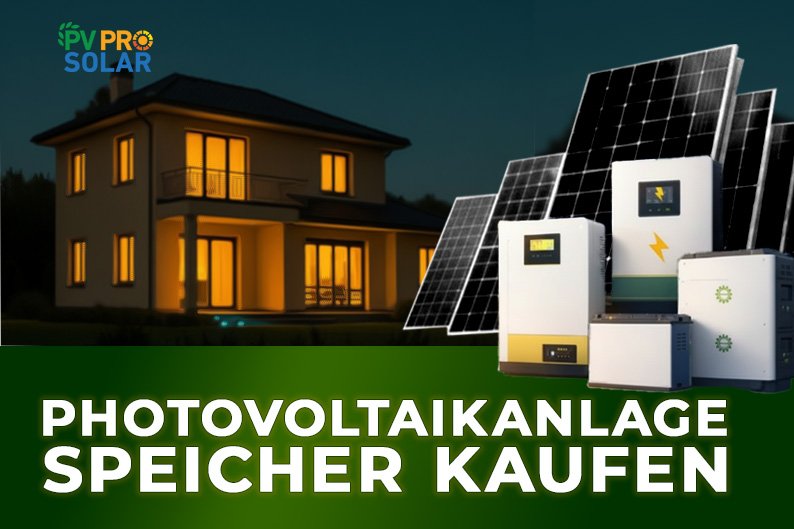
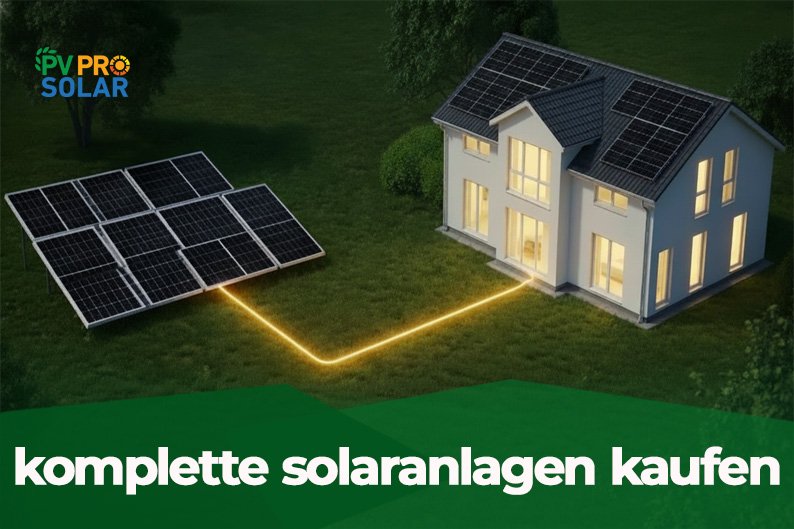
A complete photovoltaic system consists of several precisely coordinated components that together form a functional energy system. These include solar modules, the inverter, mounting structures, wiring, energy management, and optionally a battery storage unit. All these elements ensure that solar energy is reliably converted into usable electricity. The quality of each component significantly affects overall performance. Therefore, it is essential to rely on certified and proven solutions that guarantee high efficiency and long service life.Which types of solar modules are suitable for complete PV systems?
Complete solar systems typically use monocrystalline modules, as they achieve higher efficiency than polycrystalline options. They perform well even in low-light conditions and require less roof space. Thin-film modules are used less frequently but can be suitable for specific roofs or large industrial areas. Each module type has specific advantages that must be evaluated based on roof type, orientation, and energy goals. High-quality modules are crucial for the efficiency, lifespan, and return of the PV system.When is a solar battery storage unit useful, and how does it work?
A battery storage system significantly increases the self-consumption rate by storing excess energy and making it available when needed. Households with high evening electricity usage benefit the most. The storage unit helps reduce grid feed-in and increases on-site consumption. Lithium-ion batteries dominate due to their long lifespan, high efficiency, and compact design. Anyone aiming for real energy independence will find that a storage unit is almost indispensable.What role does the inverter play in a complete solar system?
The inverter is the heart of the system, converting generated direct current into standard household alternating current. Modern devices also handle energy management, module monitoring, and optimization of self-consumption. Choosing the right inverter has a major impact on overall system performance. A high-quality model minimizes losses, reacts flexibly to shading, and ensures maximum yields for many years.Which roof areas are best suited for a solar system?
Ideal roofs have a south-facing orientation and a tilt between 25° and 40°. However, modern systems can efficiently utilize east- and west-facing roofs as well. Even flat roofs can be optimized using special mounting structures. The crucial factor is keeping shading to a minimum. Even small amounts of shade from trees, chimneys, or nearby buildings can significantly reduce the performance of individual modules.How do you calculate the ideal size of a complete solar system?
System size depends on annual electricity consumption, roof space, and the desired level of self-sufficiency. Many households benefit from a PV output between 4 and 10 kWp, depending on lifestyle and consumption patterns. Those who use an electric car or heat pump should strongly consider a larger PV system. A well-planned system meets the energy needs without unnecessary oversizing.What advantages does a complete solar system offer compared to individual solutions?
The main advantage lies in system optimization: All components are compatible, perfectly matched, and therefore highly efficient. Installation errors are reduced, planning becomes easier, and maintenance is simplified. Complete systems also allow better long-term scalability. Extensions, battery integration, or system upgrades are much easier to implement later.How is a complete solar system installed?
The process begins with technical planning and a thorough roof analysis. This is followed by module installation, inverter setup, and connection to the home’s electrical system. Final steps include system inspection, commissioning, and documentation. For an average single-family home, installation usually takes only a few days. Professional installation is essential to ensure output, safety, and long system life.What mistakes should be avoided when buying a complete solar system?
Many buyers choose a system that is too small or too large because they misjudge consumption or roof capacity. Other mistakes include selecting poor-quality components, inadequate safety standards, or incorrect battery sizing. Long-term planning is equally important: A PV system should not only cover current consumption but also consider future needs—such as electric vehicles or electric heating systems.What documentation do you receive with a complete solar system?
Every system includes technical data sheets, installation manuals, warranty documents, and wiring diagrams. Modern systems also provide digital monitoring access for performance analysis. This documentation is essential for warranty claims, easier maintenance, and future upgrades such as adding a storage unit.How do you monitor and optimize the performance of a complete PV system?
Many inverters include smart monitoring apps. They display yields, energy flows, storage levels, and consumption patterns in real time, helping users detect issues quickly. Intelligent energy management allows large electrical loads—such as washing machines, heat pumps, or electric car chargers—to operate automatically when solar production is high.What is the lifespan of a complete solar system?
High-quality modules last 25–30 years or more. Inverters typically need replacement after 10–15 years, while storage units last 10–20 years depending on the technology. Regular maintenance increases lifespan and ensures stable performance over decades.Is a complete solar system worthwhile even without battery storage?
Yes—especially if electricity consumption occurs mainly during the day. Without a battery, the investment is lower while system yield remains significant. A storage unit can always be added later, making the system flexible and future-proof.How can a solar system be expanded later?
Many systems are modular and can easily be expanded with additional modules, battery storage, or a wallbox. A well-planned design and appropriately sized inverter are key. Battery storage systems can also be added later as long as the interfaces and capacity limits allow it.What should you consider when choosing a battery storage system?
The storage unit should be neither too small nor too large. Too-small batteries add little value, while oversized ones operate inefficiently. Other important factors include charge cycles, efficiency, safety technologies, and compatibility with the inverter.Conclusion – When is it worthwhile to buy a complete solar system?
A complete solar system is worthwhile whenever you want to reduce energy costs long-term and become less dependent on the electricity market. Households with high consumption, electric mobility, or heat pumps benefit the most. A well-planned PV system is a secure, sustainable, and future-ready investment that delivers stable yields for decades.How much roof space do I need?
Depending on the module size, around 5–7 m² per kWp.
Can I install a PV system on an old roof?
Yes, as long as the structural integrity is sufficient and the roofing is in good condition.
How long does the payback period take?
Due to rising electricity costs, systems pay off faster than before—exact figures, however, depend on individual calculations.
Do I need a building permit?
Rooftop systems are usually exempt. Protected buildings may require special approvals.
PVPro Solar GmbH
In 3 Schritten zur PV-Anfrage
Bedarf klären · Daten senden · Angebot erhalten
Jetzt Anfrage senden1
Bedarf klären
Schritt 1
2
Daten senden
Schritt 2
3
Angebot erhalten
Schritt 3