
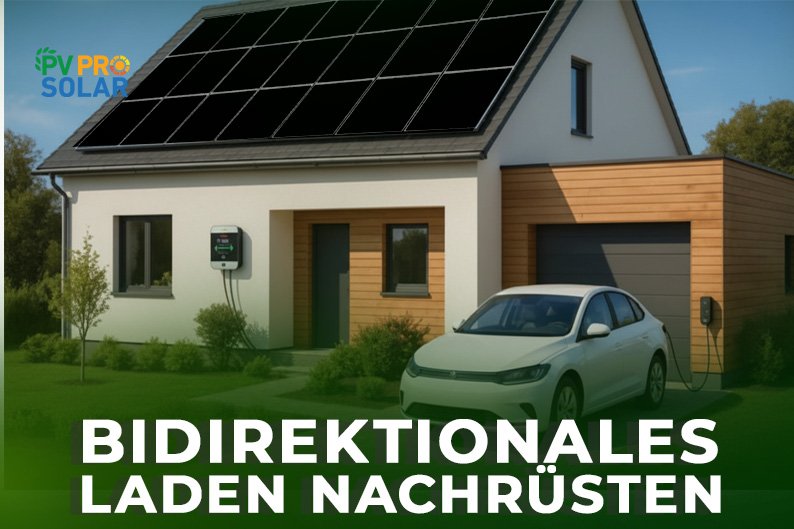
Retrofitting Bidirectional Charging: What’s Actually Possible in Germany in 2026
Diese Seite ist auch auf Deutsch verfügbar
Artikel auf Deutsch lesen
The idea is compelling: using your electric vehicle as a power storage system for your entire home. With a battery capacity of 60–80 kWh, an EV typically stores three to five times more energy than a standard residential battery system, and it’s already sitting in your garage.
It’s no surprise that many EV owners are asking whether bidirectional charging can be retrofitted.
On this page, we provide an honest assessment from the perspective of a professional electrical contractor, without marketing hype. The short answer is: Vehicle-to-Home (V2H) has effectively arrived in Germany in 2026, but “retrofitting” rarely means simply unlocking a feature through a software update. In most cases, it requires the right combination of vehicle, bidirectional charging station, and regulatory approval. Here’s what that means in practice.
PVPro Solar GmbH
Bedarf klären · Daten senden · Angebot erhalten
Jetzt Anfrage sendenBedarf klären
Schritt 1
Daten senden
Schritt 2
Angebot erhalten
Schritt 3
V2L, V2H, and V2G: Understanding the Differences
Before discussing retrofitting, it’s important to distinguish between the three concepts, as they are often confused.
Vehicle-to-Load (V2L)
The vehicle provides electricity through an onboard power outlet for external devices such as tools, camping equipment, or garden machinery. This works without a special charging station or grid registration, but it does not replace a home battery system.
Vehicle-to-Home (V2H)
The vehicle supplies stored energy back to your home’s electrical system. For homeowners with solar PV, this is the most relevant and valuable application, and where the practical benefits lie in 2026.
Vehicle-to-Grid (V2G)
Electricity is fed back into the public grid, ideally in exchange for compensation. This is both technically and regulatorily more complex and is still in the early stages of adoption for private households.
For most homeowners, V2H is the primary goal: using self-generated solar power stored in the vehicle during the evening instead of exporting it to the grid for only a few cents per kilowatt-hour.
What Has Changed in 2026? The Real Situation
The major breakthrough in 2026 is not so much the vehicle technology itself but the regulatory framework. Three developments are particularly important:
- Amendments to Germany’s Energy Industry Act (EnWG) have eliminated the double network charge burden for electricity fed back into the grid, removing a key economic barrier that previously made V2H and V2G unattractive.
- The 2026 version of VDE-AR-N 4105 has provided a technical standard for the grid-parallel operation of bidirectional charging systems.
- Since early 2026, V2H installations up to 11 kW benefit from a simplified registration process with the local grid operator, similar to registering a standard wallbox. V2G systems, however, still require full registration as power generation assets.
One important point that is often overlooked: AC-based V2H via wallboxes using the new ISO 15118-20 standard is currently supported by virtually no mass-market production vehicle available for sale. The solutions that work reliably today are DC-based systems paired with compatible vehicles and charging equipment.
In other words, don’t be misled by claims that a charger is “BiDi-ready.” Hardware readiness does not necessarily mean the functionality is available or usable today.
Can Bidirectional Charging Actually Be Retrofitted?
In many cases, yes, but usually not through a simple software activation.
Whether retrofitting is feasible depends on three key factors:
The Vehicle
The manufacturer must officially support vehicle discharge functionality. In many models, the determining factor is the firmware rather than the charging connector itself. The list of V2H-capable vehicles changes frequently, so we assess compatibility for your specific model.
The Charging Station
A conventional EV charger cannot feed electricity back into your home. You need a genuine bidirectional charging station, typically a DC wallbox, that can manage power flow in both directions and is approved for integration into the home electrical system.
Home Electrical System, Metering Concept, and Registration
Integration requires modifications to the home electrical infrastructure by a licensed electrical contractor, as well as registration with the grid operator. This is where professional planning and installation become essential.
If your vehicle meets the necessary requirements, retrofitting can be implemented successfully with the right equipment and proper coordination of all components.
What You Need for a Bidirectional Charging Retrofit
Bidirectional Charging Station
Currently, most practical solutions use DC wallboxes. Make sure the unit offers genuine V2H/V2G functionality, not just “BiDi-ready” hardware.
Compatible Vehicle
Your EV must support bidirectional discharge and have the feature enabled by the manufacturer.
Energy Management System (EMS)
An EMS ensures that the vehicle only discharges when solar generation is insufficient while maintaining adequate charge for daily driving needs.
Learn more on our Energy Management System page.
Suitable Grid Connection
Depending on the system, higher connection capacities may be required.
Registration with the Grid Operator
For V2H systems up to 11 kW, a simplified registration process applies. V2G systems must be registered as full power generation installations. We handle the entire process on your behalf.
V2H with Solar Power: Why This Combination Is So Powerful
The greatest benefits of bidirectional charging are achieved when combined with a photovoltaic system.
During the day, excess solar power charges the vehicle. In the evening, the vehicle returns that stored solar energy to the home. Depending on consumption patterns and battery capacity, this can significantly increase self-consumption rates using a battery you already own.
This is particularly attractive if you have a PV system without a dedicated home battery. In this scenario, the vehicle battery effectively serves as a large-scale energy storage system.
For evening base loads and backup power applications, V2H can substantially reduce the reliance on a conventional battery storage system, provided that both the vehicle and charging station support discharge functionality.
For a comparison with traditional battery storage, see our guide on Solar Systems with EV Charging Stations.
Is It Economically Worthwhile?
The honest answer depends on how you intend to use it.
PV Self-Consumption (V2H)
This offers the clearest financial benefit. Using self-generated electricity from your vehicle instead of purchasing power from the grid directly reduces energy costs.
Dynamic Electricity Tariffs
Charging when electricity prices are low and using that energy when prices are high can generate savings, although the payback period is generally longer.
V2G Revenue Opportunities
The first residential V2G tariff models are emerging in 2026. However, widespread availability and attractive compensation schemes are still likely several years away.
Actual payback periods depend heavily on electricity prices, driving patterns, and hardware costs. During a consultation, we provide a realistic assessment tailored to your situation, without recommending solutions that do not make financial sense.
Incentives and Funding: What’s Available in 2026?
Funding programs remain dynamic and are often limited to specific project types.
Potential sources of support include:
- KfW funding programs
- BAFA renewable energy incentives
- Regional state and municipal funding schemes
There is currently no universally available nationwide subsidy program for homeowners, and eligibility requirements change regularly.
Safety and Registration: Not a DIY Project
Installing a bidirectional charging station involves modifications to the home electrical system and must be carried out by a licensed electrical contractor.
Registration with the grid operator is mandatory in all cases. V2G systems additionally require authorization for grid feed-in.
As a regional photovoltaic specialist, we provide:
- System planning
- Standards-compliant installation in accordance with VDE regulations and local utility requirements (TAB)
- Registration with the grid operator
- Registration in the German Market Master Data Register (Marktstammdatenregister)
—all from a single source.
Conclusion
In 2026, V2H is no longer a future concept. For the right combination of vehicle and charging hardware, it is now a practical and compelling solution, especially when paired with a photovoltaic system.
V2G for private households, on the other hand, is still in its early stages.
If you own a bidirectionally capable EV and want to increase your energy independence, it is worth evaluating a retrofit rather than relying on marketing promises.
Want to know whether your home and vehicle are suitable?
We offer honest, no-obligation consultations free of charge.
No. The discharge function must be enabled and approved by the manufacturer. In many cases, this depends on the vehicle firmware rather than the charging connector alone. The list of compatible models continues to grow and changes regularly. Always verify V2H compatibility before investing in hardware—or let us assess your vehicle for you.
Usually not. “BiDi-ready” only means the hardware has been designed with future bidirectional functionality in mind. It does not guarantee that bidirectional charging is currently available. The charger must be able to feed power back into your home and work with your specific vehicle.
Current studies indicate that moderate bidirectional charging places little additional stress on the battery compared to normal charging. The key is intelligent energy management that optimizes charge cycles and avoids prolonged operation under extreme conditions.
Every bidirectional charging installation must be registered with the local grid operator. V2H systems up to 11 kW benefit from a simplified process introduced in 2026. V2G installations require full registration as power generation assets. We handle all registration requirements as part of the installation process.
The greatest financial benefits come from pairing V2H with a photovoltaic system. Without solar generation, the main advantage is energy arbitrage through dynamic electricity tariffs, which can still be beneficial but generally offers a slower return on investment.
A qualified electrical contractor can typically complete the installation of the charging station and its integration into the energy management system within one to two days, depending on the home electrical infrastructure and metering setup.Can every electric vehicle support bidirectional charging?
Is my existing wallbox sufficient if it is labeled “BiDi-ready”?
Does bidirectional charging damage the battery?
Do I need approval?
Is V2H worthwhile without solar panels?
How long does installation take?
PVPro Solar GmbH
In 3 Schritten zur PV-Anfrage
Bedarf klären · Daten senden · Angebot erhalten
Jetzt Anfrage sendenBedarf klären
Schritt 1
Daten senden
Schritt 2
Angebot erhalten
Schritt 3