
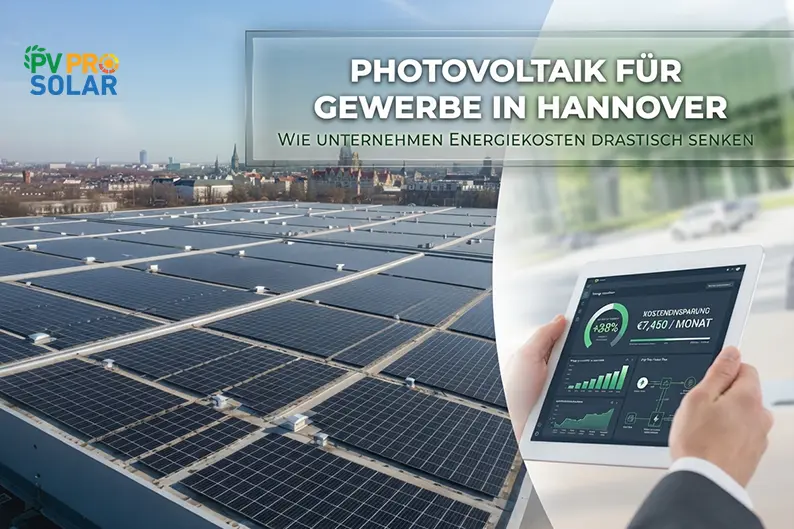
Commercial Photovoltaics in Hanover: Costs, Sizing and Funding
Diese Seite ist auch auf Deutsch verfügbar
Artikel auf Deutsch lesen
At PVPro Solar, commercial photovoltaics in Hanover means systems of around 10 to 150 kWp, planned and installed for workshops, offices and medical practices, small to medium-sized halls and agricultural buildings. Our largest documented roof to date has 67 modules, which is around 30 kWp (see our references). Request your free, no-obligation quote for your business now, including your company name, annual electricity consumption in kWh and a photo of your roof.
PVPro Solar GmbH
Bedarf klären · Daten senden · Angebot erhalten
Jetzt Anfrage sendenBedarf klären
Schritt 1
Daten senden
Schritt 2
Angebot erhalten
Schritt 3
PVPro Solar: Your Partner for Commercial Photovoltaics in Hanover
Systems from 10 to 150 kWp for Your Business
We plan and install commercial systems for workshops, offices and practices, small to medium-sized halls and agricultural buildings. If you wish, with a BYD battery, wallboxes and energy management, so the solar power reaches where your business needs it.
Planned by Your Load Profile, Not a Rule of Thumb
We size the system by your load profile and roof area. An office that closes at 4 pm needs a different system from a cold store that runs around the clock. That’s why we analyse your electricity consumption and calculate with your real electricity tariff, not a flat rate.
Structure and Grid Connection Checked Before the Fixed Price
We clarify whether your roof can carry the system without reinforcement, and what the grid operator, usually enercity Netz in Hanover and Avacon in parts of the region, requires for your connection, before the fixed price, not afterwards. So there are no extras once installation is already planned.
Net Prices, a Fixed Price and Fair Payment
We show you net prices from the start, as is usual for businesses entitled to deduct input tax. The price in the quote is a fixed price, and you pay using the 30/70 model: 30% on order, 70% after installation.
Our Own Specialists and Brand-Name Components
Installation and electrical work are carried out by our own certified specialists, without changing subcontractors. We install modules from AIKO, JA Solar or Longi, Fronius inverters, BYD batteries and K2 Systems mounting systems, including for flat roofs.
Funding and Financing from One Source
Before the quote, we tell you which funding actually applies to your system size, from the KfW 270 loan to the City of Hanover’s “Große Dächer” grant, and support you with the technical documents.
Member of the German Solar Association
PVPro Solar is a member of the Bundesverband Solarwirtschaft e. V. (BSW-Solar). This means we hear early about changes such as the Solar Peak Act or the planned EEG amendment, which matter especially for commercial systems and direct marketing.
How Large Should Your Commercial Solar System Be?
The usual rule of thumb for private roofs, one kWp per 1,000 kWh of annual consumption, often doesn’t fit a business. An office that closes at 4 pm would end up oversized, and a cold store that runs around the clock would end up too small. As a guide:
| Business | Load | Typical system size |
|---|---|---|
| Office or practice, 20,000–40,000 kWh/year | mainly during the day | approx. 15–25 kWp |
| Workshop or production | peak loads at midday | approx. 30–75 kWp |
| Hall with a flat roof | limited by structure and grid connection | approx. 75–150 kWp |
We only fix the exact size for your business after checking your load profile and your roof, not beforehand on the phone.
What a Commercial Solar System Costs in Hanover: Two Worked Examples
Instead of a blanket statement, here are two fully calculated cases. Case A is an office or workshop that works during the day. Case B is a business with a continuous load:
| Item | Case A: office/workshop, 30 kWp | Case B: hall with continuous load, 150 kWp |
|---|---|---|
| Annual yield | approx. 27,000 kWh | approx. 135,000 kWh |
| Self-consumption share | approx. 60–70% (used during the day) | approx. 75–80% (e.g. cooling or multi-shift operation also runs at midday) |
| Savings from self-consumption | approx. €3,500/year (assumption: 17,500 kWh × 20 cents) | approx. €21,600/year (assumption: 108,000 kWh × 20 cents) |
| Feed-in revenue for the rest | approx. €660/year (9,500 kWh × around 7 cents) | approx. €1,620/year (27,000 kWh × an assumed 6 cents, direct marketing) |
| Installed price (modelled, net) | approx. €40,000–45,000 | approx. €165,000–195,000 |
| Payback period | approx. 10 years | approx. 7–8 years |
The 20 cents per kWh is an illustrative assumption, not a market average for commercial electricity. In your actual quote, we use the price from your real electricity contract. In both cases, the feed-in tariff is a side issue. The reason for the system is self-consumption.
For the yield, we use our standard value of about 893 kWh per kWp for the Hanover region. The feed-in tariff falls as system size increases. For the portion between 10 and 40 kWp, it is below the rate for small systems, hence the blended value of around 7 cents in Case A. Systems over 100 kWp must sell their surplus through direct marketing, via a direct marketer on the power exchange, so revenue depends on the market value, hence the 6-cent assumption in Case B.
VAT on a Commercial System
The 0% VAT rate under Section 12(3) of the German VAT Act (UStG) applies to the supply and installation of PV systems and batteries on or at residential buildings and buildings used for public-interest activities. For systems up to 30 kWp (gross output according to the Market Master Data Register), these conditions count as met, including on a workshop or office building. If your system is larger and sits on a purely commercial hall, you pay the standard 19% VAT. If you are entitled to deduct input tax, you reclaim this 19%, so economically you pay the net price. For most businesses, the VAT rate therefore makes no difference in the end.
Depreciation and the Investment Deduction
A commercial PV system is a business asset that you depreciate over its useful life. For movable assets acquired between 1 July 2025 and 31 December 2027, declining-balance depreciation of up to 30% a year is possible again. Small and medium-sized businesses can also claim an investment deduction under Section 7g EStG of up to 50% of the expected costs before the purchase, if the conditions are met. Which option brings your business the most is best clarified with your tax adviser; we provide the cost breakdown for this.
Funding for Commercial Photovoltaics in Hanover
For a commercial system, the EEG feed-in tariff is not the main lever; daytime self-consumption is. These programmes are relevant for financing and grants:
- KfW 270 “Renewable Energy – Standard”: a low-interest KfW loan for companies of any legal form. It finances PV systems, including battery storage, up to 100% of eligible costs. You apply for the loan through your bank, and we’re happy to tell you whether and how we can help with the paperwork.
- The City of Hanover’s “Große Dächer” (Large Roofs) programme: a grant for existing non-residential buildings within the city of Hanover from 75 kWp. It pays €100/kWp for standard modules (max. €40,000) or €400/kWp for lightweight modules on structurally weak roofs (max. €80,000), capped at 70% of eligible costs, for the funding years 2026 and 2027. Below 75 kWp, this programme does not apply, and KfW 270 remains the relevant option.
- The Hanover Region’s Dach-Solar programme: also for non-residential buildings, but only if the roof is insulated at the same time. It funds €150 per m² of module area above the legal minimum, insulation at €50 per m² and electrics on non-residential buildings with up to €5,000, up to €200,000 in total. If the calculated grant is below €4,000, the application is excluded.
According to the City of Hanover, the “Große Dächer” programme excludes new buildings, systems covered by Lower Saxony’s solar obligation and replacements of existing systems, among others. Extensions of 35 kWp or more are eligible. The proKlima DachVollToll funding that we mention in our residential articles is for residential buildings and does not apply to a commercial hall. Don’t confuse the programmes, as that can cost you the funding.
Solar Obligation for Commercial Buildings in Lower Saxony
Anyone building a new commercial building with at least 50 m² of roof area in Lower Saxony has had to cover at least 50% of the roof area suitable for photovoltaics with a PV system since 2023. If you’re planning a new building or an extension, include the solar system in the planning from the start. Systems covered by this obligation are not eligible under the “Große Dächer” programme.
Cutting Business Energy Costs: When Solar Is the Biggest Lever
Businesses cut energy costs by avoiding consumption, shifting loads in time and generating their own electricity when they need it. For an office or workshop in Hanover that works during the day, its own roof is usually the single biggest lever, because purchased electricity costs more than the feed-in tariff you give up. But if your premises are largely empty at midday, for example a shop that only opens in the late afternoon, a solar system is not the first investment that pays off. In that case, look at load management and reducing consumption first, and only then at the roof.
From First Contact to Commissioning
For a commercial system, the installation itself is often not the long part; two to five days is realistic. The longer step is usually the grid connection review by the grid operator, especially above certain connection capacities. We tell you how long this review will take in your specific case after our first assessment of your connection, not as a blanket figure beforehand. How installation works in detail is explained under solar panel installation in Hanover.
Conclusion
Commercial photovoltaics in Hanover pays off above all where the business uses the electricity itself during the day, not automatically on every roof. We size the system by your load profile, calculate with an honest self-consumption case instead of a flat rate, and tell you which funding actually applies to your system size. Request your free, no-obligation quote now, or call us on +49 511 3360603.
Note: This article provides a general overview (as of October 2026) and does not replace tax or legal advice.
Frequently Asked Questions About Commercial Photovoltaics in Hanover
Up to what size does PVPro Solar install commercial systems?
We plan and install commercial systems of around 10 to 150 kWp for workshops, offices, small to medium-sized halls and agricultural buildings. Our largest documented roof to date has 67 modules, which is around 30 kWp.
What does a 30 kWp commercial solar system cost, and when does it pay for itself?
Modelled at around €40,000 to €45,000 net installed. With an annual yield of around 27,000 kWh and 60 to 70% self-consumption, it pays for itself in about 10 years at an assumed commercial electricity price of 20 cents per kWh. We calculate the actual price and your real electricity tariff in the quote for your business.
Does the 0% VAT rate also apply to a commercial solar system?
Partly. The zero rate under Section 12(3) UStG applies to systems on or at residential buildings and public-interest buildings. Up to 30 kWp gross output, the conditions count as met, including on commercial buildings. Larger systems on purely commercial halls are subject to the standard 19% VAT, which you can reclaim as a business entitled to deduct input tax. That's why we show net prices.
What funding is available for commercial photovoltaics in Hanover?
The low-interest KfW 270 loan for companies of any legal form, the City of Hanover's Große Dächer grant for existing non-residential buildings from 75 kWp (100 to 400 euros per kWp depending on the module type, for 2026 and 2027), and the Hanover Region's Dach-Solar, but only with simultaneous roof insulation and from a 4,000-euro grant. proKlima DachVollToll applies only to residential buildings.
Can I depreciate a commercial PV system?
Yes. For movable assets acquired between 1 July 2025 and 31 December 2027, declining-balance depreciation of up to 30% a year is possible. Small and medium-sized businesses can also use an investment deduction under Section 7g EStG. Clarify the best option with your tax adviser.
Is there a solar obligation for commercial buildings in Lower Saxony?
Yes. For new commercial buildings with at least 50 m² of roof area, at least 50% of the suitable roof area has had to be covered with photovoltaics since 2023. Such mandatory systems are not eligible under the Große Dächer programme.
How long does it take from first contact to commissioning a commercial system?
The installation itself usually takes two to five days. The grid connection review by the grid operator is often the longer step for commercial connections. We tell you how long it will take after our first assessment of your specific connection.
Is a solar system worth it if my business uses little electricity at midday?
Not as a first measure. A solar system pays off most when you use the electricity it generates during the day. If your premises are largely empty at midday, we first look at load management and reducing consumption with you, before recommending a system that would otherwise have to pay for itself mainly through the feed-in tariff.
PVPro Solar GmbH
In 3 Schritten zur PV-Anfrage
Bedarf klären · Daten senden · Angebot erhalten
Jetzt Anfrage sendenBedarf klären
Schritt 1
Daten senden
Schritt 2
Angebot erhalten
Schritt 3