
EEG 2026 for Photovoltaics: What PV System Owners Need to Know
Diese Seite ist auch auf Deutsch verfügbar
Artikel auf Deutsch lesen
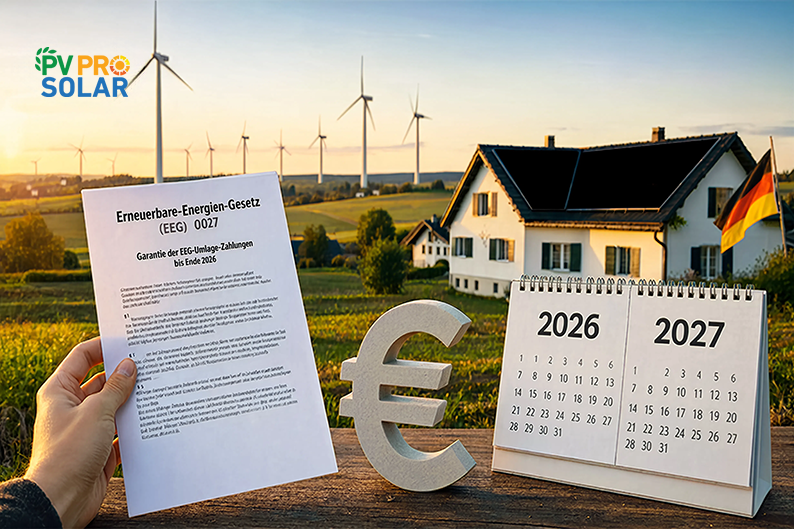
Germany’s Renewable Energy Sources Act (EEG) provides the legal framework for every photovoltaic system in the country. It determines how much compensation you receive for electricity fed into the grid, what obligations you have as a system owner, and what requirements must be met during registration.
Several important changes have taken effect in 2026. If you are planning a solar installation, it is essential to understand the current rules.
As a regional photovoltaic specialist based in Hanover, we explain what matters in practice: current feed-in tariffs, registration requirements, your rights when dealing with the grid operator, and the most important regulatory changes. No legal jargon; just the information that matters for your solar investment.
PVPro Solar GmbH
Bedarf klären · Daten senden · Angebot erhalten
Jetzt Anfrage sendenBedarf klären
Schritt 1
Daten senden
Schritt 2
Angebot erhalten
Schritt 3
What the EEG Regulates for PV System Owners?
The EEG guarantees a statutory entitlement to compensation for solar electricity fed into the public grid for 20 years plus the year of commissioning.
The amount of compensation depends on three factors:
- The size of the photovoltaic system
- The commissioning date
- The chosen feed-in model
Important: The decisive date is the commissioning date, not the date the system is ordered or approved. The tariff in effect on the commissioning date remains fixed for the entire 20-year compensation period.
Current Feed-in Tariffs for 2026
The German Federal Network Agency (Bundesnetzagentur) adjusts feed-in tariff rates twice per year, on February 1 and August 1.
For rooftop photovoltaic systems commissioned between February 1 and July 31, 2026, the following rates apply:
| System Size | Partial Feed-In (Surplus Export) | Full Feed-In |
| Up to 10 kWp | 7.78 ct/kWh | 12.35 ct/kWh |
| 10–40 kWp | 6.73 ct/kWh | 10.35 ct/kWh |
| 40–100 kWp | 5.50 ct/kWh | 10.35 ct/kWh |
For systems larger than 10 kWp, compensation is calculated on a tiered basis.
For example, a 15 kWp system receives:
- The higher tariff for the first 10 kWp
- The lower tariff for the remaining 5 kWp
A further reduction of approximately 1% is scheduled for August 1, 2026.
Because tariff levels change regularly, we verify the current rates applicable to your expected commissioning window during the planning process.
Partial Feed-In or Full Feed-In: Which Option Is Better?
The EEG provides two basic operating models.
Partial Feed-In (Surplus Export)
You use your solar electricity on-site first and export only excess energy to the grid.
For most homeowners, this is the more economical option because every kilowatt-hour consumed directly offsets grid electricity costs of approximately 35–40 ct/kWh, whereas exported electricity currently earns only 7.78 ct/kWh.
Full Feed-In
All generated electricity is exported to the grid, and household electricity is purchased separately from your energy supplier.
The higher full feed-in tariff can be attractive in situations where self-consumption is low—for example, large roof areas with minimal daytime electricity demand.
The Real Economic Driver: Self-Consumption
The most important factor for profitability is no longer the feed-in tariff itself but the percentage of electricity you consume yourself.
A battery storage system can significantly increase self-consumption rates. Learn more on our Battery Storage Systems page.
Registration Process: Step by Step
Several steps must be completed before your system becomes eligible for compensation.
1. Registration with the Grid Operator
Before installation, the grid operator reviews the project, assesses grid compatibility, and approves the connection.
2. Registration in the Market Master Data Register (MaStR)
The system must be registered with the Federal Network Agency’s Market Master Data Register (Marktstammdatenregister) within one month of commissioning.
This registration is mandatory and a prerequisite for receiving feed-in compensation.
3. Metering and Measurement Concept
A suitable meter must be installed to record exported electricity.
4. ZEREZ Registration
Since 2025/2026, systems and relevant components must be recorded in the Central Register for Unit and Component Certificates (ZEREZ).
5. Compliance with Technical Connection Requirements (TAB)
All applicable technical connection standards of the grid operator must be met.
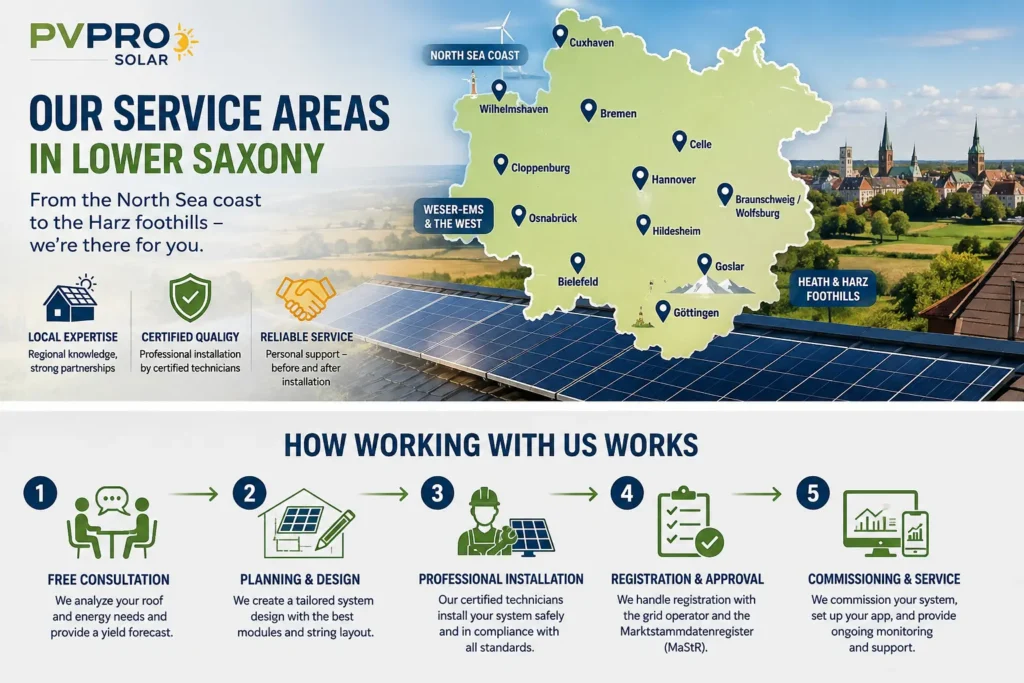
As part of our turnkey service, we handle registration with both the grid operator and the Market Master Data Register on your behalf.
For more information, see our page on Photovoltaic Funding.
Your Rights When Dealing with the Grid Operator
The EEG imposes clear obligations on grid operators.
They must:
- Connect properly registered photovoltaic systems to the grid
- Accept all electricity fed into the network
- Pay feed-in compensation on time
- Provide information about applicable technical connection requirements
If a grid operator causes unjustified delays, system owners may have legal claims.
In practice, the best protection is a complete and accurate application process, which is why we ensure all documentation is submitted correctly from the start.
What Changed in 2026?
Several important changes affect newly installed systems.
No Compensation During Negative Electricity Prices
For newly commissioned systems, feed-in compensation is suspended during periods of negative wholesale electricity prices.
To offset this, the compensation period is extended by the same duration at the end of the standard 20-year term.
Direct Marketing Thresholds
Above certain system sizes, operators are required to participate in direct electricity marketing rather than relying solely on fixed feed-in tariffs.
This threshold is particularly relevant for larger rooftop and commercial systems and is considered during our planning process.
Output Limitation Without Smart Metering
Systems without intelligent metering and control technology may face restrictions on export capacity.
Outlook for 2027 and Beyond
For newly installed small-scale systems, policymakers are planning a gradual transition from fixed feed-in tariffs toward more market-oriented compensation models.
Homeowners who wish to secure today’s fixed tariff structure for the next 20 years may benefit from commissioning their systems sooner rather than later.
Is Solar Still Worthwhile with EEG Compensation in 2026?
Absolutely, but the economics have changed.
Feed-in compensation is now primarily a supplementary source of revenue rather than the main financial driver.
The greatest value comes from self-consumption.
Every kilowatt-hour of solar electricity used on-site replaces expensive grid electricity and is therefore worth considerably more than exporting it.
When combined with battery storage and properly sized system design, photovoltaic systems remain one of the most attractive investments available for both homeowners and businesses in 2026.
Get Advice from a regional photovoltaic specialist
Want to know which feed-in model and system size make the most sense for your situation?
We provide an honest assessment tailored to your property and handle the complete registration process on your behalf.
Phone: +49 511 3360603 Email: hallo@pvprosolar.de
Request a free quotation today, and we’ll get back to you promptly.
For more information about available incentives and subsidy programs, visit our Photovoltaic Funding 2026 page.
For systems up to 10 kWp commissioned between February and July 2026, the tariff is 7.78 ct/kWh for partial feed-in and 12.35 ct/kWh for full feed-in, with tiered rates applying to larger systems.
Yes, every PV system must be registered with the grid operator and the Market Master Data Register (MaStR), and ZEREZ requirements may also apply.
Feed-in compensation is paid for 20 years plus the year of commissioning at the tariff rate valid on the commissioning date.
Partial feed-in prioritizes self-consumption and exports only surplus electricity, while full feed-in exports all generated electricity to the grid.
For newly commissioned systems, feed-in compensation is suspended during periods of negative electricity prices, with those periods added to the end of the support term.
Future EEG support is expected to become more market-oriented for new systems, although the final details have not yet been determined.What is the EEG feed-in tariff in 2026?
Do I have to register my PV system?
How long is feed-in compensation paid?
What is the difference between partial and full feed-in?
What happens during negative electricity prices?
Will EEG support change after 2027?
PVPro Solar GmbH
In 3 Schritten zur PV-Anfrage
Bedarf klären · Daten senden · Angebot erhalten
Jetzt Anfrage sendenBedarf klären
Schritt 1
Daten senden
Schritt 2
Angebot erhalten
Schritt 3