
Best Battery Storage: Comparison, Test Winners and Buying Guide
Diese Seite ist auch auf Deutsch verfügbar
Artikel auf Deutsch lesen
There’s no one-size-fits-all answer to which battery storage system is best. We’ll tell you honestly which battery storage performs best in independent testing, and which one we install ourselves in Hanover and the surrounding region. At PVPro Solar GmbH, we install BYD batteries combined with the Fronius GEN24 Plus hybrid inverter. That’s the combination we work with and recommend from experience. It isn’t Sungrow, Fox ESS or RCT Power. If you want to know which battery performs best in independent testing, you’ll find the correct figures below. If you want to know what you get from us and what it costs, read on.
Last updated: October 2026
PVPro Solar GmbH
Bedarf klären · Daten senden · Angebot erhalten
Jetzt Anfrage sendenBedarf klären
Schritt 1
Daten senden
Schritt 2
Angebot erhalten
Schritt 3
What Makes the Best Battery Storage?
There’s no single best battery for everyone. What matters is which system suits your installation and your consumption. These six criteria are decisive:
- Usable capacity: it is typically 5–10% below the nominal capacity and determines how much solar power you can store for the evening and night.
- Efficiency (SPI): the System Performance Index from HTW Berlin makes complete storage systems comparable and reflects real losses. The best systems currently reach around 97%.
- Charge and discharge power: stated in kW, it determines how many appliances can be supplied at the same time. At least 5 kW is recommended for backup power and for use with a heat pump.
- Expandability: modular systems can be extended later. If you want to start small and grow with an electric car or heat pump, look for scalability.
- Warranty: around 10 years of product warranty is standard. Also check the guaranteed remaining capacity at the end of the warranty period.
- Backup or emergency power: an often-overlooked criterion. More on this below, specifically for the combination we install.
Modern batteries now almost exclusively use LiFePO4 (lithium iron phosphate) cells. They are considered particularly robust and durable and often manage 6,000 or more charge cycles, which equals many years of daily use.
What Does the Latest HTW Storage Inspection Really Show?
The HTW Berlin Storage Inspection (Stromspeicher-Inspektion) is the most independent technical test of battery storage in the German-speaking world. It doesn’t rate systems on marketing promises but on the System Performance Index (SPI), the actual efficiency of the battery and inverter working together.
In the current 10 kWh class, the ranking looks like this, as of our research on the update date above:
- Fox ESS PQ-H3-Ultra-10.0 achieves the highest measured SPI in the class, around 97%.
- RCT Power DC 10.0 comes second, also in class A (over 95%). Older articles still list RCT Power as the “test winner in the 10 kW class”, but that reflects an earlier test year, not the current one.
- Kostal Plenticore G3 M10 combined with the BYD HVS 12.8 also reaches class A, over 95%, when DC-coupled. AC-coupled, the same combination reaches 94.3%, i.e. class B. This is the only specifically named BYD combination available to us that demonstrably exceeds 95% SPI in the 10 kW segment.
- Fronius’s own combination (Symo GEN24 10.0 Plus SC with the Fronius Reserva 12.6 battery, not BYD) comes fourth with 95.3%.
To be clear and honest: we can’t find a citable current source naming an SMA + BYD or Fronius + BYD combination with a specific SPI above 95%. The only reliable BYD combination in the test is BYD with Kostal. Fronius tests there with its own Reserva battery, not with BYD. Our recommendation of BYD with Fronius below is based on our own installation experience and the manufacturer specifications, not on an HTW ranking of exactly this combination.
Test Winners by Battery Size: 5, 10, 15, 20 and 30 kWh
Many people search for the test winner for a specific battery size. It’s important to know that HTW Berlin doesn’t group its storage inspection by capacity in kWh but by system output in kW, currently a 5 kW and a 10 kW class. A “10 kWh test winner” is therefore, strictly speaking, the winner of the 10 kW class. These systems usually have batteries of around 10 kWh, but not always.
5 kWh Battery Storage: Test Winner
In the 5 kW class of the 2026 storage inspection, the AC system from SAX Power achieved the best SPI at 93.2%. The best hybrid system was the SMA Sunny Boy Smart Energy 5.0 with Home Storage 6.5 at 92.8%, just ahead of the Kostal hybrid inverter with a BYD battery, tested for the first time, at 92.7%. With us, this size corresponds to the BYD HVS 5.1. More under 5 kWh battery storage.
10 kWh Battery Storage: Test Winner
In the 10 kW class, the Fox ESS PQ-H3-Ultra-10.0 DC system set a new record at 97%. Systems from RCT Power, Energy Depot, Fronius and Kostal (DC-coupled) with BYD also exceeded 95%, i.e. efficiency class A. With us, this is the most common size, the BYD HVS 10.2 with the Fronius GEN24 Plus. More under 10 kWh battery storage price.
15 kWh Battery Storage: Test Winner
There is no HTW test winner for this size yet. The testers have announced a separate 15 kW class for systems with 16 to 24 kWh for 2027. Until then, it’s worth looking at manufacturers that perform well in the 10 kW class and at expandability. With us, the BYD HVS 12.8 or HVM 13.8 are options here.
20 kWh Battery Storage: Test Winner
There is no independent test winner for 20 kWh yet either; the planned 15 kW class from 2027 will cover this size for the first time. A 20 kWh battery is rarely necessary for a single-family home. It can make sense with a heat pump, two electric cars or a PV system well above 15 kWp. With us, the modular BYD HVM covers this size in a single tower.
30 kWh Battery Storage: Test Winner
Batteries of 30 kWh are usually built from several towers in parallel. For a normal single-family home, that is almost always too large because the battery never fills up in winter. This size becomes interesting for apartment buildings, small businesses or farms with high evening consumption. There is no test winner in this size.
Balcony Power Plant Batteries: Stiftung Warentest
Stiftung Warentest has not yet tested home batteries for rooftop systems, only small batteries for balcony power plants of about 2 to 2.7 kWh. The result: three out of five batteries were rated “poor”. What a balcony power plant battery brings is explained under power storage for balcony power plants.
Warranties Compared
For the 2026 inspection, HTW also compared the warranty terms of 20 manufacturers. The guaranteed remaining capacity at the end of the warranty ranges from 60% to 85%. BYD guarantees 60% of usable energy after 10 years or a minimum energy throughput. That is at the lower end, and we tell you so honestly. With any battery, also check proof requirements and who bears replacement costs in a warranty case.
Storing Grid Power with a Dynamic Electricity Tariff
With a dynamic tariff, it can pay to charge the battery at night with cheap grid power. According to HTW, in an example with 25 ct/kWh at night and 35 ct/kWh in the evening, this only pays off if inverter and battery together lose less than 29%. Not all tested batteries achieve this. More under dynamic electricity tariff.
The Best Battery Storage from Hanover: What We Actually Install
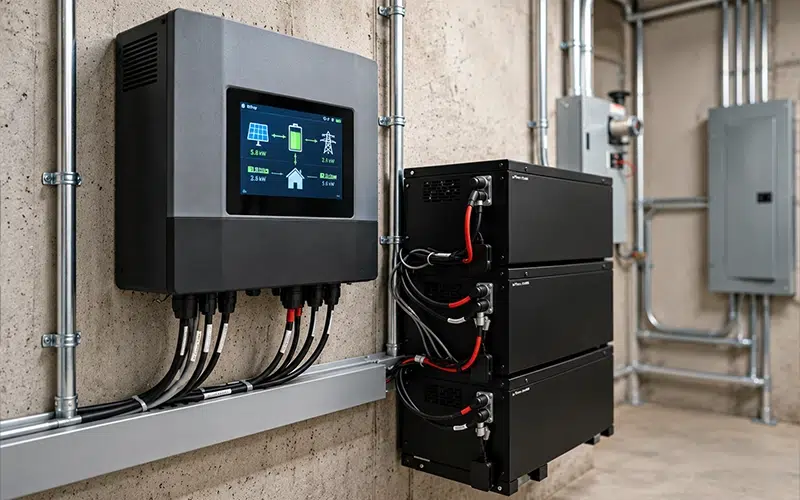
We don’t compare five brands here, four of which we don’t install. This is the overview that counts:
| What we install | With which inverter | Usable capacity | Backup / emergency power | Warranty, remaining capacity | Installed price, Hanover |
|---|---|---|---|---|---|
| BYD Battery-Box HVS / HVM | Fronius GEN24 Plus (hybrid), our standard combination | HVS: 5.1–12.8 kWh · HVM: up to approx. 22.1 kWh, modularly expandable | Yes, see the backup power section below | 10-year BYD product warranty | see price table below |
| The same BYD system, AC-coupled | Existing inverter, retrofit | as above | Only with a backup-capable existing inverter, otherwise limited | 10-year BYD product warranty | see price table below |
| An alternative we also install | depending on the project, e.g. for an existing non-Fronius system | project-dependent | project-dependent | manufacturer-dependent | on request |
| What we don’t install | Sungrow, Fox ESS, RCT Power, E3/DC | — | — | — | — |
In individual cases, we also install other manufacturers, for example when a customer has an existing system that is technically incompatible with BYD. That’s the exception, not the rule, which is why no third brand is named here unless we actually use it in a project.
What the Best Battery Storage Really Costs
A range of 5,000 to 10,000 euros for “a 10 kWh battery” doesn’t tell you whether you can request a fixed price. Here’s the breakdown:
| Battery size | BYD model | With a new PV system or an existing hybrid inverter | Retrofit with a new inverter or battery inverter |
|---|---|---|---|
| 5 kWh | HVS 5.1 | approx. €3,800–4,600 | approx. €5,300–7,600 |
| 7.7 kWh | HVS 7.7 | approx. €5,800–6,900 | approx. €7,300–9,900 |
| 10 kWh | HVS 10.2 | approx. €7,700–9,200 | approx. €9,200–12,200 |
| 12.8 kWh | HVS 12.8 | approx. €9,600–11,500 | approx. €11,100–14,500 |
All prices are guide values including installation and 0% VAT. Battery modules alone are cheaper online, but installation, connection and commissioning then come on top.
For our standard combination, a BYD HVS 10.2 together with a new PV system and the Fronius GEN24 Plus, we calculate about €7,700 to €9,200 extra, including installation. More under BYD battery storage.
Battery storage prices have fallen significantly in recent years. That’s an important reason why most new PV systems on single-family homes are now built with a battery from the start.
Want a fixed price for battery and PV system? Request your free, no-obligation quote now.
VAT: if the battery is bought together with a PV system, the 0% VAT rate under Section 12(3) UStG applies. For a battery retrofitted to an existing system invoiced separately, this may differ, and we check it with you case by case.
Worked example: 8 kWp PV system, 10 kWh battery, 5,000 kWh annual consumption. In the Hanover region, the system generates around 7,100 kWh a year (893 kWh per kWp). Without a battery, a household typically uses 25–35% of this itself, and 55–70% with a battery. Because consumption here is below the yield, we cautiously assume 30% without and 55% with a battery. That’s around 1,750 kWh a year that you additionally use yourself instead of feeding it in and buying it back expensively in the evening. At the German average household electricity price of around 37 cents/kWh (BDEW electricity price analysis, as of August 2026), that saves you around 650 euros of grid electricity. After deducting the forgone feed-in tariff of around 7.70 cents/kWh, you’re left with around 510 euros a year net. Your actual consumption, load profile and the electricity price in your contract determine the exact result, and we calculate this specifically for you in the consultation.
Retrofitting Backup Power: What the Fronius GEN24 Plus Can Really Do
Many people ask: can I retrofit a battery with backup power? With the Fronius GEN24 Plus, our standard inverter, there are two levels that differ technically and in price:
PV Point (socket backup): supplies a single socket with up to 3 kW directly from current PV production. It only works while the sun is shining and needs no additional switching equipment. It’s enough for a fridge, router, chargers and small household appliances. Extra cost compared with a system without this function: approx. 300–800 euros.
Full Backup: supplies large loads, including three-phase loads such as heat pumps, day and night, because the battery takes over once the sun has gone. This requires a battery in addition to the inverter, plus a switchover device for safe, standards-compliant disconnection from the grid. According to Fronius, Full Backup is not available for the smaller Symo GEN24 3.0–5.0 Plus models, only from the larger power classes or the SC variants. Extra cost: switchover device approx. 1,200–1,800 euros including installation. When retrofitting an existing system with an inverter that can’t provide backup power, an inverter replacement for approx. 1,500–3,000 euros including installation comes on top.
If you want to dig deeper into the technical differences between backup power, emergency power and UPS, or want to know what can be retrofitted to an existing system, you’ll find it in detail in our article on solar backup power systems.
The Right Battery Size: Our Rule of Thumb
We consistently use one rule of thumb: around 1 kWh of storage capacity per 1 kWp of installed PV output. The reason is that the battery size should mainly absorb your system’s actual midday surplus, and that depends directly on the installed PV output, not on annual consumption alone. A household with low consumption but a large roof would be systematically mis-sized with a consumption-only rule.
Example, four-person household: an 8 kWp PV system gives a base size of around 8 kWh under the rule of thumb. If you also plan a genuine backup reserve for outages (see above), you usually add 1–2 kWh of buffer, so in practice most households of this size end up at around 10 kWh.
If you’re also planning a heat pump or an electric car, your electricity demand changes significantly, and you should choose a larger, expandable solution from the start.
The Most Common Mistakes When Choosing the Best Battery Storage
Many problems arise during the buying phase. Avoid these mistakes:
- Planning in the wrong order: first analyse the roof potential and future electricity demand, then size the PV system, and only then derive the battery. Not the other way round.
- Oversizing the battery: an oversized battery never fills up and pays off worse.
- Ignoring inverter compatibility: not every battery fits every inverter. Matching within one manufacturer ecosystem is the most reliable.
- Looking only at the price: a low purchase price often means a shorter service life and fewer charge cycles. Look at the overall package of efficiency, warranty and durability.
- Forgetting future demand: if you’re planning a heat pump or an electric car, factor it in when choosing the battery.
Conclusion: Which Battery Storage Is the Best?
There’s no universal “best battery storage”. There’s the one with the highest technical rating (Fox ESS, 10 kWh class), and there’s what we actually install and stand behind in Hanover: BYD combined with the Fronius GEN24 Plus. If reliably high, independently measured efficiency matters more to you than the brand we install, we’ll tell you so honestly. If you want a battery that we plan, install, register and support locally in Hanover and Lower Saxony for years, BYD with Fronius is our recommendation. How planning, prices and registration work locally is described on our page battery storage in Hannover.
Get a quote for your specific roof and consumption profile: Request your free, no-obligation quote now, or call us on +49 511 3360603 or message us on WhatsApp at +49 176 2399 8536. If you’re also thinking about a wallbox to charge your car with PV surplus, see our page on home wallbox installation. And if you’d first like to understand how a battery works and what it costs, start with our guide to power storage for your home.
Frequently Asked Questions About the Best Battery Storage
Which battery storage is currently the best?
In the independent HTW test, the Fox ESS PQ-H3-Ultra-10.0 currently achieves the highest measured efficiency in the 10 kWh class (SPI, around 97%), followed by RCT Power and a combination of a Kostal inverter with a BYD battery, both above 95%. At PVPro Solar, we install BYD combined with the Fronius GEN24 Plus. That is our recommendation for Hanover and the region, based on experience and manufacturer specifications, not on an HTW ranking of exactly this combination.
How large should my battery be?
As a rule of thumb, plan around 1 kWh of storage capacity per 1 kWp of installed PV output. If you also want a backup reserve, add 1–2 kWh of buffer. An 8 kWp system therefore ends up at a base size of about 8 kWh, and often 10 kWh with a backup buffer.
How much does a 10 kWh battery cost?
Battery modules alone cost around 2,000 to 4,000 euros. A complete solution with a new hybrid inverter for a new system costs around 5,000 to 10,000 euros, while a retrofit to an existing system with AC coupling is usually somewhat less, at around 3,500 to 6,000 euros. If the battery is bought together with the PV system, 0% VAT applies.
Is battery storage worth it at all?
With a typical 8 kWp system, a 10 kWh battery and 5,000 kWh of annual consumption, you additionally use around 1,750 kWh a year yourself. At an electricity price of around 37 cents/kWh, that's about 650 euros less grid electricity, or around 510 euros a year net after deducting the forgone feed-in tariff. Your actual consumption profile determines the exact result.
Which 10 kWh battery is the test winner?
In the 10 kW class of the 2026 HTW storage inspection, the Fox ESS PQ-H3-Ultra-10.0 achieved the highest SPI at 97%. Systems from RCT Power, Energy Depot, Fronius and Kostal with BYD (DC-coupled) also exceeded 95% in efficiency class A. HTW groups by output in kW, not by capacity in kWh.
Which 5 kWh battery is the test winner?
In the 5 kW class 2026, the AC system from SAX Power led at 93.2%. The best hybrid system was the SMA Sunny Boy Smart Energy 5.0 with Home Storage 6.5 at 92.8%, closely followed by Kostal with BYD at 92.7%.
Is there a test winner for 20 kWh batteries?
Not yet. HTW has so far only tested the 5 kW and 10 kW classes. A 15 kW class for systems with 16 to 24 kWh has been announced for 2027. For a single-family home, 20 kWh is rarely needed; it makes more sense with a heat pump, two electric cars or a large PV system.
Has Stiftung Warentest tested battery storage?
Stiftung Warentest has so far tested small batteries for balcony power plants of about 2 to 2.7 kWh, and three out of five were rated poor. Home batteries for rooftop systems were not tested there. The most important independent test for those is the HTW Berlin storage inspection.
PVPro Solar GmbH
In 3 Schritten zur PV-Anfrage
Bedarf klären · Daten senden · Angebot erhalten
Jetzt Anfrage sendenBedarf klären
Schritt 1
Daten senden
Schritt 2
Angebot erhalten
Schritt 3