
Home Battery Storage: Is It Worth It? Size, Costs and Backup Power
Diese Seite ist auch auf Deutsch verfügbar
Artikel auf Deutsch lesen
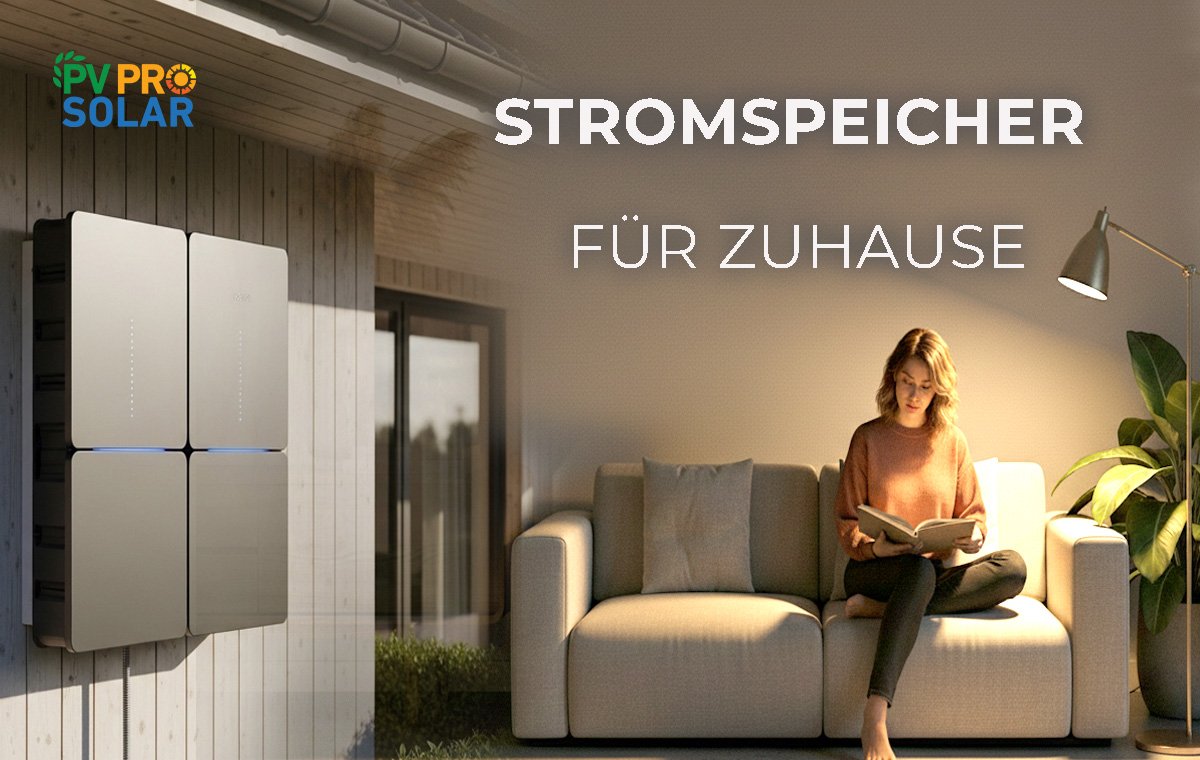
A home battery saves your midday solar power for the evening. Instead of feeding your surplus into the grid for a few cents and buying expensive grid electricity in the evening, you use more of your own power. But is it really worth it? How large should the battery be, what does it cost, and what does it do during a power cut? Here are honest answers with concrete figures.
Want to know which battery suits your PV system? Request your free, no-obligation quote now.
PVPro Solar GmbH
Bedarf klären · Daten senden · Angebot erhalten
Jetzt Anfrage sendenBedarf klären
Schritt 1
Daten senden
Schritt 2
Angebot erhalten
Schritt 3
Home Battery Storage: Key Facts at a Glance
| Question | Answer |
|---|---|
| Self-consumption | about 25–35% of solar power without a battery, about 55–70% with one |
| Right size | at most about 1.5 kWh per 1,000 kWh of annual consumption (HTW Berlin) |
| Cost at PVPro Solar | BYD HVS 10.2 approx. €7,700–9,200 extra on a new PV system, smaller sizes from approx. €3,800 |
| VAT | 0% for residential buildings |
| Backup power | only with a suitable inverter; the battery alone is not enough |
| Funding | no federal grant, but the KfW 270 loan |
How Does a Home Battery Work?
During the day, your PV system usually generates more power than you need at that moment. Without a battery, this surplus flows into the grid. With a battery, it works like this:
- Generate: the PV system produces power, and the household first uses what it needs right now.
- Store: the surplus charges the battery.
- Use: in the evening and at night, the battery supplies your home before power is drawn from the grid.
Today’s home batteries almost always use lithium iron phosphate (LiFePO4) cells. They are considered safe and durable, often managing 6,000 or more charge cycles. Energy management in the inverter, or a separate energy management system, controls when the battery charges and discharges.
What Does a Home Battery Really Deliver?
- More self-consumption: without a battery, a typical household uses about 25–35% of its solar power itself, and about 55–70% with a battery.
- Less grid electricity: every stored kilowatt-hour replaces grid electricity, which is 37 cents at an assumed price of 37 ct/kWh. In return, you give up the feed-in tariff of about 7.70 ct/kWh.
- Backup power: with the right inverter, the battery can supply individual appliances or the whole house during a power cut. A battery alone isn’t enough for this; more on that below.
- Better predictability: the more of your own power you use, the less you depend on future electricity prices.
Is a Home Battery Worth It? An Honest Worked Example
Take a four-person household using 5,000 kWh a year with an 8 kWp system. In the Hanover region, the system produces around 7,100 kWh a year (893 kWh per kWp). Without a battery, the household uses around 30% of this itself. With a 10 kWh battery, a cautious estimate is around 55%. That’s about 1,750 kWh a year more from your own power.
| Item | Value |
|---|---|
| Additional self-consumed solar power | approx. 1,750 kWh/year |
| Grid electricity saved (37 ct/kWh, assumption) | approx. €650/year |
| Forgone feed-in tariff (7.70 ct/kWh) | approx. €135/year |
| Net benefit from the battery | approx. €510/year |
| Extra cost of a BYD HVS 10.2 (guide value, modelled) | approx. €7,700–9,200 |
| Payback of the battery alone | approx. 15–18 years, without electricity price increases |
To be honest, that means the battery alone takes a long time to pay for itself at today’s electricity prices. For 5,000 kWh of consumption, a 10 kWh battery is also on the large side: HTW Berlin recommends at most about 7.5 kWh. A BYD HVS 7.7 costs about €5,800–6,900 with us and shortens the payback, because it is fully charged and discharged more often. Households with higher consumption reach about 12–14 years with a 10 kWh battery; see 10 kWh battery storage price. It becomes more attractive if electricity prices rise, if you use a lot of power in the evening (for example with a heat pump or electric car), and if backup power and independence matter to you. There’s another argument for batteries ahead: according to the government’s draft EEG 2027 amendment, the fixed feed-in tariff for new small systems is set to fall significantly. That would make every self-consumed kilowatt-hour even more valuable. You can read more under EEG amendment 2027.
How Large Should Your Home Battery Be?
Two rules of thumb help you get your bearings:
- By PV output: around 1 kWh of storage per 1 kWp, so an 8 kWp system suits about 8 kWh of storage.
- By consumption: the battery should cover roughly one night’s electricity demand. The Verbraucherzentrale (German consumer advice centre) recommends this too.
- HTW Berlin upper limit: at most about 1.5 kWh of usable capacity per 1,000 kWh of annual consumption. For 5,000 kWh, that’s up to 7.5 kWh.
An oversized battery often doesn’t fill up, costs more and pays off worse. If you’re planning a heat pump or an electric car, choose a modular system that can be expanded later. You’ll find specific sizes and prices in our guides to 5 kWh battery storage and 10 kWh battery storage.
How Much Does a Home Battery Cost?
For a new PV system, we calculate extra costs of around €7,700–9,200 for the BYD HVS 10.2 battery. A 10 kWp system with this battery therefore costs about €22,200–26,700. These are modelled guide values. Your fixed price depends on your roof, meter cabinet and components.
Since 1 January 2023, the zero VAT rate has applied to the supply and installation of PV systems and batteries on or at residential buildings, so you pay 0% VAT. There is no federal grant for private battery storage. You can finance the system and battery with the KfW 270 loan, for example, which is a loan and not a grant. Regional programmes change frequently. You’ll find the current situation for Hanover under solar funding in Hanover.
Want a fixed price for your PV system and battery? Request your free, no-obligation quote now.
Which Battery We Install and What to Look For
We install BYD batteries, usually the Battery-Box HVS, together with the Fronius GEN24 Plus hybrid inverter. We use this combination based on our experience. Our comparison of the best battery storage shows honestly how different systems perform in the independent HTW Berlin efficiency test. You can read more about the BYD system itself under BYD battery storage.
Check these criteria for any battery:
- Usable capacity: it is somewhat below the nominal capacity.
- Efficiency of the whole system: the battery and inverter together count, not just the battery.
- Charge and discharge power: this determines how many appliances can be supplied at once.
- Expandability: modular systems grow with a heat pump or electric car.
- Warranty: around 10 years is standard. Also check the guaranteed remaining capacity.
- Compatibility: battery and inverter must work together.
Home Batteries and Power Cuts: What Really Works
A battery alone doesn’t supply power during a power cut, because grid-connected systems switch off for safety reasons. Backup power requires a suitable inverter and, depending on the option, a switchover device:
- Backup socket: with the Fronius GEN24 Plus, the PV Point function supplies a single socket during the day when the sun shines, even without a battery.
- Whole-house backup: with a battery and a switchover device, the house keeps running at night too, for as long as the battery lasts.
We explain which level suits you and what it costs under solar backup power systems.
Retrofit a Battery or Plan It from the Start?
It’s usually cheapest to plan the battery together with the PV system: one hybrid inverter, one installation, one registration. If you already have a PV system, you can retrofit a battery, either AC-coupled to the existing inverter or with a new hybrid inverter. You’ll find everything about this under retrofitting a solar battery. If you’re planning a new system with storage, our page on buying a photovoltaic system with storage shows our standard package.
Home Batteries and Dynamic Electricity Tariffs
With a dynamic electricity tariff, the price changes every hour. In theory, you can then charge the battery cheaply from the grid at night or when there is a lot of wind, and bridge expensive evening hours. In practice, this only pays off with very efficient systems: in its 2026 battery storage inspection, HTW Berlin concludes that charging from the grid only pays off if the system’s losses are below 29%. A dynamic tariff also requires a smart metering system. A battery that can charge from the grid at more than 4.2 kW also counts as a controllable consumer under Section 14a EnWG and can receive reduced grid fees if the grid operator may throttle its power in exceptional cases.
A Home Battery Without Solar Panels?
A battery without any PV system only earns money from price differences in a dynamic tariff. For most households, the numbers are tight so far. It mainly makes sense if you plan a PV system later anyway or need backup power.
Build Your Own Battery, or Use a Power Station Instead?
We advise against building a grid-connected battery yourself. Lithium cells need a reliable battery management system, and a battery on your home’s circuits must be connected in line with standards and registered in the Market Master Data Register.
A portable power station is no alternative to a home battery. It usually has only 1–3 kWh, isn’t integrated into your home’s circuits, and is better suited to camping, the garden or as a small reserve for individual devices.
How It Works at PVPro Solar
We analyse your consumption, plan the PV system and battery to match each other, and install everything with our own certified technicians. That includes modules from AIKO, JA Solar or Longi, Fronius inverters, BYD batteries and the K2 Systems mounting system. We handle registration with the grid operator and in the Market Master Data Register, commission the system and set up the app with you. You get a fixed price and pay using the 30/70 model.
Request your free, no-obligation quote now, or call us on +49 511 3360603 or message us on WhatsApp at +49 176 2399 8536.
Frequently Asked Questions About Home Batteries
Is a home battery worth it?
It significantly increases your self-consumption, by around 1,750 kWh a year for a typical 8 kWp system. That's around 510 euros a year net. On the numbers alone, the battery takes a long time to pay for itself. It becomes more attractive with rising electricity prices, high evening consumption and if backup power matters to you.
How large should a battery be for a single-family home?
As a rule of thumb, around 1 kWh of storage per 1 kWp of PV output, or as much as you use in one night. For an 8 kWp system, that's usually 8 to 10 kWh. An oversized battery often doesn't fill up and pays off worse.
How much does a home battery cost?
For a BYD HVS 10.2 in a new PV system, we calculate extra costs of around 7,700 to 9,200 euros. A 10 kWp system with a battery therefore costs about 22,200 to 26,700 euros. Supply and installation on residential buildings are subject to 0% VAT.
Does a home battery work during a power cut?
Only with a suitable inverter. Grid-connected systems switch off during a power cut. With a backup function, the system supplies a single socket, or the whole house with a switchover device, for as long as the battery lasts.
Is there funding for home batteries?
There is no federal grant for private battery storage. The 0% VAT rate does apply, though, and the KfW 270 loan lets you finance the system and battery at a low rate. Regional programmes change frequently.
How long does a home battery last?
Modern lithium iron phosphate batteries often manage 6,000 or more charge cycles, which equals many years of daily use. Around 10 years of manufacturer's warranty is standard; also check the guaranteed remaining capacity.
Is a home battery worth it with a dynamic electricity tariff?
Only with very efficient systems. According to HTW Berlin, charging from the grid only pays off if system losses are below 29%. You also need a smart metering system. A battery still delivers the most with your own solar power.
Is a home battery worth it without solar panels?
For most households, hardly. Without PV, the battery only earns money from price differences in a dynamic tariff. It mainly makes sense if a PV system is planned or backup power is needed.
Note: This article provides a general overview (as of October 2026) and does not replace tax or legal advice.
PVPro Solar GmbH
In 3 Schritten zur PV-Anfrage
Bedarf klären · Daten senden · Angebot erhalten
Jetzt Anfrage sendenBedarf klären
Schritt 1
Daten senden
Schritt 2
Angebot erhalten
Schritt 3