

EEG Amendment 2027: Lock In Your Feed-in Tariff Before the End of 2026
Diese Seite ist auch auf Deutsch verfügbar
Artikel auf Deutsch lesen
PVPro Solar GmbH
Bedarf klären · Daten senden · Angebot erhalten
Jetzt Anfrage sendenBedarf klären
Schritt 1
Daten senden
Schritt 2
Angebot erhalten
Schritt 3
What the Cabinet Decided on July 29, 2026
Germany’s Federal Ministry of Economic Affairs and Energy, under Minister Katherina Reiche, has put forward two draft laws: the EEG Amendment, set to take effect as the EEG 2027 on January 1, 2027, and a Grid Connection Package. The guiding idea is that solar power should compete more directly in the market rather than rely on guaranteed compensation—the minister described it as ending the EEG’s era as an “all-inclusive package.”The path to this point was turbulent. The first draft, from February 2026, proposed simply abolishing the feed-in tariff for new systems under 25 kilowatts with no replacement. Following fierce criticism from industry associations such as BSW-Solar, BDEW, and BEE, the ministry presented a softened draft in mid-July: instead of an abrupt cutoff, there will be a phase-out model with a transitional payment and a direct-marketing bonus. The Grid Connection Package supplements the reform with new grid rules, including the designation of overloaded grid zones with reduced compensation for curtailment, as well as a permanent cap on the feed-in capacity of new systems. Both drafts build on the 2025 Solar Peak Act. Importantly, nothing is finalized yet: the Bundestag, the Bundesrat, and the European Commission still need to give their approval.The New Rules for Systems Under 25 Kilowatts
Currently, your grid operator purchases your surplus electricity at a fixed rate, guaranteed for 20 years—we explain the details in our article on how the feed-in tariff works. For new systems from 2027 onward, a staged transition takes its place.According to the cabinet draft, systems commissioned between 2027 and 2030 will receive a transitional payment for 36 months, based on the applicable tariff rates but roughly one cent per kilowatt-hour lower. After that comes direct marketing: surplus electricity is sold on the power exchange through a service provider, with fluctuating revenue and a service fee. Systems under 25 kilowatts will receive a bonus there of 1.5 cents per kilowatt-hour for a maximum of 48 months; a smart metering system effectively becomes standard equipment. Our articles on selling solar power and on dynamic electricity tariffs explain how exchange-based marketing works. In addition, the threshold for mandatory direct marketing—currently set at 100 kilowatts—will be lowered, meaning mid-sized rooftop systems will be affected sooner as well.Grandfathering: Existing Systems Keep Their Tariff
The draft law explicitly states that systems commissioned before January 1, 2027 remain subject to the existing legal framework. The guaranteed rates run for the full 20 years, with no retroactive changes planned—this includes systems still coming online in 2026. Just make sure your details in the Market Master Data Register (Marktstammdatenregister) stay up to date. If you expand an existing system after 2026, be aware that the new component falls under the new rules; however, retrofitting a battery storage system alone does not affect your existing tariff entitlement.Deadline: December 31, 2026 — Lock In 20 Years of Fixed Compensation
This is where the deadline everyone is talking about comes from: any system commissioned by December 31, 2026 will still be treated under current law. What matters is commissioning as defined by the EEG, not the order date. On top of that, there’s the 0 percent VAT rate for private systems up to 30 kilowatts and low-interest loans through the KfW 270 program—our page on current 2026 photovoltaic incentives gives a full overview. Since February 1, 2026, rates for systems up to 10 kilowatts peak have stood at 7.78 cents for surplus feed-in and 12.34 cents for full feed-in; following the scheduled reduction on August 1, these now stand at roughly 7.70 and 12.22 cents respectively. Once a system is commissioned, its rate stays fixed for 20 years.On a realistic timeline for the Hannover region: installing a single-family home’s roof system takes one to two days, and modules from AIKO, JA Solar, or LONGi, along with Fronius inverters and BYD storage batteries, are readily available. What actually takes time is the grid operator registration under VDE-AR-N 4105 and the Technical Connection Conditions, along with meter installation—depending on the grid area, for example enercity Netz or Avacon, this can take several weeks. Plan on six to twelve weeks overall from commissioning the project to going live, so get your project underway by early autumn at the latest.Does Solar Still Pay Off From 2027 Onward?
Yes, but the calculation follows a different logic. Every kilowatt-hour you use yourself replaces grid electricity costing 35 to 40 cents, while every kilowatt-hour fed into the grid will soon earn only a few cents. Already today, the bulk of returns comes from self-consumption, and the amendment only widens this gap further. That makes your self-consumption rate and degree of energy independence the decisive factors—our independence calculator offers a first sense of where you stand.Here’s a worked example: a single-family home in Lower Saxony with a 10-kilowatt-peak system generates around 9,500 kilowatt-hours per year, while the household consumes 4,500 kilowatt-hours at an electricity price of 37 cents. Without storage, the system covers about 30 percent of consumption, saving roughly €500 a year, plus around €620 in feed-in tariff revenue for a system commissioned in 2026. Add a 10-kilowatt-hour battery, and coverage rises to around 70 percent: nearly €1,200 in savings plus about €490 in tariff payments. For a system commissioned from 2027 onward, the self-consumption savings stay the same—only the feed-in revenue drops. Home battery storage is thus shifting from an optional add-on to a core building block of the system.Even greater gains are available to those who intelligently link generation and consumption: an AI-controlled solar battery charges based on forecasts and, in the future, will also be able to factor in electricity market price signals; a solar system paired with a home EV charger turns the electric car into a flexible major consumer; and combining a PV system with a heat pump lets you store solar power as heat. Controllable consumption devices under Section 14a of the Energy Industry Act (EnWG) bring additional reductions in grid fees. This makes self-sufficiency levels achievable that would have seemed unrealistic just a few years ago.Balcony Solar Systems: Barely Affected
Plug-in solar devices with up to 2 kilowatts of module capacity remain outside the new compensation system; surplus electricity from new devices will in future be fed into the grid free of charge. In practice, little changes, since balcony solar systems are designed around self-consumption anyway, and the simplified registration process, 800-watt inverter capacity limit, and tenants’ right to consent remain in place. For renters, a balcony solar system remains the easiest entry point; anyone with their own roof is considerably better off with a full-scale system.Commercial Properties and Multi-Family Buildings: What to Check Now
Commercial rooftop systems naturally achieve high self-consumption rates thanks to daytime load profiles, so their economic viability already depends less on feed-in compensation. What’s new is mainly the organizational framework: with the direct-marketing threshold falling, even mid-sized systems will need a marketing contract, a metering concept, and controllable technology, and for larger projects, the upcoming designated grid-constraint zones will carry more weight in site assessments. If you’re already planning a project, there’s a strong case for implementing it under the current rules still in 2026—more on our page on commercial photovoltaics in Hannover. For property owners and management companies, tenant electricity models and shared building supply arrangements remain unchanged, and common-area electricity continues to provide a reliable self-consumption base; you can find an introduction on our page on photovoltaics for multi-family buildings.How PVPro Solar GmbH Guides You Through the Transition
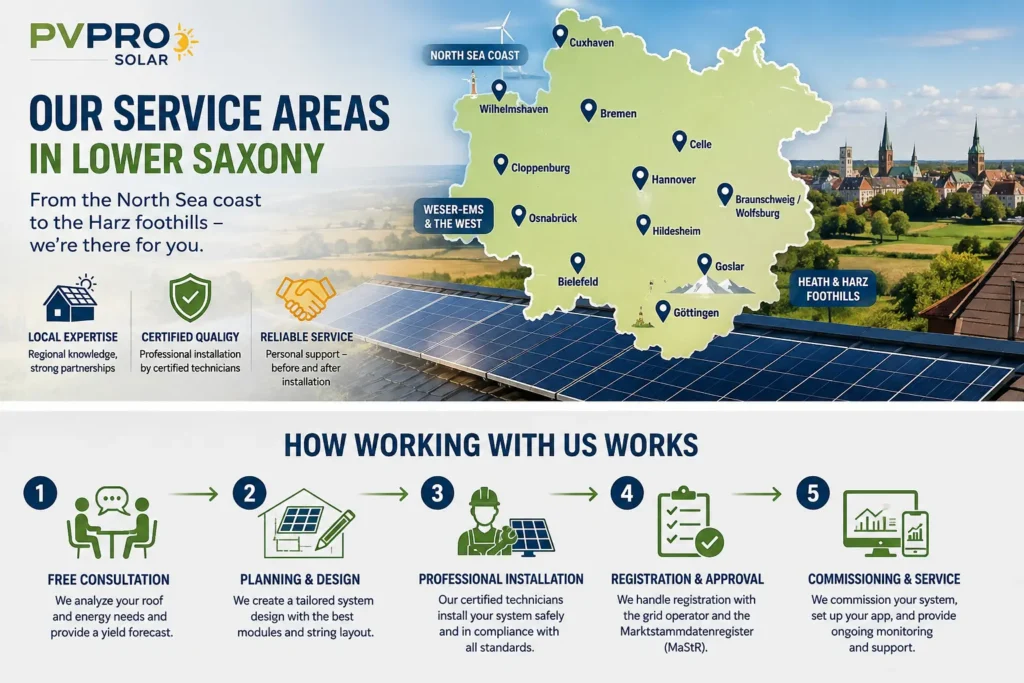
Laws change; the planning substance of a good solar project does not. Our process: a free initial consultation with roof analysis and yield forecast, engineering design with string layout and appropriately sized storage, VDE- and TAB-compliant installation by certified specialists, complete registration with the grid operator and the Market Master Data Register, commissioning with app onboarding, monitoring, and after-sales service. Our fixed-price guarantee with a 30/70 payment model provides planning certainty in a year of predictably high demand, and for projects targeting 2026 commissioning, we’ll tell you honestly whether the timeline is realistic. You can find reference installations in Hannover, Wolfsburg, Bremen, Braunschweig, and Hildesheim; for an overview specific to the state capital, see our page on buying a photovoltaic system in Hannover.Conclusion: Act Now or Wait?
The EEG Amendment 2027 is no reason to panic, but it is a genuine turning point: Germany is moving away from the principle of guaranteed compensation for new small-scale solar systems and shifting toward self-consumption and market participation. Existing system operators can stay relaxed. If you’re actively planning a system, commissioning it by the end of 2026 still locks in 20 years of fixed compensation, the zero VAT rate, and full planning certainty—a package that won’t be available again in this form. And even from 2027 onward, photovoltaics will remain economically worthwhile; planning simply becomes more demanding, since system size, storage, and consumption profile need to align precisely. We’ll work with you honestly to determine whether your project can realistically be completed by the end of 2026. It all starts with a free initial consultation including a roof analysis and yield forecast; you can request a free photovoltaic quote directly online. The rules are changing—the sun over Lower Saxony is not.Will the feed-in tariff be completely abolished in 2027?
Not completely, but it is being fundamentally restructured. The permanent fixed tariff will no longer apply to new systems under 25 kilowatts; instead, there will be a transitional payment for 36 months, followed by direct marketing with a time-limited bonus. Existing systems keep their tariff unchanged.
Do existing PV systems keep their feed-in tariff?
Yes. For systems commissioned before January 1, 2027, existing law continues to apply, with rates running for the full 20 years. The draft explicitly rules out any retroactive changes to existing commitments.
By when does my system need to be commissioned to lock in the fixed tariff?
By December 31, 2026; what matters is commissioning as defined under the EEG, not the order date. Since grid operator processes and meter installation can take several weeks, we recommend placing your order by early autumn 2026 at the latest.
What does direct marketing mean for private PV systems?
Your surplus electricity is sold on the power exchange through a service provider, rather than going to the grid operator at a fixed price. Revenue fluctuates with market prices, the service provider charges a fee, and a smart metering system becomes practically a requirement.
Does a photovoltaic system still pay off without a feed-in tariff?
Yes, because the economic core lies in self-consumption: every kilowatt-hour you use yourself replaces grid electricity costing 35 to 40 cents. With storage, energy management, an EV charger, or a heat pump, self-sufficiency levels of 70 percent or more are achievable.
Are balcony solar systems affected by the amendment?
Barely. Devices up to 2 kilowatts remain outside the new system, and surplus electricity will in future be fed into the grid free of charge. Since balcony solar systems are designed around self-consumption, little changes in practice; all the existing simplifications remain in place.
Has the EEG Amendment 2027 already been finally approved?
No. Following the cabinet decision on July 29, 2026, approval is still needed from the Bundestag and Bundesrat, as well as state-aid clearance from the European Commission. Entry into force is planned for January 1, 2027; details may still change.
What is the current feed-in tariff as of August 2026?
Following the scheduled reduction on August 1, rates for systems up to 10 kilowatts peak stand at around 7.70 cents for surplus feed-in and around 12.22 cents for full feed-in. The rate in effect at commissioning remains fixed for 20 years.
PVPro Solar GmbH
In 3 Schritten zur PV-Anfrage
Bedarf klären · Daten senden · Angebot erhalten
Jetzt Anfrage sendenBedarf klären
Schritt 1
Daten senden
Schritt 2
Angebot erhalten
Schritt 3