
Solar Carport Costs 2026: What You’ll Really Pay
Diese Seite ist auch auf Deutsch verfügbar
Artikel auf Deutsch lesen
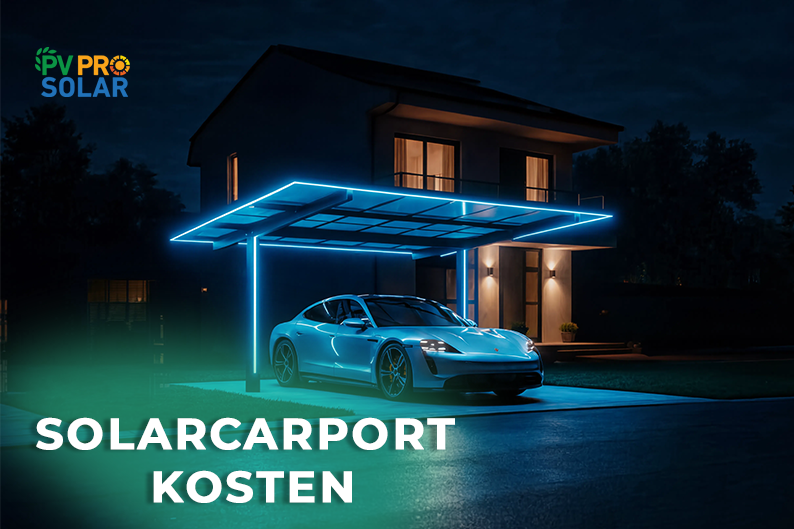
A solar carport costs between 8,000 and 25,000 euros in 2026. A single-space carport with 3 to 5 kWp typically runs 8,000 to 13,000 euros, while a double carport with 5 to 7 kWp lands at 14,000 to 22,000 euros. Add a battery storage system and you’ll start at around 15,000 euros, with premium setups exceeding 30,000 euros. The good news: prices have dropped noticeably over the past two years, mainly because solar modules have become far cheaper per watt-peak. At the same time, electricity prices keep climbing, which makes the power from your own roof more valuable than ever.
PVPro Solar GmbH
Bedarf klären · Daten senden · Angebot erhalten
Jetzt Anfrage sendenBedarf klären
Schritt 1
Daten senden
Schritt 2
Angebot erhalten
Schritt 3
Solar Carport Costs by Size
The single biggest factor in your price is size and output. Here’s a realistic overview for 2026:
| Type | Output | Without storage | With storage |
| Single carport | 3–5 kWp | 8,000–13,000 € | 15,000–19,000 € |
| Double carport | 5–7 kWp | 14,000–22,000 € | 20,000–28,000 € |
| Premium / large | 7+ kWp | from 22,000 € | 30,000 €+ |
These are guide values. The actual figure depends on your property, the material you choose, the desired output, and the equipment. A reliable quote is only possible after individual on-site planning.
What Makes Up the Cost?
A solar carport combines two functions, vehicle protection and power generation — and the cost reflects that. It breaks down into three core components.
The first is the supporting structure, the carport frame itself. Material drives the price here. Wood is cheapest to buy but needs regular maintenance. Aluminium costs more but is rust-free, lightweight, and virtually maintenance-free, often the most economical choice over its lifespan. Steel offers maximum stability but adds weight and a higher need for corrosion protection.
The second component is the photovoltaic system: the solar modules and the inverter. Carports often use semi-transparent glass-glass modules that double as the roof skin, replacing a separate roof covering. That typically saves 1,500 to 3,000 euros compared with a standard carport that has a PV system mounted on top afterwards.
The third component is installation, including electrical work, mounting, wiring, grid connection, and registration with the grid operator and the Marktstammdatenregister. In Germany, the electrical installation may only be carried out by a registered electrician.
A wallbox for your EV and a battery storage system are optional. Both raise the investment but significantly increase how much of your own power you use.
0% VAT and Funding
One point is often overlooked but saves real money: since 2023, private photovoltaic systems in Germany qualify for the zero VAT rate under Section 12 (3) of the German VAT Act (UStG). That means no value-added tax on the PV components, and on the wallbox and storage if installed together with the system. You automatically save 19 percent, with no application or extra effort. On top of that, depending on the program, there may be low-interest KfW loans and regional subsidies in Lower Saxony for storage systems or charging infrastructure. It’s worth checking the current programs for Hanover and the surrounding region.
Is a Solar Carport Worth It?
Profitability can’t be stated as a single number, but an example makes it tangible: with a system of around 5 kWp and solid self-consumption, you save several hundred euros per year through self-used electricity and the feed-in tariff. The higher your self-consumption and the more electricity prices rise, the faster the system pays for itself.
Looking at the PV portion alone, the extra cost over a standard carport often pays back within just a few years. The combination of solar carport, wallbox, and EV is close to ideal: your car sits under the roof during the day, exactly when the modules produce the most power. Instead of 40 to 60 cents per kilowatt-hour at a public charging station, you pay only the generation cost of your own solar power, a fraction of that. A solar carport also increases your property’s value.
Do You Need a Building Permit?
That depends on the federal state and the specific construction. In many cases a building permit is required, especially if the carport is firmly anchored, exceeds a certain size, or stands close to the property line. Lower Saxony has its own rules on size and boundary distances. When the modules serve as the roof skin over the parking space (overhead glazing), special requirements under DIN 18008 apply. We clarify the permit situation for your project up front so you’re on the safe side.
Solar Carport in Hanover: Your Specialist
Hanover offers excellent conditions for photovoltaics, with around 1,560 hours of sunshine per year. Whether you’re in Misburg, the List district, or the surrounding area toward Lehrte, Laatzen, or Garbsen, a solar carport is a smart option for most homes with their own parking space. What makes the difference between a system that runs reliably for decades and one that causes early problems is proper planning and execution: structural design, the right module choice, clean electrical installation to VDE standards, and correct registration with the responsible local grid operator.
As a photovoltaics specialist based in Hanover, we plan and deliver your solar carport from the first consultation to the finished grid connection, with high-quality components and an honest profitability calculation tailored to your situation.
Request a free, no-obligation quote now — by phone at 0511 3360603 or by email at hallo@pvprosolar.de.
A solar carport with battery storage starts at around 15,000 € and reaches over 25,000 € depending on capacity and size. The storage alone accounts for roughly 4,000 to 7,000 €, but raises self-consumption to up to 70–80%.
Yes. Thanks to the zero VAT rate under Section 12 (3) UStG, private individuals pay 0% VAT on the PV components. Depending on the program, there are also low-interest KfW loans and regional subsidies in Lower Saxony for storage or charging infrastructure.
A single carport with 3–5 kWp generates around 3,000 to 5,000 kWh per year in the Hanover region, and a double carport with 5–7 kWp produces correspondingly more. That covers a large share of a household's consumption or charges an EV for several thousand kilometers.What does a solar carport with storage cost?
Is a solar carport eligible for funding?
How much electricity does a solar carport generate?
PVPro Solar GmbH
In 3 Schritten zur PV-Anfrage
Bedarf klären · Daten senden · Angebot erhalten
Jetzt Anfrage sendenBedarf klären
Schritt 1
Daten senden
Schritt 2
Angebot erhalten
Schritt 3