
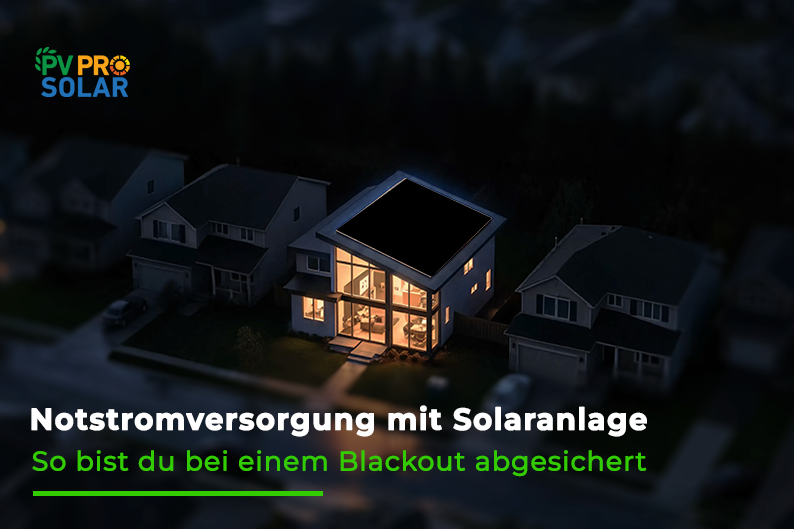
Solar backup power systems: How to be protected during a blackout
Diese Seite ist auch auf Deutsch verfügbar
Artikel auf Deutsch lesen
Solar backup power systems are becoming increasingly important for homeowners who want greater energy security and independence. While major blackouts are relatively rare, local power outages caused by storms, grid failures, or technical issues can leave households without heating, internet access, lighting, and other essential services. Many homeowners assume that their solar panels will continue producing electricity during an outage, but in reality, most standard solar systems automatically shut down when the grid goes offline. In this article, you’ll learn how solar backup power systems work, which components are required, what the different backup options are, and how to choose the right solution to keep your home powered when you need it most.
PVPro Solar GmbH
Bedarf klären · Daten senden · Angebot erhalten
Jetzt Anfrage sendenBedarf klären
Schritt 1
Daten senden
Schritt 2
Angebot erhalten
Schritt 3
Why Does My Solar System Shut Down During a Power Outage?
This is one of the first questions PV owners ask, and the answer often comes as a surprise.
The shutdown is legally required. Under the VDE-AR-N 4105 standard, PV systems must immediately disconnect from the public grid during a power outage. The reason is safety: utility technicians working on damaged power lines must be protected from electricity potentially flowing back into the grid from private properties.
In simple terms, this means that without additional backup equipment, your solar system will not provide a single watt of electricity during a blackout. While the panels continue generating power, the inverter detects the absence of the grid signal and prevents any electricity from being supplied.
The 3 Levels of Solar Backup Power
Not all backup power solutions are created equal. In practice, there are three distinct approaches, each varying in performance, convenience, and cost.
Level 1: Emergency Power Outlet (Basic Solution)
Certain backup-capable hybrid inverters offer a dedicated emergency power outlet that automatically supplies electricity during a grid outage, provided the sun is shining.
Output: Up to 3,000 watts
This is sufficient for charging devices, powering lights, or keeping your internet router running.
The drawback? At night or during heavy cloud cover, the outlet provides no electricity. Without a battery storage system, there is no power after sunset.
Additional cost for a new installation: Approximately €300–€800
Level 2: Whole-Home Backup with Battery Storage (Recommended for Residential Homes)
This is the most practical solution for the majority of homeowners.
A backup-capable hybrid inverter automatically detects a grid failure, disconnects the home from the public utility network, and works together with a battery storage system to create a self-sufficient microgrid. Essential appliances continue operating, including:
- Refrigerator and freezer
- Lighting
- Heating circulation pump
- Internet router
- Home office equipment
Modern systems switch over in less than 20 milliseconds—so quickly that most devices do not even notice the interruption.
A 10 kWh battery can typically supply a household with a 1 kW base load for approximately 8–10 hours. During daylight hours, the PV system continuously recharges the battery, allowing the system to operate independently as long as sufficient sunlight is available.
Additional cost for a new installation: Approximately €1,000–€2,500 compared to a system without backup functionality.
Level 3: Fully Off-Grid Operation (Maximum Energy Independence)
The highest level of energy security is a complete off-grid system capable of operating permanently without a utility connection.
For most homeowners in Germany, this is not economically necessary. However, for remote locations or households with critical energy requirements, it provides the ultimate level of independence.
Additional cost: Up to €6,000, depending on system size and infrastructure requirements.
What Do I Need for a Reliable Backup Power System?
Three key components must work together seamlessly:
1. Backup-Capable Hybrid Inverter
Not every inverter can provide backup power.
When purchasing a system, it is advisable to specifically look for a backup-capable hybrid inverter and request written confirmation of its backup power capabilities.
If your current system uses a conventional inverter, retrofitting typically requires a complete inverter replacement.
Cost: Approximately €1,500–€3,000 including installation.
2. Compatible Battery Storage System
Without battery storage, there is no backup power at night or during periods of low solar production.
A certified lithium-ion battery combined with a compatible hybrid inverter is today’s standard solution.
One important feature to verify is Black Start capability, the ability of the battery system to restart independently after a complete power outage.
3. Automatic Transfer Switch (Grid Isolation Device)
Installed within the electrical distribution panel, this component physically disconnects your home from the public grid when a power outage is detected.
This is a mandatory safety requirement. During island operation, no electricity may be fed back into the utility network.
Cost: Approximately €500–€1,300, including installation by a certified electrician.
What Can I Power During a Blackout?
This depends on the size and configuration of your backup system.
A typical 10 kW hybrid inverter operating in backup mode provides approximately 3–5 kW of continuous power, which is generally sufficient for:
- Refrigerators and freezers
- LED lighting
- Routers and home office equipment
- Heating pumps and thermostats
- Smartphones and laptop chargers
- Small appliances such as coffee makers and electric kettles
Typically Not Suitable for Standard Backup Systems
- Electric stoves (3,500–7,000 W)
- Heat pumps (3,000–6,000 W)
- Tumble dryers
- Saunas
If you want to operate these high-demand appliances during a blackout, you will need a specially designed backup system sized for your home’s total electrical load.
Is Backup Power Really Worth It?
This question deserves an honest answer.
Germany has one of the most reliable electricity grids in Europe. In 2024, the SAIDI index—the average annual outage duration per customer, was just 11.7 minutes. Large-scale, multi-day blackouts remain statistically rare.
Nevertheless, there are compelling reasons to consider backup power:
- Local outages caused by storms, cable failures, or sabotage can affect any household.
- Home offices, medical devices, and heating controls often cannot tolerate extended power interruptions.
- The additional cost for backup capability in a new PV installation is relatively small.
- Backup functionality can often be integrated seamlessly when adding battery storage.
Ultimately, the investment is less about the probability of a blackout and more about personal energy security and peace of mind.
Can Backup Power Be Added to an Existing Solar System?
The good news is that in many cases, the answer is yes.
The main requirement is that your existing inverter must either support backup power or be replaced with a suitable hybrid model.
You will also need:
- A compatible battery storage system
- An automatic transfer switch
Additional cost for backup functionality: Approximately €500–€1,500, excluding battery storage if one is not already installed.
If an inverter replacement is already planned, which is often advisable after 10–15 years of operation, this is the ideal time to add backup capability.
Conclusion: Plan Today, Protect Your Home for the Next 25 Years
A solar backup power system is not a luxury reserved for worst-case scenarios. It is a practical and relatively affordable upgrade that significantly enhances the value and resilience of your solar investment.
If you are planning a new PV installation or considering battery storage, incorporating backup functionality from the beginning is highly recommended. The additional cost is modest, while the benefits during an outage can be substantial.
The right combination of a backup-capable hybrid inverter, battery storage system, and automatic transfer switch can transform your home in Hanover and the surrounding region into a self-sufficient energy island, secure, independent, and future-ready.
Protect Your Home Today, Free Consultation from PVPro Solar GmbH in Hanover
Would you like to know whether your existing solar system can be upgraded with backup power functionality, or are you planning a new PV installation with integrated emergency power?
The team at PVPro Solar GmbH in Hanover provides honest, transparent, and pressure-free advice, from the initial consultation to final installation.
As a regional photovoltaic specialist, we design and install complete energy systems throughout Hanover and Lower Saxony, including:
- Solar PV systems
- Battery storage solutions
- Backup power systems
- EV charging stations
- Heat pumps
Everything from a single source, perfectly integrated and tailored to your needs.
Request your free, no-obligation quote today and discover how your home can remain powered, even during a blackout.
No. Unless the system was originally designed with a backup-capable hybrid inverter, compatible battery storage, and an automatic transfer switch, it will automatically shut down during a grid outage.
This depends on battery capacity and actual energy consumption. A 10 kWh battery can typically power a household with a 1 kW base load for approximately 8–10 hours. During daylight hours, the PV system can recharge the battery, significantly extending runtime.
For a new installation, a backup-capable inverter typically adds €300–€800. A complete backup solution with battery storage and transfer switching generally adds €1,000–€2,500. Fully off-grid systems can add up to €6,000 or more.
In most cases, standard backup systems are not designed to support heat pumps because of their high startup power requirements. Dedicated three-phase backup systems can be engineered for this purpose but require custom planning.
Modern hybrid inverters typically switch within 20 milliseconds, fast enough that most devices experience no noticeable interruption. Highly sensitive equipment, such as servers or medical devices, may require an additional UPS (Uninterruptible Power Supply) system.
The PV system itself must be registered with the grid operator. The backup infrastructure must be installed by a certified electrical contractor. Separate building permits are generally not required.Does my existing PV system automatically provide backup power?
How long will a battery storage system last during a blackout?
How much does backup functionality add to the cost of a solar system?
Can I operate my heat pump during a blackout?
How quickly does a backup-capable inverter switch during an outage?
Does a backup power system require special permits?
PVPro Solar GmbH
In 3 Schritten zur PV-Anfrage
Bedarf klären · Daten senden · Angebot erhalten
Jetzt Anfrage sendenBedarf klären
Schritt 1
Daten senden
Schritt 2
Angebot erhalten
Schritt 3