
Photovoltaics with a Heat Pump and Wallbox: How the Energy-Efficient Home Works
Diese Seite ist auch auf Deutsch verfügbar
Artikel auf Deutsch lesen
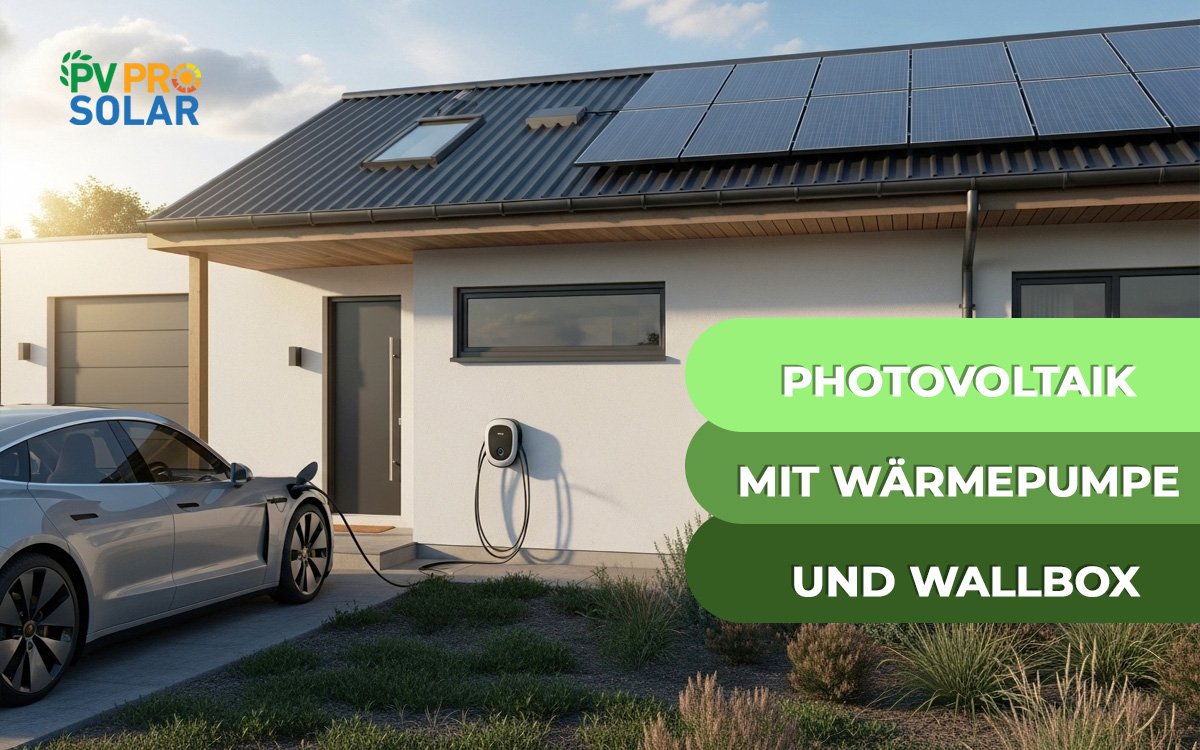
A heat pump heats with electricity, an electric car runs on electricity, and the PV system on your roof generates it. When you combine photovoltaics with a heat pump and a wallbox, three separate devices become one energy system that keeps as much solar power as possible in your own home. This guide explains how they work together, how large the PV system should be, what matters technically when charging with solar power, and which rules apply to wallboxes and heat pumps.
Planning a PV system, a wallbox or both? Request your free, no-obligation quote now.
PVPro Solar GmbH
Bedarf klären · Daten senden · Angebot erhalten
Jetzt Anfrage sendenBedarf klären
Schritt 1
Daten senden
Schritt 2
Angebot erhalten
Schritt 3
PV with a Heat Pump and Wallbox: Key Facts at a Glance
| Question | Answer |
|---|---|
| System size | household + heat pump + EV ÷ 893 kWh/kWp, often 12–15 kWp; cover the roof as fully as possible |
| Additional electricity demand | heat pump approx. 3,000–6,000 kWh, EV approx. 2,000–6,000 kWh a year |
| Charging with solar power | PV surplus charging; with phase switching from approx. 1.4 kW of surplus |
| Value of a self-consumed kWh | approx. 37 ct instead of about 7.70 ct feed-in tariff |
| Rules | register the wallbox with the grid operator (Section 19 NAV); controllable under Section 14a EnWG with reduced grid fees |
| Control | energy management distributes the solar power by priority |
Why Photovoltaics, Heat Pumps and Wallboxes Fit So Well Together
At midday, a PV system often produces more power than the household needs at that moment. Without extra consumers, this surplus goes into the grid for about 7.70 ct/kWh (new systems up to 10 kWp with partial feed-in since 1 August 2026). Grid electricity, on the other hand, costs you several times more: about five times as much at an assumed price of 37 ct/kWh. Every kilowatt-hour you use yourself is therefore worth far more than one you feed in.
A heat pump and an electric car are the two biggest electricity consumers a household can add, and both are flexible. A hot water tank can be heated at midday, and a car can charge while the sun shines. That’s exactly what makes the combination so economical. Without a battery, a typical household uses about 25–35% of its solar power itself, and about 55–70% with a battery. A wallbox and heat pump raise self-consumption further, because more consumers absorb the midday power.
Running a Heat Pump on Solar Power: What’s Realistic
A heat pump turns one kilowatt-hour of electricity into about three to four kilowatt-hours of heat. Running it on solar power makes heating especially cheap. The catch is that most sunshine comes in summer, while heating happens in winter. According to the German consumer advice centre (Verbraucherzentrale), a PV system without a battery covers about 20 to 30% of the total electricity demand of household and heat pump, and up to 40% with a battery.
You get more out of it if the heat pump uses solar surpluses deliberately, for example via the SG-Ready interface: when there’s a surplus, it heats the hot water or buffer tank a little higher. Importantly, a heat pump is more efficient for hot water than an electric heating rod, because it turns each kilowatt-hour into several kilowatt-hours of heat. A heating rod makes more sense where there’s no heat pump. You’ll find everything on sizing, costs and funding in our guide to combining a heat pump with a PV system.
Charging Your EV with Solar Power: How PV Surplus Charging Works
With PV surplus charging, a meter or energy manager at the house connection continuously measures how much power the PV system generates and how much the house is using. When there’s a surplus, the wallbox receives exactly that output. When clouds roll in, it turns the charging current down. Your car charges with solar power instead of drawing expensive grid electricity.
Without this control, a wallbox simply starts at full power as soon as the cable is plugged in. In the morning or on cloudy days, much of the power then comes from the grid.
Why Phase Switching Matters
Electric cars need a minimum charging current of 6 amps per phase. On three phases, that’s about 4.1 kW. Smaller PV systems, or cloudy days in Lower Saxony, often don’t reach this surplus, so charging stops or grid power is bought in.
Wallboxes with automatic phase switching then switch to single-phase charging. This lets the car charge with solar power from a surplus of only about 1.4 kW. When the sun gets stronger again, the wallbox switches back to three phases.
Is a Battery Worth It for the EV?
For commuters whose car isn’t at home during the day, a battery can make sense. It collects midday power and releases it in the evening. However, routing power through two batteries, first the home battery and then the car battery, loses around 10% of the energy. It’s most economical to charge the car directly, for example at weekends or when working from home. Plan the home battery mainly for evening household consumption. You can read more in our guide to power storage for your home.
How Large Should the PV System Be for a Heat Pump and an EV?
The rule of thumb: add up household electricity, the heat pump’s demand and the car’s driving electricity, then divide the total by the yield per kWp. In the Hanover region, we calculate about 893 kWh per kWp per year. An electric car uses about 20 kWh per 100 kilometres, so around 3,000 kWh a year for 15,000 kilometres.
| Driving profile | Annual mileage | Additional electricity demand | Recommended minimum size incl. household |
|---|---|---|---|
| Second car | 10,000 km | approx. 2,000 kWh | at least 6–8 kWp |
| Average driver | 15,000 km | approx. 3,000 kWh | at least 8–10 kWp |
| Commuter | 20,000 km | approx. 4,000 kWh | at least 10–12 kWp |
| High-mileage driver | 30,000 km | approx. 6,000 kWh | from 14–15 kWp |
If you add a heat pump, include its electricity demand too, typically 3,000 to 6,000 kWh a year. In practice, with a heat pump and an electric car it almost always pays to cover the entire suitable roof area. The larger the system, the more often the surplus is enough for three-phase charging. Our article on the 10 kWp photovoltaic system shows what a system of this size costs. As a guide, we calculate about €1,450–1,750 per kWp without a battery.
Want to know which size suits your home? Request your free, no-obligation quote now.
Worked Example: An Energy-Efficient Home in the Hanover Region
A single-family home with 4,000 kWh of household electricity, a heat pump using about 4,000 kWh and an EV driven 15,000 km a year, i.e. about 3,000 kWh of charging power:
| Item | Value |
|---|---|
| Total electricity demand | approx. 11,000 kWh a year |
| Calculated system size | approx. 12 kWp (11,000 kWh ÷ 893 kWh/kWp) |
| Annual yield | approx. 10,700 kWh |
| PV system without a battery | approx. €17,400–21,000 (€1,450–1,750 per kWp, 0% VAT) |
| With a BYD HVS 10.2 battery | plus approx. €7,700–9,200 |
Over the year, the system produces almost as much electricity as the home uses. But the home can only use part of it directly, because the heat pump runs mainly in winter. So the biggest gains come from the car being charged with the midday surplus and from the heat pump heating hot water with solar power in summer. By the way, the zero VAT rate doesn’t apply to the wallbox; it only covers the PV system and battery. We calculate your specific case in the quote using your real consumption figures.
Your Energy-Efficient Home with PVPro Solar
PV System, Battery and Wallbox from One Source
We plan and install the PV system, BYD battery and wallbox so they work together, with modules from AIKO, JA Solar or Longi, the Fronius GEN24 Plus hybrid inverter and installation by our own certified technicians.
A Heat Pump from Us, or Coordinated with Your Existing One
We also install heat pumps and design them together with the PV system and battery. If you already have a heat pump, we plan the PV system, battery and energy management so they work together with it, for example via the SG Ready interface, so it uses solar surpluses specifically for hot water and heating.
Meter Cabinet and Registration Included
We check before the quote whether the meter cabinet needs modifying for the wallbox, heat pump and PV system. We handle registration of the PV system and wallbox with the grid operator, and you get a fixed price with 30/70 payment.
Energy Management: The Conductor in Your Home
So that the heat pump, wallbox and battery don’t work against each other, you need energy management. It continuously monitors how much the PV system generates, what the household uses, how full the battery is and what the heat pump and car need. It then distributes solar power by priority, for example like this:
- First, current household consumption is covered.
- Then the heat pump heats the hot water tank.
- Next, the wallbox charges the car.
- The rest goes into the battery.
- Only what’s left after that is fed into the grid.
The order can be adjusted, for example if the car must be full by the evening. We explain how such systems work in our energy management system guide.
Which Rules Apply to Wallboxes and Heat Pumps?
- Registering the wallbox: under Section 19 of the Low Voltage Connection Ordinance (NAV), every charging point must be notified to the grid operator before commissioning. Wallboxes above 12 kVA, for example 22 kW, also need the grid operator’s prior consent.
- Controllable consumption devices (Section 14a EnWG): since 1 January 2024, newly connected wallboxes and heat pumps above 4.2 kW have counted as controllable. The grid operator may temporarily limit their output to 4.2 kW if the grid is at risk of overload, but may not switch them off completely, and power from your PV system and battery is not affected. In return, you pay reduced grid fees and can choose: module 1 is a flat-rate reduction, usually about €110 to €190 a year depending on the grid operator. Module 2 cuts the grid-fee energy price by 60%, but needs a separate meter for the wallbox or heat pump and tends to pay off with high consumption. Module 3 adds time-variable grid fees to module 1.
- Meter cabinet: a wallbox, heat pump and PV system often require changes to the meter cabinet, for example for an extra meter or the control box. We check this in advance.
- Electrical installation: connection and commissioning belong in the hands of a registered electrical contractor.
We install wallboxes including registration with the grid operator. You can find more under home wallbox installation.
Step by Step to an Energy-Efficient Home
- Determine your demand: household electricity, heat pump and mileage, today and in the coming years.
- Plan the PV system: as large as your roof and demand make sensible.
- Choose the wallbox: with PV surplus charging and phase switching.
- Integrate the heat pump: via SG-Ready or direct control by the energy management system.
- Size the battery: to match evening consumption, not as large as possible.
At PVPro Solar, we plan the PV system, battery, wallbox and, if you wish, the heat pump from a single source. That includes a free initial consultation with roof analysis and yield forecast, modules from AIKO, JA Solar or Longi, Fronius inverters and BYD batteries, installation by our own certified technicians, and registration with the grid operator. You get a fixed price and pay using the 30/70 model.
Request your free, no-obligation quote now, or call us on +49 511 3360603 or message us on WhatsApp at +49 176 2399 8536.
Frequently Asked Questions About PV with a Heat Pump and Wallbox
Can I charge my EV entirely with solar power?
Largely, especially from spring to autumn. A wallbox with PV surplus charging only uses the power the house doesn't currently need. With phase switching, a surplus of about 1.4 kW is enough. In winter and in the evening, part of the charging power comes from the grid or the battery.
How large should the PV system be for a heat pump and an EV?
Add up household electricity, the heat pump (usually 3,000 to 6,000 kWh) and driving electricity (around 3,000 kWh for 15,000 km), then divide by around 893 kWh per kWp. In practice, with a heat pump and an EV it almost always pays to cover the entire suitable roof area.
What is PV surplus charging?
The wallbox charges only with the solar power that's currently left over. An energy manager measures generation and consumption and continuously adjusts the charging current. That way, the car charges with your own power instead of grid electricity.
Do I have to register my wallbox?
Yes. Under Section 19 NAV, every charging point must be notified to the grid operator before commissioning. Wallboxes above 12 kVA, for example 22 kW, also need the grid operator's consent. We handle the registration for you.
Do I need a battery for a heat pump and wallbox?
Not necessarily. It's most economical to charge the car and hot water tank directly with midday power. A battery pays off mainly for evening household consumption and for commuters whose car isn't at home during the day.
What does Section 14a EnWG mean for wallboxes and heat pumps?
Wallboxes and heat pumps above 4.2 kW connected since 2024 count as controllable consumption devices. The grid operator may temporarily throttle them to 4.2 kW if the grid is at risk of overload. In return, you pay reduced grid fees.
Which Section 14a module pays off for a wallbox and heat pump?
Module 1 gives a flat-rate grid-fee reduction, usually about €110 to €190 a year depending on the grid operator, without an additional meter. Module 2 cuts the grid-fee energy price by 60%, but needs a separate meter and tends to pay off with high consumption by the controllable devices. Module 3 adds time-variable grid fees to module 1.
What does a PV system for a heat pump and EV cost?
For a home with about 11,000 kWh of total demand, a system of about 12 kWp fits on paper, costing about €17,400 to €21,000 without a battery with us, plus about €7,700 to €9,200 with a BYD HVS 10.2. The PV system and battery are subject to 0% VAT, the wallbox is not.
PVPro Solar GmbH
In 3 Schritten zur PV-Anfrage
Bedarf klären · Daten senden · Angebot erhalten
Jetzt Anfrage sendenBedarf klären
Schritt 1
Daten senden
Schritt 2
Angebot erhalten
Schritt 3