
Combining a Heat Pump with a PV System: Sizing, Costs and Funding in Hanover
Diese Seite ist auch auf Deutsch verfügbar
Artikel auf Deutsch lesen
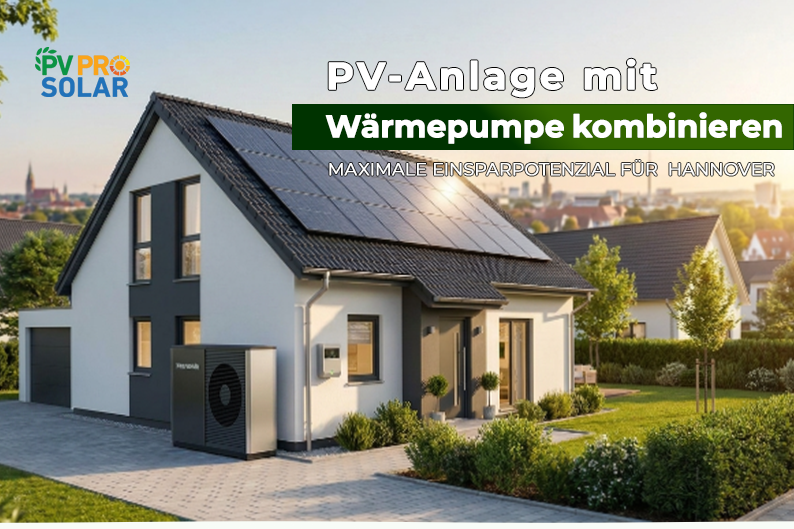
Pairing a heat pump with a PV system makes obvious sense: the heat pump needs electricity, and the solar panels on your roof produce it. There is one catch that many providers don’t mention. Most of the sunshine comes in summer, but most of the heating happens in winter. This guide explains how much of your heat pump’s electricity a solar system can realistically supply, how to match the PV system, battery and heat pump, and which funding is available. It also includes an honest worked example for a single-family home in the Hanover region.
Want to know which PV size suits your heat pump? Request your free, no-obligation quote now. We calculate your system using your actual consumption data.
PVPro Solar GmbH
Bedarf klären · Daten senden · Angebot erhalten
Jetzt Anfrage sendenBedarf klären
Schritt 1
Daten senden
Schritt 2
Angebot erhalten
Schritt 3
Is a PV System with a Heat Pump Worth It?
In most cases, yes, for a simple reason. A heat pump raises your electricity consumption considerably, and every kilowatt-hour of solar power you use yourself replaces expensive grid electricity. At an assumed electricity price of 37 ct/kWh, each self-consumed kilowatt-hour saves you 37 cents. If you feed that kilowatt-hour into the grid instead, new systems up to 10 kWp with partial feed-in have earned only about 7.70 ct/kWh since 1 August 2026. Self-consumption is therefore worth roughly five times as much as feed-in.
The heat pump’s efficiency adds to this. Depending on the unit, the building and the flow temperature, it turns one kilowatt-hour of electricity into about three to four kilowatt-hours of heat. Every kilowatt-hour of solar power that goes into the heat pump becomes several kilowatt-hours of heating or hot water.
The German consumer advice centre (Verbraucherzentrale) gives a useful rule of thumb. For a PV system to pay off, ideally at least 30% of the solar power it generates should be used in the home. With a heat pump in the house, you reach that figure much more easily.
How Much Electricity Does a Heat Pump Need, and How Much Can the PV System Supply?
An air-to-water heat pump in a single-family home typically needs 3,000 to 6,000 kWh of electricity a year, depending on floor area, insulation and hot water demand. Using our standard yield of about 893 kWh per kWp in the Hanover region, a 10 kWp system produces just under 9,000 kWh a year. On paper, that easily covers both the household and the heat pump.
In practice, the picture is different, because generation and demand are spread very differently across the year:
- Summer: the PV system produces far more electricity than you need, and the heat pump runs almost only for hot water.
- Spring and autumn: this is where the two match best. You are already heating, or still heating, and the sun delivers a good amount.
- Winter: the heat pump needs the most electricity while the PV system generates the least. Most of the power then comes from the grid.
According to the Verbraucherzentrale energy advice service, a PV system without a battery covers about 20 to 30% of the total electricity demand of household and heat pump in a single-family home. With a battery, this share rises to up to 40%. Complete self-sufficiency is not realistic without seasonal storage, so don’t let anyone promise you otherwise.
Worked Example: A Single-Family Home with 10 kWp in the Hanover Region
The following example shows the order of magnitude. All assumptions are stated. Your actual figures depend on your roof, building and consumption.
Assumptions: household electricity 3,500 kWh plus heat pump 4,500 kWh, for a total of 8,000 kWh a year. A 10 kWp PV system with an annual yield of about 8,900 kWh. Assumed electricity price 37 ct/kWh, feed-in tariff 7.70 ct/kWh, no electricity price increase and no subsidies.
| Without battery | With battery (approx. 10 kWh) | |
|---|---|---|
| Share of consumption from PV (self-sufficiency) | 25–30% | approx. 40% |
| Solar power used on site | 2,000–2,400 kWh | approx. 3,200 kWh |
| Savings on grid electricity | approx. €740–890 | approx. €1,180 |
| Feed-in revenue for the rest | approx. €500–530 | approx. €440 |
| Benefit per year | approx. €1,270–1,390 | approx. €1,620 |
| Purchase price (PVPro guide value, modelled) | €14,500–17,500 | €22,200–26,700 |
| Calculated payback period | approx. 10–14 years | approx. 14–16 years |
The result is honest and important. A battery increases your independence considerably, but it does not automatically improve the pure return. If electricity prices rise, the calculation shifts in favour of self-consumption, and therefore in favour of the battery. If your heat pump instead runs on cheaper electricity through a heat pump tariff, each self-consumed kilowatt-hour is worth somewhat less. You can find more on pricing in our overview of solar panel costs and on the cost of a 10 kWp PV system.
Want to see this calculation with your own figures? Request your free, no-obligation quote now. We will prepare a yield forecast for your roof that takes your heat pump’s consumption into account.
Heat Pump and PV System from PVPro Solar
Heat Pump and PV System from One Source
We don’t just install PV systems and batteries, we also install heat pumps. If you’re planning both, we design the heat pump, PV system and battery to work together from the start, with one contact person, one schedule and one quote.
PV Matched to Your Existing or Planned Heat Pump
If your heat pump is already running, or another specialist is planning it, we size the PV system to its consumption, based on the heat pump meter reading or the design of the new heat pump.
Coordinated Control via SG Ready and Energy Management
We make sure the heat pump uses solar surpluses specifically, for example via the SG Ready interface or energy management that supplies the household, heat pump, battery and wallbox by priority.
Funding in View
For the heat pump, the KfW 458 grant may apply; for the PV system and battery, the zero VAT rate and the KfW 270 loan. We tell you before the quote what applies to you and provide the documents you need from us as the installer.
Fixed Price and Our Own Specialists
Installation and electrical connection are carried out by our own certified technicians in line with VDE and TAB, with modules from AIKO, JA Solar or Longi, Fronius inverters and BYD batteries. You get a fixed price and pay according to the 30/70 model.
How to Size the PV System, Battery and Heat Pump Correctly
1. Determine your consumption
The starting point is your total consumption: household electricity plus the heat pump’s demand. For a new heat pump, the expected electricity consumption is in its design, which we prepare ourselves for a heat pump from PVPro Solar. For an existing one, the reading on the heat pump meter helps. These rough guidelines do not replace a heating load calculation:
- House up to approx. 120 m²: PV system of about 7–10 kWp
- House up to approx. 180 m²: PV system of about 10–14 kWp
- Larger houses: from approx. 15 kWp, if the roof allows it
2. Use your roof area generously
With a heat pump, it usually pays to cover the entire suitable roof area. East-west roofs spread the yield across morning and evening, which are the times when the house is heating and needs hot water. Steeply pitched south-facing roofs produce comparatively more power in winter than flat roofs, because the low sun hits the modules at a steeper angle.
3. Size the battery to match
A battery shifts solar power from daytime into the evening and night. It cannot bridge dull winter weeks. The Verbraucherzentrale recommends a battery that roughly covers one night’s electricity demand. An oversized battery ages faster without ever being fully used. For 10 kWp with a heat pump, a battery of around 10 kWh, such as the BYD HVS 10.2, is a common size. You can read more in our guide to power storage for your home.
Energy Management, SG-Ready and Thermal Storage
The biggest lever is often not the battery but how the heat pump is controlled. Water is far cheaper to store than electricity:
- SG-Ready interface: many heat pumps have this input. When the PV system reports a surplus, the heat pump heats the hot water or buffer tank a little higher. The solar power is then used in the house instead of being fed into the grid for a few cents.
- Hot water at midday: simply moving hot water heating to the middle of the day covers a noticeable part of the heat pump’s summer electricity from your own roof.
- Energy management system: it distributes solar power by priority. It covers the household first, then supplies the heat pump, battery or wallbox. We explain how this works in our energy management system guide.
Not every heat pump can be controlled by every system, so check which interfaces your heat pump has before you buy.
Heat Pump Tariffs, Meters and Section 14a EnWG
Many heat pumps run on a separate meter with a cheaper heat pump tariff. This can clash with a PV system, because solar power only reaches the heat pump if the metering setup allows it. Whether a separate heat pump tariff or a shared meter is cheaper for you depends on your consumption and your supplier’s tariffs. We clarify this with you and your grid operator during planning.
Since 1 January 2024, newly connected heat pumps and wallboxes with more than 4.2 kW have counted as controllable consumption devices under Section 14a of the German Energy Industry Act (EnWG). If the grid is at risk of overload, the grid operator may temporarily limit their output to 4.2 kW. In return, you pay reduced grid fees, either as a flat reduction or, with a separate meter, through a reduced energy price. In practice, normal operation of your heating is hardly affected.
Funding for the Heat Pump and the PV System
Heat pump: KfW subsidises heating replacement with a grant under its heating subsidy for private individuals (458). New conditions have applied since 21 July 2026:
- 30% basic subsidy
- 16% climate speed bonus if you live in the house yourself and replace a working oil, coal, gas-storey or night-storage heater, or a gas or biomass heater that is at least 20 years old. The bonus is reduced in steps from 1 February 2027.
- Income bonus of up to 40% for owner-occupiers with a lower taxable household income
- A total of usually no more than 70%, or up to 80% for very low incomes, on a maximum of €28,000 of eligible costs for the first residential unit
You apply to KfW before the project starts. Check the details directly on the KfW website, as the rates will change several times over the next few years.
PV system and battery: there is no federal grant for private PV systems or batteries, and they are not part of the heating subsidy. Instead, the zero VAT rate has applied since 1 January 2023: you pay 0% VAT on the supply and installation of a PV system and battery on or at residential buildings. This does not apply to the heat pump. You can finance the PV system with, for example, the KfW 270 loan. It is a loan, not a grant.
Hanover region: in Hanover, Hemmingen, Laatzen, Langenhagen, Ronnenberg and Seelze, proKlima funds roofs that are fully covered with PV through its “DachVollToll” programme. According to proKlima, applications for 2026 are possible until 31 October 2026. It applies only while funds are available, and you must apply before placing the order. The budget was already largely used up in August 2026. You can find all programmes in our overview of solar funding in Hanover.
Next Steps
We start with a free initial consultation with roof analysis and a yield forecast matched to your heat pump’s consumption. You then receive a written fixed-price quote for the PV system, battery and, if you wish, the heat pump. We handle installation, registration with the grid operator and in the Market Master Data Register, commissioning and app setup.
You get a fixed-price guarantee and pay using the 30/70 model: 30% when you place the order and 70% after installation.
Request your free, no-obligation quote now, or call us on +49 511 3360603 or message us on WhatsApp at +49 176 2399 8536.
Frequently Asked Questions About Combining a Heat Pump with PV
Can a PV system power a heat pump completely?
Not over the whole year. In summer and in spring and autumn, the PV system covers a large share of the heat pump's electricity, but in winter most of the power comes from the grid. According to the Verbraucherzentrale, a PV system without a battery covers about 20 to 30% of the total electricity demand of household and heat pump, and up to 40% with a battery.
How big should the PV system be for a heat pump?
For a typical single-family home with a heat pump, 10 to 14 kWp is a good starting point. What matters is your total consumption and the usable roof area. With a heat pump, it usually pays to cover the entire suitable roof area.
Do I need a battery for the heat pump?
No, but a battery increases your self-consumption. It shifts solar power into the evening and night, but it cannot bridge winter weeks. It is often cheaper to charge the hot water or buffer tank with solar power via SG-Ready first. As a battery size, the Verbraucherzentrale recommends roughly one night's electricity demand.
What does SG-Ready mean for a heat pump?
SG-Ready is an interface through which the heat pump receives an external signal, for example from your PV system's energy management. When there is a solar surplus, it heats the hot water or buffer tank higher and stores the solar power as heat.
What funding is available for a heat pump with a PV system?
The heat pump is funded through the KfW 458 grant: a 30% basic subsidy plus possible bonuses, usually up to 70% in total on a maximum of €28,000 of eligible costs (as of October 2026). The PV system itself receives no federal grant, but 0% VAT applies, and proKlima funding is available in parts of the Hanover region while funds last.
Is a heat pump tariff worth it if I have a PV system?
It depends on your situation. A separate heat pump meter with a cheaper tariff can prevent your solar power from reaching the heat pump. Whether a separate tariff or a shared meter is cheaper depends on your consumption, the tariffs and the metering setup. We clarify this during planning.
Does PVPro Solar also install the heat pump?
Yes. We install heat pumps, PV systems and batteries and design them to work together. If your heat pump is already running or another specialist is planning it, we size the PV system to match its consumption.
Should I plan the PV system and heat pump at the same time?
If possible, yes. Then the system size, battery, meter cabinet and control can be coordinated from the start, with one point of contact. If the heat pump comes later, we plan the PV system so it is ready for it.
Note: This article provides a general overview (as of October 2026) and does not replace tax or legal advice.
PVPro Solar GmbH
In 3 Schritten zur PV-Anfrage
Bedarf klären · Daten senden · Angebot erhalten
Jetzt Anfrage sendenBedarf klären
Schritt 1
Daten senden
Schritt 2
Angebot erhalten
Schritt 3