
In-Roof Solar Panels: Costs, Systems and Planning with Your Roof Renovation
Diese Seite ist auch auf Deutsch verfügbar
Artikel auf Deutsch lesen
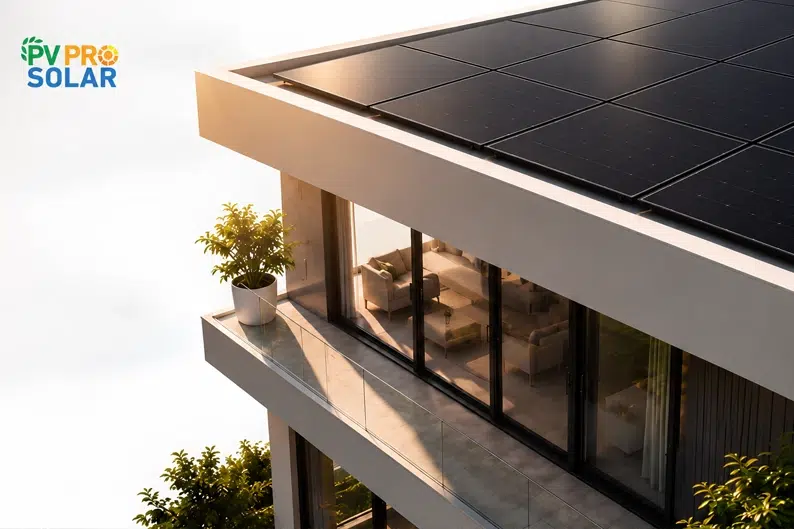
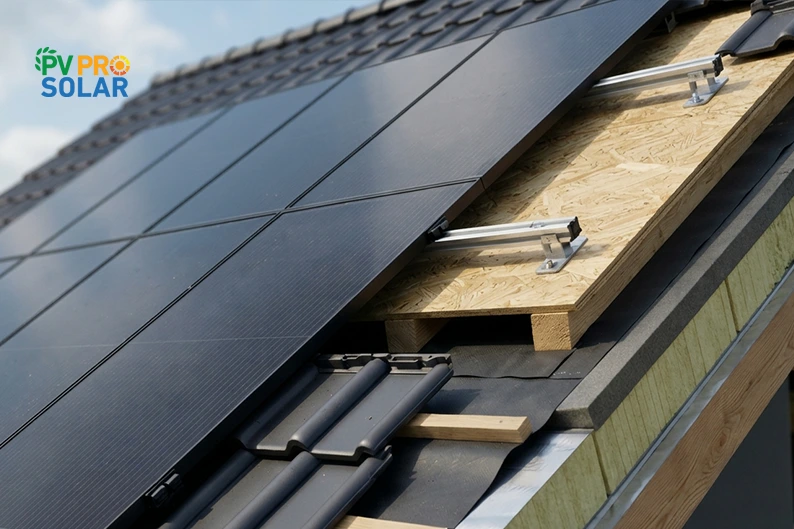
In-roof solar panels do not sit on top of the roof tiles, they replace them. The modules lie flush with the roof surface and, together with a water-shedding mounting system, take over the job of the roof covering in that area. This looks calmer and saves tiles, but it makes most sense when your roof is being re-covered anyway. That is exactly when the Lower Saxony solar duty under § 32a NBauO usually applies as well. We install in-roof systems with the GSE In-Roof System and the K2 In-Roof System, and for the in-roof system we calculate approx. €250–400 per kWp. Here you will learn how in-roof PV works, when it pays off and how roof renovation, funding and PV installation fit together.
Request your free, non-binding quote now: ideally before you hire the roofer.PVPro Solar GmbH
Bedarf klären · Daten senden · Angebot erhalten
Jetzt Anfrage sendenBedarf klären
Schritt 1
Daten senden
Schritt 2
Angebot erhalten
Schritt 3
In-roof solar panels: the key facts
| Topic | What applies |
|---|---|
| Principle | Modules replace the roof covering in the module area; a mounting system with flashing drains the water |
| Our systems | GSE In-Roof System and K2 In-Roof System, with modules from AIKO, JA Solar or Longi |
| Cost of the in-roof system | approx. €250–400 per kWp; for comparison, an on-roof system costs a guide price of €1,450–1,750 per kWp |
| Yield | According to PVGIS about 3 % less than a well-ventilated on-roof system (Hannover, 10 kWp, south, 35 degrees) |
| Best timing | Re-roofing during a roof renovation or on a new build |
| Solar duty | When the roof skin is renewed on at least 50 m²: at least 50 % of that area with PV (§ 32a NBauO) |
| Funding in the Hannover region | Dach-Solar: grant for PV above the mandatory area, only together with roof insulation and with an application before placing the order |
What is an in-roof solar system?
With an on-roof system the roof covering stays in place. Roof hooks reach under the tiles, rails run across them and the modules sit a little above the roof. With an in-roof solar system the tiles in the module area are not laid at all, or they are removed. In their place comes a mounting system that rests on the roof battens, drains rainwater reliably and carries the modules. The edges are connected to the rest of the roof covering with flashing.How an in-roof system is built
From bottom to top, the in-roof solution consists of the roof’s underlay, the battens, the water-shedding in-roof system, the modules and the side connections at ridge, eaves and verge. Watertightness does not depend on the modules alone but on the interplay of underlay, system and cleanly executed connections. That is why an in-roof system belongs in the hands of a team that follows the manufacturer’s installation manual and understands the roof build-up.Which modules we use for in-roof solar panels
You do not need special modules for an in-roof installation: both systems we work with take standard framed modules. We use modules from AIKO, JA Solar and Longi and check during planning which module format is approved for the chosen system. Solar roof tiles, where the cells are built into individual tiles, are a separate product group and not part of this article. You will find more on module types and power classes in our overview of photovoltaic modules.In-roof vs. on-roof: a direct comparison
| Criterion | In-roof | On-roof |
|---|---|---|
| Appearance | flush, calm roof surface | modules visible above the covering |
| Covering under the modules | not needed | stays fully in place |
| Ventilation and yield | somewhat lower, about 3 % less yield according to PVGIS | very good |
| Installation effort | higher, coordination with the roofer needed | lower, possible on an intact covering |
| Cost | in-roof system approx. €250–400 per kWp, but fewer tiles | guide price €1,450–1,750 per kWp |
| Ideal for | re-roofing, new builds, design requirements | intact roofs, quick installation |
Yield of in-roof solar panels according to PVGIS
Because the modules sit directly in the roof surface, air circulates less freely behind them. The modules get warmer in summer, and warm modules produce slightly less electricity. We calculated the size of this effect for Hannover with the EU tool PVGIS: a 10 kWp system facing south at 35 degrees produces about 10,100 kWh a year when freely ventilated and about 9,780 kWh as a building-integrated system. That is just over 3 % less. PVGIS assumes a fully integrated system; in-roof systems with a ventilation gap tend to be closer to the on-roof value. How much orientation and tilt change the yield is shown in our article on the best direction for solar panels.When in-roof solar panels pay off, and when they don’t
Who in-roof solar panels suit
In-roof systems play to their strengths when the roof covering is being renewed anyway. During a roof renovation or on a new build you save the tiles under the module area, the scaffolding goes up only once, and roofer and PV installation run as one process. If a calm, uniform roof matters to you, or a development plan sets design requirements, in-roof is also a good choice. For listed buildings you always need prior approval from the monument protection authority, whether in-roof or on-roof.When on-roof is the better choice
If your roof is watertight and still good for many years, it would not make economic sense to remove intact tiles just to make room for an in-roof system. In that case on-roof mounting is quicker and cheaper. Flat roofs, thatched and bitumen roofs and roofs with a very shallow pitch are also unsuitable for in-roof systems. How we plan a system on your existing roof is explained under rooftop solar system, and the particulars of different roof shapes and coverings in our article on the sloped roof.What roof pitch an in-roof system needs
To make sure water drains reliably, every in-roof system needs a minimum pitch set by the manufacturer. For the GSE In-Roof System the installation manual states a range of 12 to 50 degrees. For every roof we check pitch, rafter layout, underlay and covering during the on-site visit and choose the right system accordingly.In-roof PV costs: what to expect
For the in-roof system we calculate approx. €250–400 per kWp. Where you land within this range depends mainly on the roof shape, the number of connections to dormers, valleys or roof windows and the chosen system. For comparison: a complete on-roof system costs a guide price of €1,450–1,750 per kWp with us, so a 10 kWp system comes to roughly €14,500–17,500 without storage. These are guide values, not a fixed price for your roof.On the other side of the calculation is the roof covering: you need no new tiles under the module area. How much that saves on your renovation only becomes clear from your roofer’s quote. We give you the exact price for the PV side as a written fixed price after the on-site visit. An overview of all cost factors of a PV system can be found on our page about solar panel costs.Since 1 January 2023 the zero VAT rate under § 12 (3) UStG applies to the photovoltaic system. Your roofer’s work on insulation and the rest of the covering is not included. So ask for the PV system and the roof work to be listed separately. Details on VAT are in our article on photovoltaic system VAT.Request your free, non-binding quote now: we visit for a roof analysis and compare in-roof and on-roof for your roof.Solar duty during roof renovation: § 32a NBauO
In Lower Saxony the solar duty of the building code does not only apply to new builds. Under § 32a (2) NBauO it also applies to existing buildings when the roof skin is renewed and the renewed roof area is at least 50 m². At least half of that area must then be covered with a solar system for generating electricity. Among other things, the duty does not apply where it is technically impossible or economically unreasonable, conflicts with other public-law obligations such as monument protection, or where solar thermal collectors are installed or planned on the roof. It also lapses for unforeseen damage such as storm damage that makes the renewal unavoidable.For you this means: if you are having your roof re-covered, plan the PV system at the same time. An in-roof system fulfils the duty just like an on-roof system, but it uses the new covering instead of sitting on top of it. You can read more about the duty, structural issues and old roofs in our guide to solar panels and roof renovation.Funding: Dach-Solar in the Hannover region
With its Dach-Solar programme, the Hannover region funds PV systems on existing buildings if you insulate the roof at the same time. The module area above the legal minimum area is funded at €150 per m². The region also subsidises the insulation at €50 per m², up to 80 % of the PV grant. You apply before you hire the roofer and order the PV system. New builds and battery storage are not eligible. Whether funds are still available and the detailed conditions are set out in the guideline on hannover.de.The programme suits an in-roof system during a roof renovation with insulation particularly well, because insulation, new covering and PV come together in one project anyway. The proKlima programme DachVollToll has ended its 2026 funding year; whether it will continue in 2027 is open. An overview of all programmes is on our page about solar panel subsidies.Roof renovation and in-roof solar panels in one plan
An in-roof system is a joint project of roof and technology. To end up with a watertight roof and a well-running system, we plan both together from the start.In-roof solar panels with GSE and K2
We build in-roof systems with two proven systems: the GSE In-Roof System and the K2 In-Roof System. For on-roof systems we use the mounting systems from K2 Systems. Which system suits your roof depends on pitch, covering, roof shape and module format. Inverters come from Fronius, and storage from BYD if you want it.Coordinated with your roofer
The roof renovation itself, meaning stripping, insulation, underlay, battens and the rest of the covering, is carried out by your roofer. We give them the module layout with the dimensions of the in-roof area early on, agree the schedule and install the in-roof system with the modules as soon as the battens are in place. That way the scaffolding goes up only once, and everyone knows what they are responsible for.Our own installers, fixed price and 30/70
Installation and electrical connection are handled by our own certified installers, not changing subcontractors. You get a written fixed price and pay according to the 30/70 model: 30 % on order, 70 % after installation. We take care of registration with the grid operator and in the Marktstammdatenregister for you.Process: how your in-roof system comes together
- Free initial consultation and roof analysis: we check pitch, covering, structure and shading and prepare a yield forecast.
- Clarify funding: if you insulate in the Hannover region, you file the Dach-Solar application before placing any order.
- Planning with the roofer: we agree the module layout, system choice and schedule together.
- Fixed-price quote: you receive our written quote; more on the free photovoltaic quote page.
- Roof work: the roofer strips the roof, insulates and lays underlay and battens.
- In-roof installation: we install the system, modules and connections, then the roofer completes the rest of the covering.
- Connection and commissioning: electrical connection according to VDE and your grid operator’s TAB, registration, commissioning and app setup.
Frequently asked questions about in-roof solar panels
What are in-roof solar panels?
With in-roof solar panels the modules replace the roof tiles in the module area. A water-shedding mounting system rests on the roof battens, carries the modules and drains rainwater. The edges are connected to the rest of the roof covering with flashing.
How much does an in-roof solar system cost?
For the in-roof system we calculate approx. €250–400 per kWp. For comparison, an on-roof system costs a guide price of €1,450–1,750 per kWp with us. We give you the exact price for your roof as a written fixed price after the on-site visit.
Is in-roof better than on-roof?
It depends on the roof. If the covering is being renewed anyway, in-roof is a good choice: a calmer roof, fewer tiles and one joint process. If the roof is intact, on-roof is quicker, cheaper and yields slightly more.
How much less yield does an in-roof system produce?
According to PVGIS, a fully integrated 10 kWp system in Hannover facing south at 35 degrees produces about 9,780 kWh a year instead of about 10,100 kWh with free ventilation, so just over 3 % less.
What roof pitch does an in-roof system need?
The minimum pitch is set by the manufacturer. For the GSE In-Roof System the installation manual states 12 to 50 degrees. Flat roofs and roofs with a very shallow pitch are not suitable for in-roof systems.
Does an in-roof system fulfil the solar duty during a roof renovation?
Yes. If the roof skin is renewed on at least 50 m² in Lower Saxony, § 32a NBauO requires at least half of that area to be covered with PV. Whether the modules sit on or in the covering makes no difference.
Is there funding for in-roof solar panels?
In the Hannover region, Dach-Solar funds PV on existing buildings at €150 per m² of module area above the mandatory area if you insulate the roof at the same time. You apply before placing the order. The PV system itself is also subject to 0 % VAT.
Is in-roof worthwhile on an intact roof?
Usually not. Removing intact tiles just to install an in-roof system costs extra money. For a roof in good condition we generally recommend on-roof mounting.
Your in-roof project with PVPro Solar
Is a roof renovation coming up, or are you planning a new build in Hannover, Braunschweig, Hildesheim, Wolfsburg or the region? Then it is worth comparing in-roof and on-roof early on. We check your roof, coordinate with your roofer and give you a fixed-price quote.Request your free, non-binding quote now or call us on 0511 3360603. On WhatsApp you can reach us at +49 176 2399 8536, or by email at hallo@pvprosolar.de.Note: This article provides a general overview (as of November 2026) and does not replace tax or legal advice.PVPro Solar GmbH
In 3 Schritten zur PV-Anfrage
Bedarf klären · Daten senden · Angebot erhalten
Jetzt Anfrage sendenBedarf klären
Schritt 1
Daten senden
Schritt 2
Angebot erhalten
Schritt 3