
Solar Panels on a New Build: Solar Duty, Planning and Costs
Diese Seite ist auch auf Deutsch verfügbar
Artikel auf Deutsch lesen
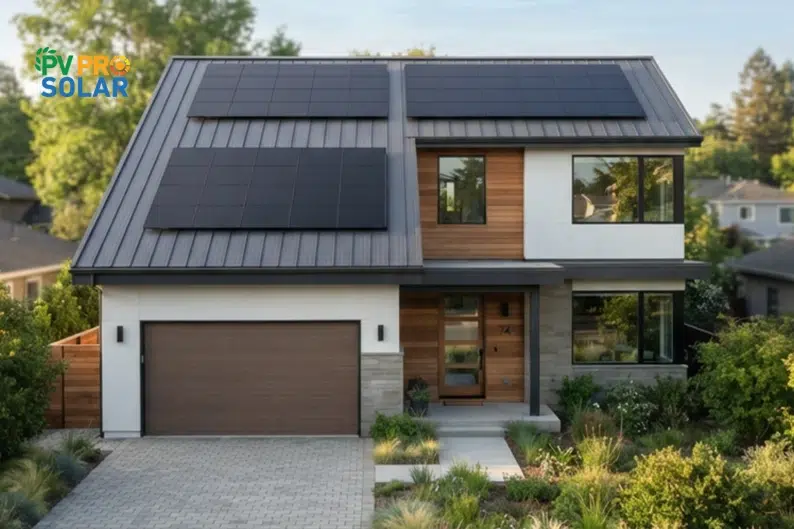
Solar panels on a new build are no longer optional in Lower Saxony: since 1 January 2025, every new building with a roof area of at least 50 m² must have a solar power system on at least half of its roof, and that includes single-family homes. The good news: during construction, a PV system is easier and cheaper to add than at any later point. The scaffolding is already up, cable routes can be laid in the shell and the meter cabinet can be planned to fit from the start. As a guide, a 10 kWp system costs around €14,500 to €17,500 without a battery and €22,200 to €26,700 with a battery, at 0 percent VAT. Here you can find out what the law requires, what to prepare in the shell and how we fit the system into your construction schedule.
Request a free, no-obligation quote now, ideally as soon as your roof design is fixed.
PVPro Solar GmbH
Bedarf klären · Daten senden · Angebot erhalten
Jetzt Anfrage sendenBedarf klären
Schritt 1
Daten senden
Schritt 2
Angebot erhalten
Schritt 3
Solar panels on a new build: the key facts
| Topic | What applies |
|---|---|
| Solar duty in Lower Saxony | New buildings with at least 50 m² of roof area: PV on at least 50 % of the roof area (§ 32a NBauO), for residential buildings since 1 January 2025 |
| Best time | Plan together with the roof, lay cable routes in the shell, mount the modules before the scaffolding comes down |
| Typical size for a single-family home | Often around 10 kWp, more with a heat pump and an electric car |
| Yield (Hannover region) | Around 893 kWh per kWp per year, so about 9,100 kWh for a 10 kWp system |
| Cost of 10 kWp | Approx. €14,500–17,500 without a battery, approx. €22,200–26,700 with a battery (BYD HVS 10.2) |
| VAT | 0 % on PV system and battery on residential buildings |
| Regional grants | proKlima DachVollToll and Region Hannover’s Dach-Solar only fund existing buildings, not new builds |
Does the solar duty apply to your new home?
In most cases, yes. Section 32a of the Lower Saxony Building Code (NBauO) states: when a building with a roof area of at least 50 m² is constructed, at least 50 percent of the roof area must be fitted with a solar power system. New commercial and other non-residential buildings have been covered since 2023, and since 1 January 2025 the duty also applies to new residential buildings. A typical single-family home almost always has more than 50 m² of roof area.
What counts towards the required area?
What matters is the roof area, not a specific output in kWp. A worked example: a 425 Wp module, like the ones in our reference system in Rethen, measures just under 2 m². Half of a 100 m² roof, i.e. 50 m², therefore takes roughly 24 to 25 modules and comes to around 10 kWp. The actual result depends on the roof shape, dormers, roof windows and spacing.
Exemptions and solar thermal
The duty does not apply to the extent that, in an individual case, it conflicts with other public-law obligations, is technically impossible or is not economically justifiable. If you plan or already have solar thermal collectors on the roof, they count towards it. Ask your architect or developer early on how your building authority wants proof. If you are building in Bremen, different rules apply; see our page on solar systems in Bremen.
What about a nationwide solar duty?
There is no nationwide law on this yet. However, the EU Energy Performance of Buildings Directive requires new residential buildings to be fitted with solar installations from the end of 2029, and Germany still has to transpose this into national law. For your building project in Lower Saxony, the state rule is what counts, and it already applies today.
Why solar panels pay off especially well on a new build
Duty or not, a new build is the cheapest moment for a solar system. Many costs that come on top when retrofitting are either part of the building project anyway or easy to avoid:
- Scaffolding: it is already up for the roofer. We mount the system before it is taken down.
- Cable routes: conduits from the roof to the technical room cost little in the shell. Later, cables often have to be run visibly or with a lot of effort.
- Meter cabinet: it is planned from the start with space for PV, battery and wallbox instead of being converted later.
- Roof design: orientation, roof pitch, dormers and roof windows can still be matched to the solar system.
- Financing: the system can be included in your construction financing instead of being financed separately later.
Then there is self-consumption: new homes today are usually built with a heat pump, often with a wallbox as well. Both make your own solar power particularly valuable.
What to prepare in the shell
Even if the modules only go on the roof shortly before you move in, some decisions have to be made during the shell stage. We coordinate these points with your site manager, roofer and electrician:
- Conduits: at least one adequately sized conduit from the loft or roof to the planned technical room for the solar cables, plus a data cable for monitoring and energy management.
- Technical room: wall space for the inverter and battery, frost-free, dry and not in a bedroom. A utility or technical room is ideal.
- Meter cabinet: planned according to your grid operator’s technical connection conditions (TAB) and VDE-AR-N 4100, with spare capacity for PV, battery, heat pump and wallbox.
- Wallbox supply cable: a cable to your future parking space, even if the electric car is still a few years away.
- Roof: agree roof hooks, penetrations and structural load with the roofer so the roof covering does not have to be opened again during mounting.
A practical tip: you have to apply to the grid operator for the house connection anyway. We prepare the PV registration to fit your construction schedule so the system can start producing power soon after you move in.
How big should solar panels on a new build be?
Do not plan for the consumption of your old flat but for the house as it will be used in a few years. A heat pump and an electric car increase electricity demand considerably. That is why it usually makes sense to make good use of the roof instead of covering only the minimum area required by the solar duty.
With or without a battery?
Without a battery, a household typically uses about 25 to 35 percent of its solar power itself; with a battery, around 55 to 70 percent. On a new build the battery can be planned from the start, but it can also be added later if space in the technical room and meter cabinet is prepared. Find out more on our page about battery storage for your home.
Plan for the heat pump and wallbox
How a PV system, heat pump and wallbox work together and how to size them is explained in detail in combining a PV system with a heat pump and photovoltaics with heat pumps and wallboxes.
Our solar panels for your new build: how we build the system
One contact alongside your developer and tradespeople
On a building site, many trades work one after another. We coordinate early with your architect, site manager and roofer so that conduits, roof hooks and the meter cabinet are prepared at the right time. That way nothing has to be chiselled open or rebuilt later.
Brand components
We install modules from AIKO, JA Solar or Longi, inverters from Fronius, batteries from BYD and mounting systems from K2 Systems. We decide which combination suits your roof during planning.
A reference from the region
Our project in Rethen (Hannover district) shows what a system of typical single-family-home size looks like: 10.23 kWp with 24 JA Solar modules, a Fronius GEN24 Plus and a BYD HVS 10.2, total investment €21,400. The yield forecast for this roof is approx. 9,800 kWh per year.
Our own installers and a fixed price
Mounting and electrical connection are carried out by our own certified technicians in line with VDE and TAB, not by changing subcontractors. You get a written fixed price and pay according to the 30/70 model: 30 percent on order, 70 percent after installation.
How much do solar panels on a new build cost?
System prices themselves hardly differ between a new build and an existing house. As a guide, we calculate €1,450 to €1,750 per kWp:
| System size | Guide price without battery |
|---|---|
| 6 kWp | approx. €8,700–10,500 |
| 8 kWp | approx. €11,600–14,000 |
| 10 kWp | approx. €14,500–17,500 |
| 10 kWp with BYD HVS 10.2 battery | approx. €22,200–26,700 |
The advantage on a new build lies in the additional costs: scaffolding, cable routes and the meter cabinet are part of the building project anyway. What drives the price in detail is explained on our page about solar panel costs. We prepare your exact quote after reviewing your building plans.
Request a free, no-obligation quote now
Grid connection, feed-in and commissioning
The same rules apply to operating a PV system on a new build as everywhere else. We handle the registration with the grid operator and the entry in the Federal Network Agency’s Marktstammdatenregister.
When the system should go into operation
The commissioning date determines the feed-in tariff. For systems up to 10 kWp with partial feed-in, it has been around 7.70 ct/kWh since 1 August 2026. Systems commissioned by 31 December 2026 keep the fixed tariff for 20 years. For later commissioning, the federal government’s cabinet draft plans a new model with a much shorter payment period. This has not been passed yet. What it means for your completion date is explained on our page about the EEG amendment.
Smart meters, feed-in limit and § 14a EnWG
Under the Solar Peak Act (in force since 25 February 2025), new systems receive no payment during hours with negative electricity prices. Without a smart metering system, feed-in is also limited to 60 percent of the system’s output. A battery and an energy management system help you use this power yourself. New heat pumps and wallboxes above 4.2 kW count as controllable consumer devices under § 14a EnWG: the grid operator may limit their output in exceptional cases, and in return you pay reduced grid fees.
Funding and taxes for solar panels on a new build
- 0 % VAT: since 1 January 2023, the supply and installation of PV systems and batteries on residential buildings has been exempt from VAT (§ 12 (3) UStG). The wallbox is not included. Details in photovoltaic systems and VAT.
- Income tax: income from systems up to 30 kWp per residential unit is tax-free under § 3 No. 72 EStG.
- KfW loan 270: a low-interest loan for the PV system, not a grant. It must be applied for before the project starts.
- KfW new-build funding: the programmes for climate-friendly new builds (297/298) are tied to an efficiency-house standard. Your energy efficiency expert can tell you what role the PV system plays in your home’s energy balance.
- No regional grants for new builds: proKlima DachVollToll and Region Hannover’s Dach-Solar programme only apply to existing buildings. There is no federal grant for private PV systems.
An overview of all programmes can be found on our page about solar panel subsidies.
Process: how we plan the PV system into your build
- Free initial consultation: we review your building plans and roof design and prepare a yield forecast.
- Planning: module layout, string design, battery size and alignment with the solar duty.
- Fixed-price quote: in writing and transparent, payment according to the 30/70 model.
- Shell: coordination of conduits, technical room and meter cabinet with the site manager and electrician.
- Mounting: modules on the roof while the scaffolding is still up, then inverter and battery.
- Registration and commissioning: grid operator, Marktstammdatenregister, commissioning and app setup.
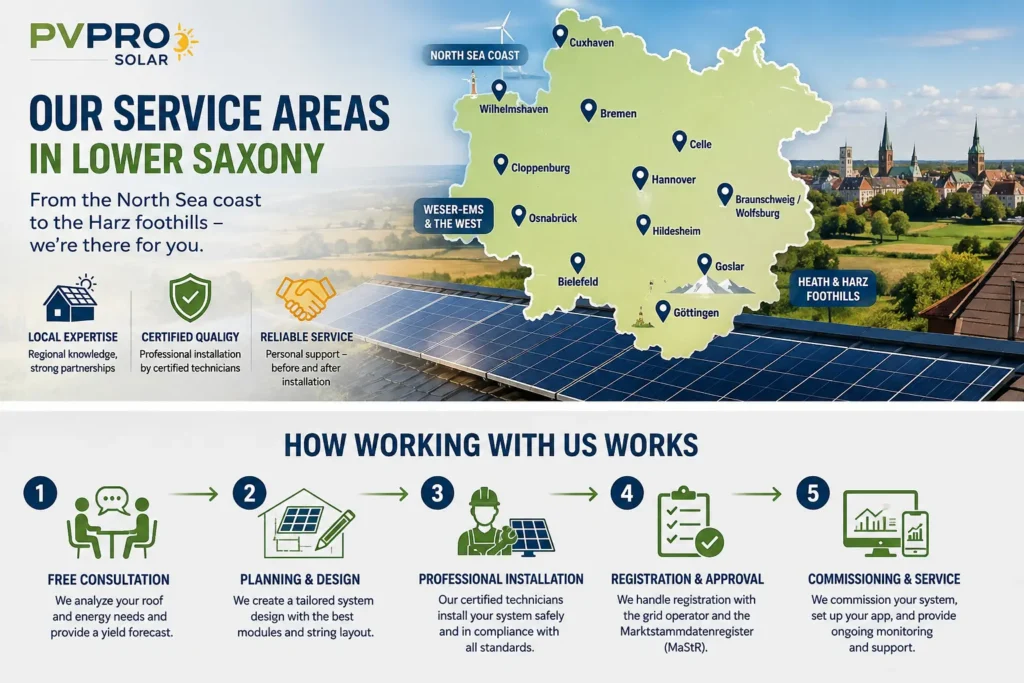
Whether it is a single-family home in the Hannover region or a new build elsewhere in Lower Saxony, you can find our service area in Lower Saxony here. If you are re-roofing rather than building new, read our article on solar panels and roof renovation.
Frequently asked questions about solar panels on a new build
Are solar panels mandatory on a new build in Lower Saxony?
Yes, in most cases. Since 1 January 2025, new buildings with at least 50 m² of roof area, including residential buildings, must have a solar power system on at least half of the roof area (§ 32a NBauO). Exemptions apply if the system is technically impossible, not economically justifiable or conflicts with other public-law obligations.
When should I plan the PV system when building a house?
Ideally together with the roof design, at the latest before the shell stage. Then conduits, the technical room and the meter cabinet can be prepared accordingly. Mounting takes place while the scaffolding is still up.
How much does a PV system for a new single-family home cost?
As a guide, a 10 kWp system costs approx. €14,500 to €17,500 without a battery and approx. €22,200 to €26,700 with a BYD battery, both at 0 percent VAT. We give you the exact price as a written fixed price after reviewing your building plans.
Can I meet the solar duty with solar thermal?
Solar thermal on the roof counts towards it: the duty does not apply to the extent that solar thermal systems are planned or already installed on the roof. Your architect can tell you how much area is then still needed for the PV system.
What needs to be prepared in the shell for a PV system?
The key items are a conduit from the roof to the technical room, a data cable, space for the inverter and battery, a meter cabinet with spare capacity according to the grid operator's TAB, and a supply cable to the future wallbox parking space.
Are there grants for a PV system on a new build?
Private new builds generally do not get direct grants: proKlima DachVollToll and Region Hannover's Dach-Solar only fund existing buildings. You do benefit from 0 percent VAT and the income tax exemption, and you can use the KfW 270 loan.
Do I need a battery straight away on a new build?
Not necessarily. A battery raises self-consumption from about 25 to 35 percent to around 55 to 70 percent. If space in the technical room and meter cabinet is prepared, it can also be added later.
Does PVPro Solar handle the registration of the system?
Yes. We register the system with the grid operator, enter it in the Marktstammdatenregister and commission it. We coordinate the planning with your site manager and electrician.
Plan solar panels into your new build from the start
The earlier we are involved, the easier it gets: send us your building plans or give us a call, and we will plan solar panels for your new build to suit your roof, the solar duty and your construction schedule. Phone 0511 3360603, WhatsApp or email hallo@pvprosolar.de.
Request a free, no-obligation quote now
Note: This article provides a general overview (as of October 2026) and does not replace tax or legal advice.
PVPro Solar GmbH
In 3 Schritten zur PV-Anfrage
Bedarf klären · Daten senden · Angebot erhalten
Jetzt Anfrage sendenBedarf klären
Schritt 1
Daten senden
Schritt 2
Angebot erhalten
Schritt 3