
Solar Funding for Businesses in Hannover: the Große Dächer Grant
Diese Seite ist auch auf Deutsch verfügbar
Artikel auf Deutsch lesen
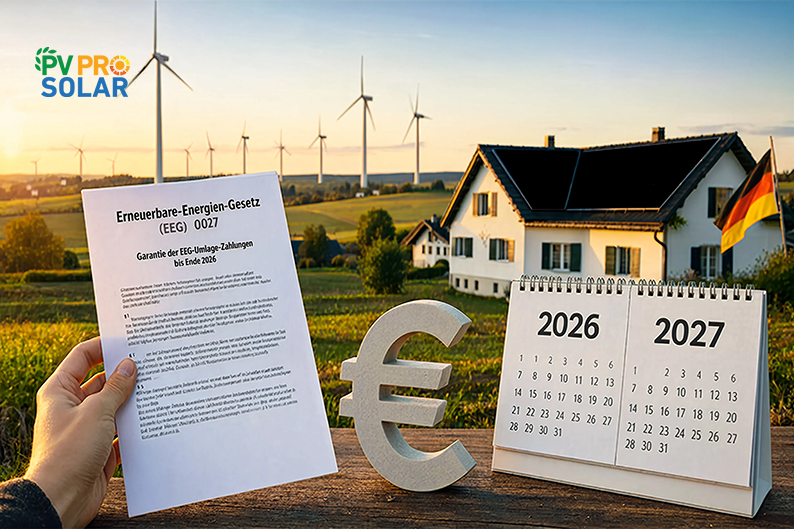
The most important solar funding for businesses in Hannover is the City of Hannover’s “Große Dächer” (large roofs) grant: €100 per kWp for conventional modules, up to €40,000 per building address, and €400 per kWp for lightweight PV on roofs with limited load capacity, up to €80,000. It covers new systems of at least 75 kWp on existing non-residential buildings within the city limits. The funding period covers 2026 and 2027, and grants are approved while funds last. The order matters: apply first, then place the order. Before we quote, we check whether your roof meets the conditions, and we supply the technical documents for the application. Request a free, no-obligation quote now, ideally with the building address, your annual electricity consumption and a photo or plan of the roof.
PVPro Solar GmbH
Bedarf klären · Daten senden · Angebot erhalten
Jetzt Anfrage sendenBedarf klären
Schritt 1
Daten senden
Schritt 2
Angebot erhalten
Schritt 3
“Große Dächer” funding: key facts
| Item | Rule according to the funding guideline |
|---|---|
| Funding body | City of Hannover, administered by BEKS EnergieEffizienz GmbH |
| Buildings | existing non-residential buildings in the city of Hannover (at least five years old), plus residence halls for students, seniors and other special groups run commercially or by a non-profit operator |
| Minimum size | 75 kWp; an additional facade PV system may be counted towards it |
| Conventional modules | €100/kWp, max. €40,000 per building address |
| Lightweight PV | €400/kWp, max. €80,000 per building address, only if the roof cannot carry conventional modules |
| Facade PV | €100/kWp, in addition to a large rooftop system |
| Upper limit | no more than 70% of the eligible costs |
| Extension | eligible from 35 kWp of added capacity according to the City of Hannover (the BEKS programme page states 50 kWp, clarify in advance), existing system keeps running; replacing a system on the same area is not |
| Exclusions | new buildings, roofs containing asbestos, used components, DIY work |
| Period | funding years 2026 and 2027, while funds last |
| Application | online with BEKS, before placing the order |
Source: funding guideline “PV auf großen Dächern”, version 2, valid from 1 August 2026 (German). This version lowered the minimum size from 100 to 75 kWp.
Who is eligible for solar funding for businesses in Hannover
Buildings: commercial, halls, residence halls
Solar funding for businesses in Hannover under this programme covers systems on non-residential buildings as defined by the German Building Energy Act (GEG), such as production and storage halls, office buildings, workshops or retail units. Newly included are residence halls for students and seniors if they are run commercially or by a non-profit operator. The building must be at least five years old, based on the date of the building completion notice. Ordinary residential buildings are not covered; they have their own grants, which we summarise under solar funding in Hannover.
Who can apply: owners, long-term tenants, contractors
The building owner can apply, whatever the legal form. Tenants or leaseholders are also eligible if their right of use is secured for at least 25 years from the application date, for example by a lease, a heritable building right or a land register entry. A contracting model is possible too, provided the electricity is available to the building user after the contract ends. BEKS asks for a current land register extract or the relevant contract as proof.
Minimum technical requirements
According to the Region Hannover solar cadastre or a yield simulation, the roof area must reach at least 650 kWh per kWp per year. Modules need the IEC 61215 and IEC 61730 test certificates; only new, market-standard components qualify, installed and connected by a specialist company. The grid connection must follow the technical connection conditions (TAB) of enercity Netz, and proof of the system’s registration is required. Roofs containing asbestos are excluded, so this has to be clarified before planning.
How much solar funding for businesses in Hannover is worth
With this solar funding for businesses in Hannover, the grant is based on installed capacity in kWp. You reach the maximum amounts at 400 kWp with conventional modules and at 200 kWp with lightweight PV. For most hall roofs between 75 and 150 kWp the rule is simply: capacity times funding rate.
| Example system | Funding rate | Grant |
|---|---|---|
| 75 kWp, conventional modules | €100/kWp | €7,500 |
| 150 kWp, conventional modules | €100/kWp | €15,000 |
| 120 kWp, lightweight PV (roof cannot carry standard modules) | €400/kWp | €48,000 |
| 60 kWp roof + 20 kWp facade, conventional | €100/kWp | €8,000 |
Lightweight means modules or films with a module weight of no more than 8 kg/m² and a total load on the roof of no more than 16 kg/m², including mounting structure, ballast and cabling. The higher rate only applies if the lightweight design is actually required because of limited load capacity. This is usually proven by a structural assessment.
Which costs count and which don’t
Eligible costs are the modules or films with their electrical connections, the mounting structure, delivery and installation, the inverter, the connection to the nearest possible grid connection point, and the grid operator’s charges for registration and connection. Not eligible are planning costs, reinforcing or converting the roof, and VAT where you can reclaim it as input tax. For a business entitled to deduct input tax, the grant is therefore calculated on net amounts. A battery storage system does not appear in the list of eligible costs.
What the grant means for profitability
Take our worked example of a hall with continuous load from the article commercial photovoltaics in Hannover: 150 kWp, modelled at around €165,000 to €195,000 net installed, around €23,200 in savings and revenue per year, assuming 20 cents per kWh for commercial electricity and 6 cents per kWh in direct marketing. Without the grant, the system pays for itself after about 7 to 8 years. With €15,000 from “Große Dächer”, the investment falls by around 8 to 9%, and the system is paid off about eight months earlier. With lightweight PV the effect is much larger, because the funding rate is four times as high. At these sizes the 70% limit makes practically no difference.
Want to know what this means for your roof? Request a free, no-obligation quote now. We calculate the system, the grant and the payback with your real electricity tariff.
Special cases for solar funding for businesses in Hannover
Solar obligation under § 32a NBauO
If a solar system has to be installed anyway, for example because the roof covering is being fully renewed and the Lower Saxony solar obligation under § 32a NBauO applies, the mandatory part is not eligible. Only the capacity you install beyond the legally required size is funded. In the application you therefore show the mandatory area and the additional area separately. New buildings are excluded entirely, because only existing buildings are funded.
Extending an existing system
If there is already a smaller system on the roof, an extension is eligible if at least 35 kWp is added and the existing system keeps running for as long as technically possible. The BEKS programme page currently states a different minimum of 50 kWp for extensions, so clarify with BEKS before you apply which minimum applies to your extension. Replacing old modules on the same area is not funded.
Our part in your solar funding for businesses in Hannover
Systems up to 150 kWp, sized to your load profile
We plan and install commercial systems up to around 150 kWp, which is exactly the range where solar funding for businesses in Hannover starts for many halls. We size the system according to your load profile and roof area. If a system of 75 kWp or more doesn’t pay off for your business, we tell you so rather than planning a bigger system just because of the grant.
Structural check and grid connection before the fixed price
We check whether your roof can carry conventional modules before we fix the price. If the load capacity isn’t sufficient, we discuss with you case by case whether a lightweight solution is an option. We coordinate the grid connection with enercity Netz according to their technical connection conditions.
The technical documents for BEKS
For the application you need a qualified quote from a specialist company, a dimensioned roof sketch showing the planned module layout, the module data sheets with the IEC certificates and a yield calculation. We prepare these documents together with the quote. We install modules from AIKO, JA Solar or Longi, inverters from Fronius and mounting systems from K2 Systems, including for flat roofs. Read more about installation on hall roofs under photovoltaic installation on flat roofs.
Our own technicians, fixed price and 30/70
Installation and electrical work are carried out by our own certified technicians. This also matters for the grant, because the guideline excludes DIY work and requires a recognised specialist company for every step. You receive net prices as a fixed price and pay according to the 30/70 model: 30% on order, 70% after installation. After commissioning, we give you the acceptance report, the final invoice and the documents for registration in the Marktstammdatenregister (market master data register), which you need for the proof of use.
Solar funding for businesses in Hannover: how the BEKS application works
- Check the conditions: building within the city, at least five years old, no asbestos, yield of at least 650 kWh/kWp, at least 75 kWp.
- Get a quote and documents: qualified quote, dimensioned roof sketch, module data sheets with IEC 61215 and IEC 61730, yield calculation and, if the solar obligation applies, a drawing of the mandatory and additional areas.
- Apply: you send the documents, together with proof of ownership or right of use and the de minimis declaration, as PDFs by email to BEKS and then complete the online application form. According to BEKS, you usually receive a confirmation within a few days.
- Wait for approval: only then do you place the order. If that isn’t possible, you can informally apply for an early project start, which is not yet a funding commitment.
- Install and commission: installation, connection and registration with the grid operator and in the Marktstammdatenregister.
- Submit proof of use: within one year of approval, the final invoice, acceptance report, the grid operator’s commissioning report and an extract from the Marktstammdatenregister. The grant is then paid out.
The funded system must be operated for at least five years from commissioning, otherwise the city can reclaim the grant. There is no legal entitlement to funding; BEKS approves applications within the available budget. Details and the application form are on the BEKS programme page (German).
Combining solar funding for businesses in Hannover
The guideline allows other investment grants for PV to be used for the same project, as long as their rules permit it and all funding together does not exceed the proven costs.
- KfW loan 270: a low-interest loan for companies of any legal form, not a grant. You apply through your bank, and here too you must apply before the project starts. More at KfW.
- Region Hannover Dach-Solar: also for non-residential buildings, but only if the roof is insulated at the same time. If you are planning a renovation anyway, read solar panels and roof renovation.
- proKlima DachVollToll: applies only to residential buildings and is not an option for a commercial hall.
- Taxes: systems over 30 kWp on purely commercial buildings are subject to 19% VAT, which you can reclaim as input tax. We explain depreciation and the investment deduction in the article commercial photovoltaics in Hannover, and VAT in detail under photovoltaic system VAT.
If your business is outside the city limits, for example in Garbsen, Laatzen or Langenhagen, “Große Dächer” does not apply. For an overview of all programmes, see our article on solar subsidies.
Conclusion: solar funding for businesses in Hannover
As solar funding for businesses in Hannover, “Große Dächer” pays off above all for halls and commercial buildings within the city that have at least 75 kWp of potential, and most of all on roofs with limited load capacity, where the lightweight rate of €400 per kWp applies. The most common mistake is placing the order before applying. We check your roof, calculate the system and grant with your real figures and supply the documents for BEKS. Request a free, no-obligation quote now, call us on 0511 3360603 or message us on WhatsApp.
Note: This article provides a general overview (as of October 2026) and does not replace tax or legal advice. Funding conditions may change; the City of Hannover’s funding guideline in force at the time is authoritative.
Frequently asked questions about the “Große Dächer” grant
Who can get the Große Dächer grant in Hannover?
Owners, long-term tenants or leaseholders with a right of use secured for at least 25 years, and contracting companies, for new PV systems of at least 75 kWp on existing non-residential buildings in the city of Hannover. Residence halls for students and seniors run commercially or by a non-profit operator are also eligible. The building must be at least five years old.
How much is the grant per kWp?
€100 per kWp for conventional modules, up to €40,000 per building address. €400 per kWp for lightweight PV if the roof cannot carry standard modules, up to €80,000. Facade PV in addition to the rooftop system at €100 per kWp. In every case no more than 70% of the eligible costs.
Do I have to apply before placing the order?
Yes. Only systems that have not yet been ordered or started at the time of application are eligible. You may get a non-binding quote beforehand; it is actually one of the required documents. If you need to start earlier, you can apply to BEKS for an early project start and place the order only after it has been approved.
Is extending an existing PV system eligible?
Yes, if at least 35 kWp is added and the existing system keeps running. Replacing old modules on the same area is not funded. The BEKS programme page states a different minimum of 50 kWp for extensions, so clarify the minimum with BEKS in advance.
Does the grant apply if the solar obligation under § 32a NBauO applies?
Only partly. In that case only the part of the system that goes beyond the legally required size is funded. The application shows the mandatory area and the additional area separately. New buildings are excluded in general.
Can I combine Große Dächer with KfW 270 or Dach-Solar?
In principle, yes. The guideline allows further investment grants for PV as long as their rules permit it and all funding together does not exceed the proven costs. The KfW 270 is a loan, not a grant. Region Hannover Dach-Solar is only available if the roof is insulated at the same time.
Which documents does PVPro Solar provide for the application?
The qualified quote as a specialist company, a dimensioned roof sketch with the module layout, the module data sheets with the IEC 61215 and IEC 61730 certificates, and a yield calculation. After installation you receive the acceptance report, the final invoice and the documents for registration in the Marktstammdatenregister for the proof of use.
Is the grant also available outside the city of Hannover?
No. Große Dächer only applies to buildings within the city of Hannover. In the surrounding municipalities of the region, the main options are the KfW loan 270 and, if the roof is insulated at the same time, Region Hannover Dach-Solar.
PVPro Solar GmbH
In 3 Schritten zur PV-Anfrage
Bedarf klären · Daten senden · Angebot erhalten
Jetzt Anfrage sendenBedarf klären
Schritt 1
Daten senden
Schritt 2
Angebot erhalten
Schritt 3