

Rooftop Solar Systems: Suitability, Mounting, Costs and Permits
Diese Seite ist auch auf Deutsch verfügbar
Artikel auf Deutsch lesen
For most homeowners, their own roof is the best place for a solar system: the space is already there, the modules bother nobody, and the power is generated where you use it. But not every roof is equally suitable. This guide explains what matters for a rooftop solar system: orientation, pitch, roof covering and condition, on-roof or in-roof mounting, costs, permits and the process.
Want to know whether your roof is suitable for a solar system? Request your free, no-obligation quote now. Our roof analysis is free of charge.
PVPro Solar GmbH
Bedarf klären · Daten senden · Angebot erhalten
Jetzt Anfrage sendenBedarf klären
Schritt 1
Daten senden
Schritt 2
Angebot erhalten
Schritt 3
Rooftop Solar: Key Facts at a Glance
| Question | Answer |
|---|---|
| Best orientation | south, but east and west also deliver about 80% of the best value in Hanover |
| Ideal pitch | approx. 30–45 degrees; 15 to 30 degrees also work well |
| Area for 10 kWp | approx. 50–60 m² |
| Additional weight | approx. 15–20 kg per m² on a pitched roof |
| Costs | approx. €1,450–1,750 per kWp without a battery, 0% VAT |
| Permit | usually not needed in Lower Saxony, except for listed buildings |
Which Roofs Are Suitable for a Solar System?
- Orientation: south gives the highest yield per module. East- and west-facing roofs deliver a little less but spread the power better across the day, which is good for self-consumption. On an east-west gable roof, both sides can be covered.
- Pitch: about 30 to 35 degrees is ideal. Flatter and steeper roofs work too, with only a slight drop in yield. Flat roofs are covered using mounting frames; read more under solar installation on a flat roof.
- Shading: trees, dormers, chimneys or neighbouring houses can reduce the yield significantly. We account for this in planning, for example with a suitable module layout and string design.
- Area: with today’s modules, a 10 kWp system needs roughly 50 to 60 m² of usable roof area, depending on the module type and the clearances to the roof edge, ridge and fire walls.
Yield by Orientation and Pitch in Hanover
We calculated how strongly orientation and pitch affect the yield using the European Commission’s PVGIS tool for Hanover. The figures show the annual yield relative to the best option (south, 45 degrees = 100%):
| Orientation | 15° pitch | 30° pitch | 45° pitch |
|---|---|---|---|
| South | 94% | 99% | 100% |
| South-east | 91% | 94% | 94% |
| East | 83% | 81% | 77% |
| West | 82% | 80% | 75% |
| North | 70% | 57% | 44% |
In other words, east- and west-facing roofs are worthwhile too, especially at a shallower pitch. On a gable roof facing east-west, we usually cover both sides. A north side is only worthwhile at a shallow pitch and is usually left free. We deliberately set our standard value of about 893 kWh per kWp conservatively; we calculate the exact forecast for your roof in the quote.
Roof Covering and Condition: What to Check First
The common roof coverings are well suited to a PV system:
- Clay tiles and concrete roof tiles: the most common option. Roof hooks are fixed to the rafters under the tiles, and the roof stays watertight.
- Trapezoidal and standing-seam metal: special clamps or rails are mounted directly onto the metal.
- Slate and plain clay tiles: possible but more complex, so careful planning is important.
- Asbestos-containing roofs: installation on these is not allowed. The roof has to be renovated first.
The roof’s condition is at least as important. A PV system stays on the roof for 25 years or more. If a renovation is due in the next few years, do it before installation. Otherwise, you’ll have to have the system removed and reinstalled later. Read more under solar panels and roof renovation. Modules and the mounting system add about 15 to 20 kg per square metre on a pitched roof. We check the structure at the on-site visit, and for older roof frames with a structural engineer if needed.
On-Roof or In-Roof: Which Mounting Is Better?
On-roof mounting is the standard: the modules sit on a rail system above the existing roof covering. It’s proven, comparatively inexpensive and well ventilated, which helps the modules because they stay cooler. We install using the K2 Systems mounting system.
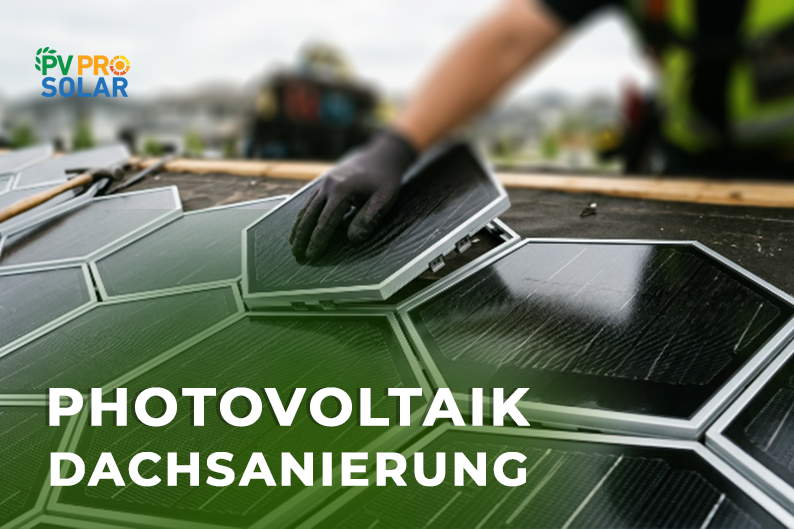
In-roof solutions and solar roof tiles replace all or part of the roof covering. They look more elegant and are sometimes an option for listed buildings, but they usually cost considerably more per kWp and are more complex. For most single-family homes, on-roof mounting is the more economical choice.
Your Rooftop System from PVPro Solar
Roof Analysis and Layout Plan
At the free on-site visit, we check your roof’s orientation, pitch, shading, covering and condition, and plan the layout so that distances to the edge, ridge and fire walls are kept and as much output as possible fits on the roof.
Mounting System to Suit the Roof Covering
We install with the K2 Systems on-roof system, using roof hooks for tiles and concrete roof tiles or clamps for metal roofs. The modules come from AIKO, JA Solar or Longi, the inverter from Fronius and, if you wish, the battery from BYD.
Our Own Specialists and a Fixed Price
Installation and electrical connection are carried out by our own certified technicians in line with VDE and TAB. You get a fixed price after the on-site visit and pay using the 30/70 model.
How Much Does a Rooftop Solar System Cost?
As a guide, we calculate about €1,450–1,750 per kWp for a fully installed on-roof system without a battery:
| System size | Guide price (modelled) |
|---|---|
| 6 kWp | approx. €8,700–10,500 |
| 8 kWp | approx. €11,600–14,000 |
| 10 kWp | approx. €14,500–17,500 |
| 10 kWp with BYD HVS 10.2 battery | approx. €22,200–26,700 |
Since 1 January 2023, the zero VAT rate has applied to supply and installation on or at residential buildings, so you pay 0% VAT. You’ll find more on cost factors under solar panel costs.
Want a fixed price for your roof? Request your free, no-obligation quote now.
How Much Power Does a Rooftop Solar System Produce?
In the Hanover region, we calculate about 893 kWh per kWp per year. A 10 kWp system therefore produces just under 9,000 kWh, more than a typical household uses. Self-consumption is what makes it pay: without a battery, a typical household uses about 25–35% of its solar power itself, and about 55–70% with a battery. Every self-consumed kilowatt-hour saves you grid electricity, which is 37 cents at an assumed price of 37 ct/kWh. Since 1 August 2026, power fed into the grid has earned about 7.70 ct/kWh. You’ll find an honest worked example under is solar worth it?
Do I Need a Permit for a Rooftop Solar System?
For a standard system on the roof of a residential building in Lower Saxony, you generally don’t need building permission. Conversely, since 2025 there has even been a solar obligation for new residential buildings and many major roof renovations (Section 32a NBauO). The main exception is heritage protection: then you need approval from the heritage protection authority first. Fire safety clearances also apply, for example to fire walls on terraced and semi-detached houses. You’ll find the details under PV fire separation rules in Lower Saxony. In addition, every system is registered with the grid operator and in the Market Master Data Register, and we handle that for you.
Funding for Your Rooftop Solar System
- 0% VAT on supply and installation on residential buildings
- No income tax on income from systems up to 30 kWp per residential unit (Section 3 No. 72 EStG)
- Feed-in tariff: fixed for 20 years for systems commissioned by 31 December 2026. According to the government’s draft EEG amendment 2027, it is set to fall significantly for new small systems after that.
- KfW 270 loan: low-interest financing, which is a loan and not a grant
- Regional: in Hanover and five neighbouring municipalities, proKlima funds fully covered roofs while funds last. According to proKlima, applications for 2026 are possible until 31 October 2026. You must apply before placing the order. Find out more under solar funding in Hanover.
- The Hanover Region’s Dach-Solar: if you insulate the roof at the same time, with €150 per m² of module area above the legal minimum and €50 per m² of insulation, from a calculated grant of €4,000. More under solar panels and roof renovation.
Maintenance and Care
PV systems need little maintenance. Rain usually cleans tilted modules well enough. Keep an eye on the yield in the app: if it drops for no obvious reason, for example due to heavy soiling or a fault, have the system checked. The electrical installation should be checked regularly by a qualified electrician, as is recommended for other electrical installations.
How Your Rooftop System Works with PVPro Solar
- Free initial consultation with roof analysis and yield forecast
- Technical planning: module selection (AIKO, JA Solar or Longi), layout and string design
- Fixed-price quote with a Fronius inverter, an optional BYD battery and the K2 Systems mounting system
- Installation by our own certified technicians, compliant with VDE and TAB
- Registration with the grid operator and in the Market Master Data Register
- Commissioning with app setup and system monitoring
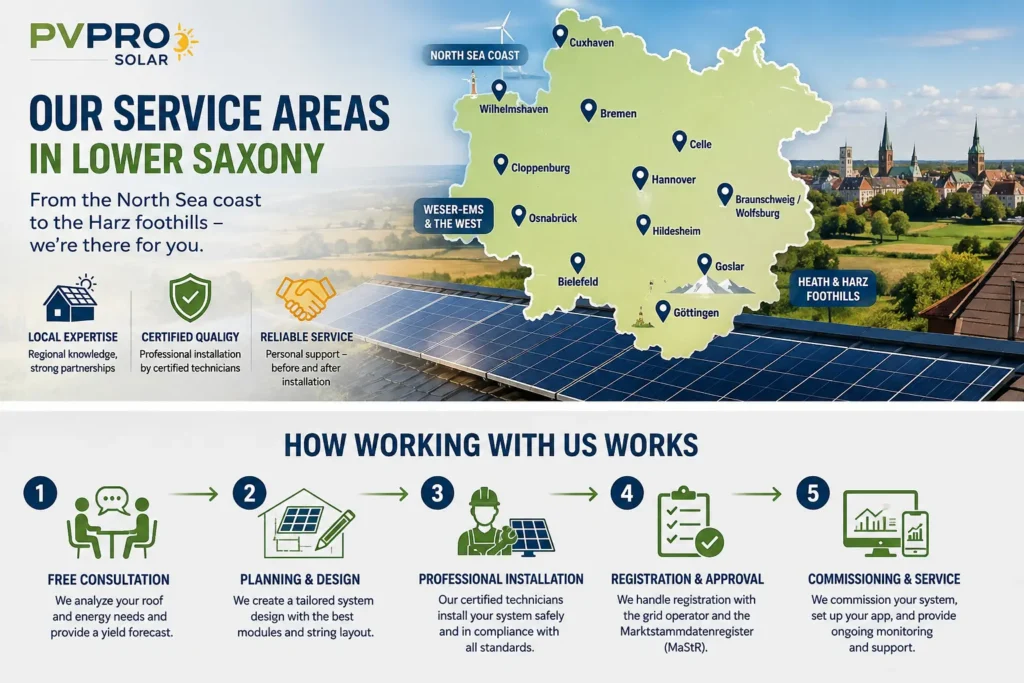
You pay using the 30/70 model: 30% when you place the order and 70% after installation. We install in Hanover, the surrounding region, throughout Lower Saxony and in Bremen.
Request your free, no-obligation quote now, or call us on +49 511 3360603 or message us on WhatsApp at +49 176 2399 8536.
Frequently Asked Questions About Rooftop Solar Systems
Do I need building permission for a rooftop solar system?
For a standard system on the roof of a residential building in Lower Saxony, generally not. With heritage protection, you need approval from the heritage protection authority first. Fire safety clearances, for example to fire walls, must be observed.
Which roof orientation is best?
South gives the highest yield per module. East- and west-facing roofs deliver a little less but spread the power better across the day, which increases self-consumption. On east-west gable roofs, both sides can be covered.
How much roof area do I need for 10 kWp?
With today's modules, roughly 50 to 60 m² of usable roof area, depending on the module type and the required clearances to the roof edge, ridge and fire walls.
Should I renovate the roof before installing solar?
If a renovation is due in the next few years, yes. A PV system stays on the roof for 25 years or more, and removing and reinstalling it for a later renovation costs unnecessary money.
Which is better, on-roof or in-roof?
For most single-family homes, on-roof mounting: it's proven, cheaper and well ventilated. In-roof solutions and solar roof tiles look more elegant but usually cost considerably more per kWp.
Can a rooftop solar system make me self-sufficient?
Not completely over the whole year, because there's little sun in winter. With a battery, though, you can generate a large share of your own power and cut your electricity costs significantly.
Is a solar system worthwhile on an east- or west-facing roof?
Yes. According to PVGIS calculations for Hanover, east- and west-facing roofs deliver about 80% of the yield of the best south orientation at a 30-degree pitch, and over 80% at 15 degrees. In return, the power is spread better over the day, which increases self-consumption.
How much weight does a solar system add to the roof?
On a pitched roof with on-roof mounting, about 15 to 20 kg per square metre for the modules and mounting system. We check the structure at the on-site visit, with a structural engineer for older roof frames if needed.
Note: This article provides a general overview (as of October 2026) and does not replace tax or legal advice.
PVPro Solar GmbH
In 3 Schritten zur PV-Anfrage
Bedarf klären · Daten senden · Angebot erhalten
Jetzt Anfrage sendenBedarf klären
Schritt 1
Daten senden
Schritt 2
Angebot erhalten
Schritt 3