
Energy Management System: How to Make the Most of Your Solar Power
Diese Seite ist auch auf Deutsch verfügbar
Artikel auf Deutsch lesen
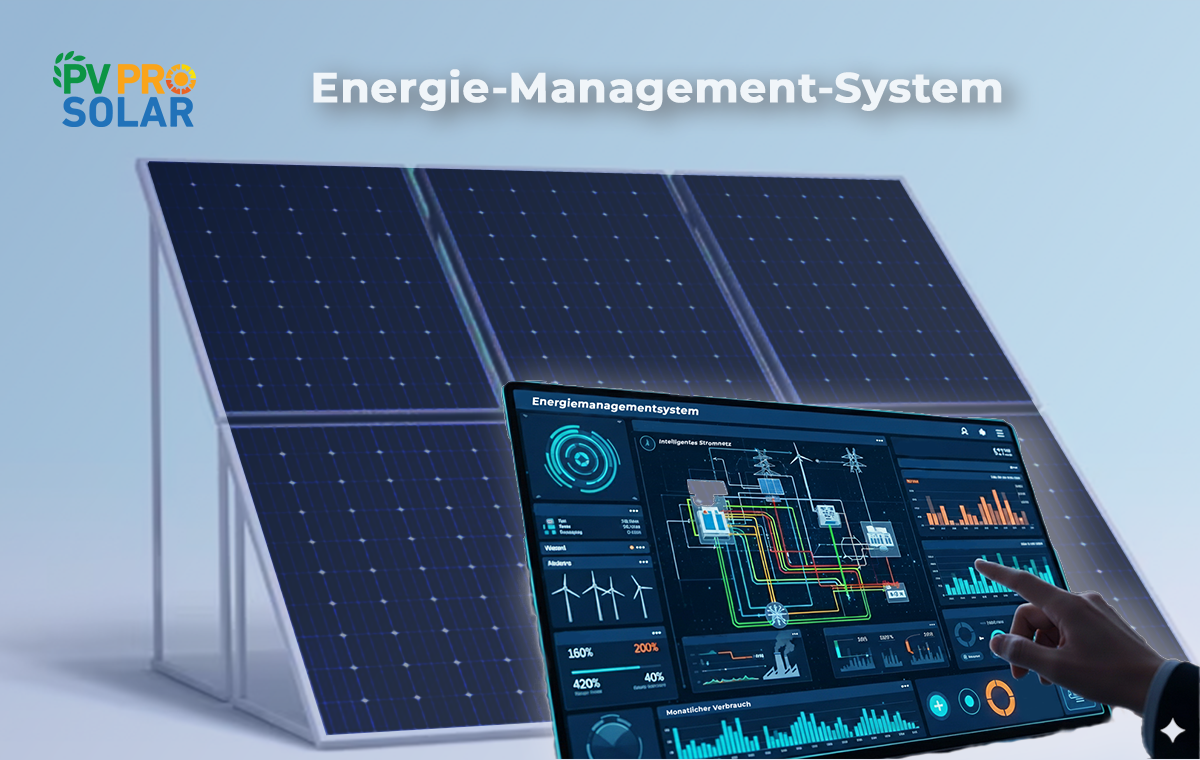
A PV system produces most of its power around midday, but you need electricity in the morning, in the evening and for large loads such as a wallbox or heat pump. An energy management system makes sure your solar power ends up where it brings you the most: first in the house, then in the battery or the electric car, and only last in the grid. Here you’ll learn how it works, what it brings and what has become part of it since the German Solar Peak Act and § 14a EnWG.
Planning a PV system with battery, wallbox or heat pump? Request your free, no-obligation quote now.
PVPro Solar GmbH
Bedarf klären · Daten senden · Angebot erhalten
Jetzt Anfrage sendenBedarf klären
Schritt 1
Daten senden
Schritt 2
Angebot erhalten
Schritt 3
Energy Management System: Key Facts at a Glance
| Question | Answer |
|---|---|
| Purpose | distributes solar power automatically: home, battery, wallbox, heat pump, grid last |
| Value of a kWh | used yourself approx. 37 ct, fed in approx. 7.70 ct |
| Self-consumption | approx. 25–35% without a battery, approx. 55–70% with one |
| Basic functions | often already included in a hybrid inverter with a smart meter |
| § 14a EnWG | Module 1 approx. €110–190 a year flat rate, Module 2 60% lower grid fee in the energy price |
| Solar Peak Act | max. 60% feed-in without a control box; an EMS with a battery largely offsets this |
What Is an Energy Management System?
An energy management system (EMS) continuously measures how much power your PV system produces and how much your household is using. Based on this data, it automatically decides where the power goes. The basis is a meter at the grid connection point, the inverter’s smart meter, which records grid consumption and feed-in in real time.
The order is always similar:
- Solar power first supplies the devices that are currently running.
- Surplus power charges the battery.
- When the battery is full, flexible loads such as the wallbox, immersion heater or heat pump get the power.
- Only what is left after that is fed into the grid.
What an Energy Management System Brings
Every kilowatt-hour you use yourself replaces expensive grid power. Power fed into the grid, by contrast, earns only about 7.70 ct/kWh (systems up to 10 kWp commissioned since 1 August 2026). At an assumed electricity price of 37 ct/kWh, every self-consumed kilowatt-hour is worth almost five times as much.
Without storage, a typical household uses about 25 to 35% of its solar power itself, and about 55 to 70% with storage. Good energy management helps reach these values, and with a wallbox or heat pump it often gets even more out of your system. Exactly how much depends on your consumption profile. There are no reliable flat-rate figures for this.
Which Devices an Energy Management System Controls
- Battery storage: charging when there is a surplus, discharging when needed. More under buy a PV system with storage.
- Wallbox: with PV surplus charging, the electric car gets exactly the power that is currently left over. More under home wallbox installation.
- Heat pump: via an SG Ready interface, the heat pump can produce more heat when there is a solar surplus and store it in the buffer tank or hot water. More under combining a PV system with a heat pump.
- Immersion heater: a controllable heating element turns surplus power into hot water, a simple solution without a heat pump.
- Household appliances: smart plugs or connected appliances can start when there is a surplus. Often, though, simply setting the washing machine and dishwasher to run at midday is enough.
Energy Management with Fronius and BYD
We install the Fronius GEN24 Plus hybrid inverter with a Fronius Smart Meter and, on request, a BYD battery. The inverter already handles the basic functions of energy management: it controls charging and discharging of the battery, limits feed-in when required and can integrate further loads via its interfaces.
In the app and the Fronius Solar.web portal, you can see generation, consumption, battery level and feed-in at a glance. For many single-family homes, that is enough. If a wallbox, heat pump and dynamic electricity tariff come together, an additional energy manager can make sense. We clarify this during planning. How a forecast-based battery works is explained under AI-controlled solar storage.
Solar Peak Act and § 14a EnWG: Why Control Is Becoming Mandatory
Energy management is no longer just about convenience. Two rules make controllability important for new systems:
- Solar Peak Act (since 25 February 2025): new PV systems without a smart metering system and control box may feed in at most 60% of their module output. When exchange electricity prices are negative, new systems receive no feed-in tariff. If you use or store your power yourself during these hours, you lose hardly anything.
- § 14a EnWG (since 1 January 2024): newly connected wallboxes and heat pumps above 4.2 kW are controllable consumption devices. The grid operator may temporarily limit their output to 4.2 kW if the grid is at risk of overload. In return, you pay reduced grid fees.
An energy management system with storage ensures that the 60% limit costs hardly any yield in everyday use, because midday peaks flow into the house, the battery or the car instead of the grid. What may still change with the planned EEG amendment 2027 is explained under EEG amendment.
For § 14a EnWG, you choose between two modules: Module 1 gives a flat-rate reduction in grid fees of about €110 to €190 a year, depending on the grid area. With Module 2, the grid-fee share of the energy price drops by 60%, but the heat pump or wallbox needs a separate meter. An energy management system can apply the grid operator’s control signal to several devices together and distribute the available power so that you hardly notice it in everyday life. More on the modules under combining a PV system with a heat pump.
Dynamic Electricity Tariffs
Since 2025, all electricity suppliers in Germany must offer a dynamic tariff whose price follows the power exchange. With a smart metering system, an energy management system can then, for example, charge the electric car or the battery during cheap hours. Whether a dynamic tariff pays off for you depends on your consumption and flexibility. It is often interesting for households with PV, battery and electric car, less so for others. An analysis by HTW Berlin shows that charging the battery with cheap grid power only pays off if the system’s losses are below about 29%. A good energy management system factors this in and does not charge at every small price difference.
Energy Management for Businesses
In businesses, load peaks also matter. For customers with power metering, the highest quarter-hour output in the year determines part of the grid costs. An energy management system can control large loads such as charging points, refrigeration or compressed air systems so that peaks fall and more solar power is used on site. More about PV systems for companies under commercial photovoltaics in Hanover.
Looking Ahead: Bidirectional Charging
In future, electric cars are meant not only to charge but also to return power to the house or the grid (vehicle-to-home and vehicle-to-grid). So far, only a few vehicles and wallboxes support this, and the legal framework is still being developed. If you are planning a system now, focus on open interfaces and expandability.
How Much Does an Energy Management System Cost?
It depends on what is already in place. Roughly, there are three levels:
| Solution | What it does | Additional cost (rough guide) |
|---|---|---|
| Hybrid inverter with smart meter | battery, feed-in limitation, monitoring via app | none, included with a PV system with battery |
| Additional energy manager | wallbox, heat pump, immersion heater and dynamic tariff in one system | often a few hundred to about €1,500, depending on device and effort |
| Smart metering system and control box | control by the grid operator, required for dynamic tariffs | annual fee of the metering operator, capped by law |
Whether an additional energy manager pays off for you depends on how many flexible consumers you have. For a single-family home with PV and a battery, the inverter is usually enough. Once a wallbox and heat pump are added, the benefit rises significantly. What a PV system with a battery costs overall is explained under buying a PV system with storage.
What to Look for When Planning
- Compatibility: inverter, battery, wallbox and heat pump must be able to communicate with each other.
- Meter in the right place: without measurement at the grid connection point, no system can control sensibly.
- Simplicity: a system you understand and use brings more than one with many functions that nobody sets up.
- Expandability: plan for a wallbox or heat pump, even if they come later.
Your Energy System from PVPro Solar
We plan and install the PV system, battery, wallbox and heat pump as a coordinated system in Hanover and throughout Lower Saxony, with our own certified technicians and a written fixed price. What is possible in combination is shown on our page photovoltaics with heat pumps and wallboxes.
Request your free, no-obligation quote now, or call us on +49 511 3360603 or message us on WhatsApp at +49 176 2399 8536.
As of October 2026. Legal rules and tariffs change regularly.
What does an energy management system do?
It continuously measures generation and consumption and distributes your solar power automatically: first to the devices currently running, then to the battery, wallbox or heat pump, and only last to the grid.
Do I need a separate energy management system?
Not always. The Fronius GEN24 Plus we install already controls the battery and feed-in with its smart meter. If a wallbox, heat pump and dynamic tariff come together, an additional energy manager can make sense.
What does the Solar Peak Act have to do with energy management?
New PV systems without a smart metering system and control box may feed in only 60% of their module output, and there is no tariff when exchange prices are negative. An energy management system with storage uses midday peaks in the house, so hardly any yield is lost.
What does § 14a EnWG mean for wallboxes and heat pumps?
Newly connected wallboxes and heat pumps above 4.2 kW are controllable. The grid operator may temporarily limit their output to 4.2 kW if the grid is at risk of overload. In return, you pay reduced grid fees.
Does an energy management system pay off for private households?
Especially with a battery, wallbox or heat pump. At an assumed 37 ct/kWh, every self-consumed kilowatt-hour saves much more than the roughly 7.70 ct feed-in tariff. How much you save depends on your consumption profile.
Can I retrofit an energy management system?
Often yes, if the inverter and battery have suitable interfaces and a meter can be installed at the grid connection point. We check this during an on-site visit.
How much does an energy management system cost?
The basic functions are often already built into the hybrid inverter with a smart meter and cost nothing extra. An additional energy manager for a wallbox, heat pump and dynamic tariff often costs a few hundred to about €1,500, depending on the device and effort. Whether it pays off depends on your flexible consumers.
PVPro Solar GmbH
In 3 Schritten zur PV-Anfrage
Bedarf klären · Daten senden · Angebot erhalten
Jetzt Anfrage sendenBedarf klären
Schritt 1
Daten senden
Schritt 2
Angebot erhalten
Schritt 3