
Combining a PV System with a Heat Pump: How Homeowners in Hanover Can Maximize Their Savings Potential

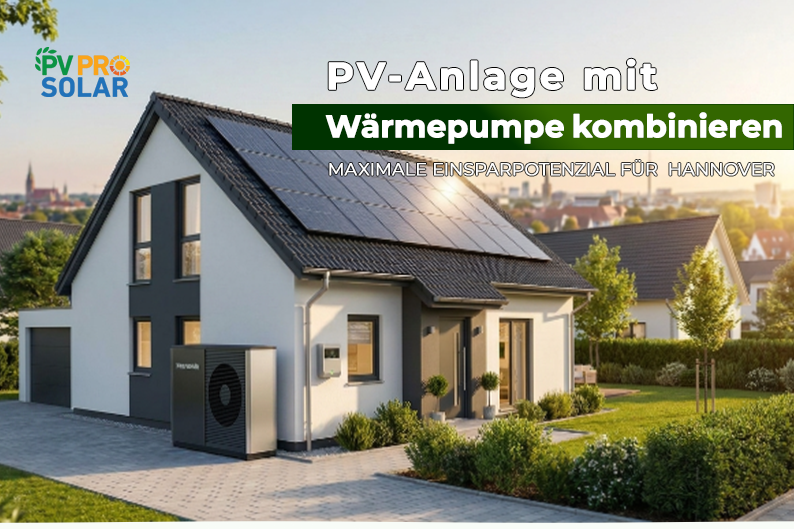
Rising energy prices are placing an increasing burden on households in Hanover, especially when heating and electricity are billed separately at high rates. By combining a photovoltaic (PV) system with a heat pump, homeowners can create an intelligent energy solution in which both technologies complement each other perfectly: self-generated solar power operates the heat pump, enabling heating at minimal cost. The result is significantly lower operating expenses, a much higher level of self-consumption, and genuine independence from the public power grid, both now and in the future.
PVPro Solar GmbH
In 3 Schritten zur PV-Anfrage
Bedarf klären · Daten senden · Angebot erhalten
Jetzt Anfrage sendenBedarf klären
Schritt 1
Daten senden
Schritt 2
Angebot erhalten
Schritt 3
Why Does a PV System Work So Effectively with a Heat Pump?
The combination of a PV system and a heat pump is far more than a marketing trend; it is one of the most technically and economically efficient energy solutions currently available for homeowners in Hanover. The principle is simple yet highly effective: during the day, the photovoltaic system generates solar electricity, which directly powers the heat pump. Instead of purchasing expensive grid electricity, the home produces its own heating energy, emission-free and without ongoing fuel costs.
What makes this synergy especially powerful is the ability to maximize self-consumption. Every kilowatt-hour of solar electricity used directly by the heat pump translates into immediate savings on electricity bills. In addition, heat pumps operate with a high Coefficient of Performance (COP), typically between 3 and 5, meaning that one kilowatt-hour of electricity can generate three to five kilowatt-hours of heat. Combined with a PV system, this creates a highly efficient energy cycle that delivers measurable savings month after month.
For homeowners in Hanover, this means that on sunny days the solar system often generates more electricity than the household requires. The surplus energy can either power the heat pump directly or be stored in a battery system for later use. The result is an efficient, future-proof energy solution designed for long-term savings.
How Much Electricity Does a Heat Pump Require, and How Much Can a Solar System Provide?
This is one of the most important questions homeowners ask before investing in a combined PV and heat pump system. A typical air-to-water heat pump for a single-family home requires approximately 3,000 to 6,000 kilowatt-hours of electricity per year, depending on household size, building insulation, and heating demand. By comparison, a well-sized 10 kWp photovoltaic system in Hanover can generate around 9,000 to 10,000 kWh annually.
This means that a properly designed PV system can fully cover the electricity demand of the heat pump while also supplying power for general household use. Experts recommend sizing the system according to the combined requirements for heating, domestic hot water, and everyday electricity consumption. General recommendations include:
- Small homes up to 120 m²: 7–10 kWp PV system + 6–8 kW heat pump
- Medium-sized homes up to 180 m²: 10–14 kWp PV system + 8–12 kW heat pump
- Large properties above 200 m²: 15+ kWp PV system + high-capacity heat pump
An intelligent energy management system can automatically control when the heat pump operates, prioritizing periods when the photovoltaic system is producing surplus electricity. This ensures that no solar energy goes to waste.
What Subsidies Are Available in Hanover for a PV System with a Heat Pump?
For homeowners in Hanover, the financial incentives are particularly attractive. Federal, state, and regional programs support the installation of combined PV and heat pump systems, and when these incentives are strategically combined, investment costs can be reduced significantly.
KfW Funding (Federal Funding for Efficient Buildings – BEG)
Under the BEG program, grants of up to 70% of eligible costs may be available when a heat pump is installed as the primary heating system. KfW funding is especially attractive for renovation projects and new construction.
BAFA Subsidies
The Federal Office for Economic Affairs and Export Control (BAFA) provides subsidies covering up to 35% of heat pump investment costs. Additional bonuses may apply when renewable energy sources such as solar power are integrated into the system.
Tax Advantages
Since January 2023, photovoltaic systems in Germany benefit from a 0% VAT rate, reducing acquisition costs immediately and without additional bureaucracy.
Hanover Utility Providers
Regional energy providers in Hanover often offer special feed-in tariffs and self-consumption incentives for homeowners operating a PV system with a heat pump. It is worth contacting local providers directly, as conditions and programs may change regularly.
By combining government subsidies with optimized self-consumption, a PV system paired with a heat pump has become one of the most economically attractive investments for property owners in Hanover.
How to Plan the Ideal PV System with a Heat Pump for a Home in Hanover?
Proper planning is the key to maximizing savings. Simply operating a solar system and heat pump side by side without intelligent integration can result in significant missed potential. A structured planning process generally includes the following steps:
Step 1 – Analyze Energy Demand
Determine annual electricity consumption, heating demand, and whether domestic hot water will also be supplied by the heat pump. These figures define the optimal system size.
Step 2 – Evaluate Roof Orientation and Available Space
South-facing and southwest-facing roofs are ideal for photovoltaic systems in Hanover. East-west roof configurations can also be highly effective because they distribute solar production more evenly throughout the day, which particularly benefits heat pump operation.
Step 3 – Correctly Size the System
The PV system should ideally cover at least 60–70% of total electricity demand. Professional planners calculate the optimal size using actual consumption data and local solar irradiation levels.
Step 4 – Integrate Battery Storage
A battery storage system allows solar electricity to be used during the evening and nighttime hours. As a result, the heat pump can continue operating with self-generated electricity even after sunset instead of relying on expensive grid power.
Step 5 – Install an Energy Management System
Modern energy management systems automatically regulate the electricity flow between the photovoltaic system, battery storage, and heat pump. This transforms the setup into a fully automated energy solution optimized around the clock.
What Role Does Battery Storage Play in a PV System with a Heat Pump?
Battery storage serves as the critical link between solar energy production and heat pump operation. Without storage, solar electricity can only be used during daylight hours, while excess electricity is fed into the grid at comparatively low compensation rates. With battery storage, surplus electricity is stored and released precisely when it provides the greatest value.
In Hanover, where the heating season typically lasts from October through April and solar generation is lower during winter months, a battery capacity of 8 to 15 kWh is often highly beneficial. A well-designed combination of PV system, heat pump, and battery storage can reduce the overall payback period to less than ten years.
Battery storage also significantly improves overall energy efficiency. The self-consumption rate can increase from approximately 30–40% without storage to as much as 70–80% with storage. This means reduced dependence on the power grid, lower energy costs, and far greater control over household energy supply.
Homeowners who fully commit to renewable energy by integrating photovoltaic systems, heat pumps, and battery storage create a stable and economically efficient energy solution that remains resilient even as electricity prices continue to rise.
Conclusion
Homeowners in Hanover who combine a PV system with a heat pump are making a smart and future-oriented investment. Energy costs are reduced, carbon emissions decrease, and dependence on the public electricity grid is significantly minimized. With attractive KfW funding programs and professional system planning, the investment often pays for itself in less than ten years.
Take the first step today by visiting PVPro Solar GmbH and securing your free, no-obligation initial consultation. Your savings potential is waiting.
Yes. Especially between March and September, a properly sized PV system can cover a large portion, or even the entire electricity demand, of a heat pump. During winter months, battery storage systems and intelligent electricity tariffs help reduce remaining energy costs.
For many single-family homes in Hanover, an air-to-water heat pump is the most practical solution. It is flexible, relatively easy to retrofit, and works exceptionally well with a photovoltaic system. The ideal choice ultimately depends on the building and the household’s energy consumption. Can a PV system fully power a heat pump?
Which heat pump works best with a solar system in Hanover?
PVPro Solar GmbH
In 3 Schritten zur PV-Anfrage
Bedarf klären · Daten senden · Angebot erhalten
Jetzt Anfrage sendenBedarf klären
Schritt 1
Daten senden
Schritt 2
Angebot erhalten
Schritt 3