
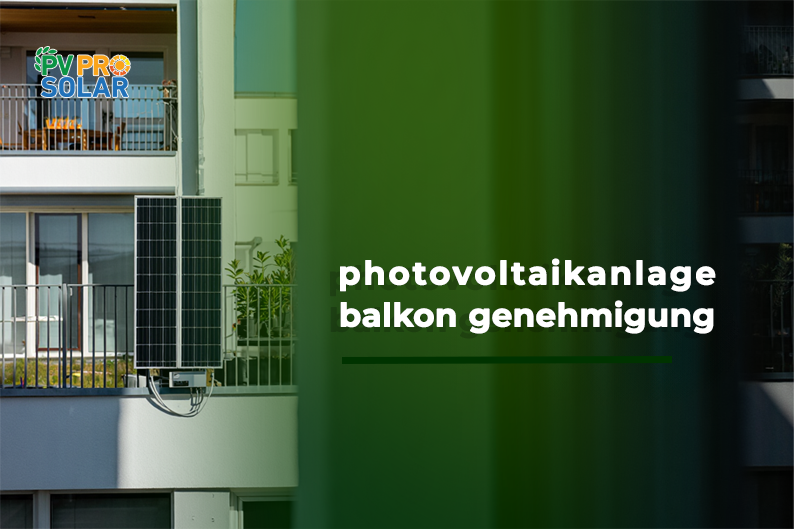
Balcony Photovoltaic System Approval: What Do You Need to Consider Before Installation?
Diese Seite ist auch auf Deutsch verfügbar
Artikel auf Deutsch lesen
In most cases, balcony photovoltaic system approval from an authority is not required in Germany, but you do have to register the system and often need the consent of others. Since the Solarpaket I, a balcony power plant with up to 800 VA inverter output and 2 kW module output only has to be registered in the Marktstammdatenregister (MaStR, the federal market master data register). Since October 2024, tenants and flat owners have a legal right to permission. We are a photovoltaic installer from Hannover, and this guide explains which approval you really need, who has to agree and where the limits are.
PVPro Solar GmbH
Bedarf klären · Daten senden · Angebot erhalten
Send request nowBedarf klären
Step 1
Send details
Step 2
Get your quote
Step 3
Balcony photovoltaic system approval: key facts
| Permit from an authority | usually not needed; exceptions for listed buildings or local design rules |
| Output limits | up to 800 VA inverter output and up to 2 kW module output (Section 8 (5a) EEG) |
| Registration | only in the MaStR, free of charge, within one month of commissioning |
| Grid operator | no separate notification any more; the operator receives the data from the register |
| Old electricity meter | may keep running until it is replaced (Section 10a EEG) |
| Tenants | right to permission under Section 554 BGB; refusal only if unreasonable for the landlord |
| Owners’ association | right under Section 20 (2) no. 5 WEG; the association decides on the «how» |
| Plug | Schuko up to 960 Wp module output, energy socket up to 2,000 Wp (standard DIN VDE V 0126-95) |
Why is balcony photovoltaic system approval so important?
Because the word «approval» covers three very different things that are often mixed up. Keeping them apart saves you trouble with the grid operator, your landlord or the building authority:
- Energy law: the system must be listed in the Federal Network Agency’s MaStR. This is a registration, not a permit.
- Tenancy and condominium law: if you mount modules on a balcony that does not belong to you alone, you need your landlord’s permission or a resolution of the owners’ association.
- Building law and heritage protection: usually exempt from a permit procedure, but not free of rules. Listed buildings or strict design statutes may require permission from the authority.
Registration or balcony system approval: the difference
A permit has to be applied for and you must wait for it. A registration is something you do yourself, without anyone having to agree. So for a balcony photovoltaic system, energy law requires no approval, only registration. The permission you actually have to wait for comes from the landlord or the owners’ association in a rented or jointly owned building. Owners of a detached house that is not listed can usually go ahead.
When does your system count as a plug-in solar device?
The simplified rules only apply to plug-in solar devices as defined in Section 8 (5a) EEG. Since 16 May 2024, these are devices with a total installed module output of up to 2 kW and an inverter output of up to 800 VA, operated behind your house connection and feeding surplus power into the grid without payment.
- If you run several devices behind the same meter, their outputs are added up.
- According to the Federal Network Agency, the highest selectable inverter output counts, not a setting throttled via an app.
- Larger systems are normal PV systems. They need a qualified electrician, registration with the grid operator and the rules explained in our guide to the EEG for photovoltaics.
Schuko or energy socket: what the standard requires
Since December 2025, DIN VDE V 0126-95 has been the product standard for plug-in solar devices. It allows connection via a normal Schuko plug if the device meets the additional protection requirements; module output is then limited to 960 Wp. With an energy socket to DIN VDE V 0628-1, for example a Wieland socket, up to 2,000 Wp are possible. Note that this is a technical standard, not a law. Devices with a battery are not yet covered by the standard; our guide to storage for balcony power plants explains what applies there.
Registration in the Marktstammdatenregister: how it works
No approval from the grid operator: only the register for your balcony system
You used to have to notify the grid operator as well. Not any more: under Section 8 (5a) EEG, grid operators may not demand any additional notifications for plug-in solar devices. They receive the location and technical data from the Marktstammdatenregister. Since 1 April 2024, registration there has been simplified: according to the Federal Network Agency, besides your personal details you only enter five items about the system instead of around 20.
| Step | What you do |
|---|---|
| 1. User account | create one free of charge on marktstammdatenregister.de |
| 2. Operator | enter yourself as the operator (name, address) |
| 3. System | choose «Balkonkraftwerk»; enter location, commissioning date, module output and inverter output (from the rating plate or data sheet) |
| 4. Deadline | no later than one month after commissioning (Section 5 (5) MaStRV) |
| 5. Confirmation | save the registration confirmation, for example for your landlord or owners’ association |
The operator, meaning you as the user of the system, registers it, not the retailer and not the landlord. Commissioning is the day the system first delivers power into your home’s wiring. If you move or dismantle the system, update the entry. A battery is registered as a separate unit.
What happens if you do not register?
Failing to register, or registering late, is an administrative offence under Section 21 MaStRV. In practice: if you missed the deadline, register straight away. It only takes a few minutes and costs nothing.
Electricity meter: may the old meter run backwards?
Yes, temporarily. Under Section 10a EEG, you may operate a plug-in solar device with your existing meter before a new one is installed, even if it is an old Ferraris meter with a rotating disc. Its readings are deemed correct until the replacement. The metering point operator replaces it with a modern metering device on its own initiative after the grid operator has checked your data in the register; you do not need to order anything. The Federal Network Agency expects this to take weeks, at most a few months.
Landlord approval: your rights as a tenant with a balcony system
As a tenant you still need your landlord’s permission, because modules on the railing or façade are a structural change. Since 17 October 2024, however, generating electricity with plug-in solar devices is one of the privileged measures in Section 554 BGB. This means:
- You have a right to permission. The landlord may only refuse if the system is unreasonable for them, even after weighing your interests.
- The landlord may have a say in how it is done, for example mounting and cable routing.
- Clauses in the tenancy agreement that exclude this right to your disadvantage are invalid.
- The landlord may ask for additional security, for example for later removal.
Our tip: request approval for the balcony photovoltaic system in writing and get it before you install. State module and inverter output, the mounting location, the fixing method and whether a professional will install it. The more specific the request, the harder it is to justify a no.
Owners’ association: approval for a balcony system
In a condominium, the outside of the balcony is usually common property. Under Section 20 (2) no. 5 WEG, every flat owner can demand reasonable structural changes that serve electricity generation with plug-in solar devices. So the association cannot simply say no to the «whether», but it decides by resolution on the «how», such as mounting location, fixing or a uniform look. Submit your request well before the owners’ meeting so that it gets onto the agenda.
Do you need a building permit for a balcony photovoltaic system?
Usually not. In Lower Saxony, solar systems in, on or attached to roof and exterior wall surfaces of buildings that are not high-rises are exempt from the permit procedure under no. 2.3 of the annex to Section 60 of the Lower Saxony Building Code (NBauO). Other federal states have similar rules in their own building codes. Exempt does not mean free of rules, though: an exempt system must still comply with public building law, and you as the builder are responsible for that yourself.
- Listed buildings: if your building is listed or part of a protected ensemble, you usually need approval from the lower heritage protection authority. Ask early; an inconspicuous solution is often possible.
- Development plan and design statute: some municipalities regulate the design of façades and balconies. A quick call to the building authority clarifies this.
- Fire protection and escape routes: modules must not block escape routes. If they project over the parapet, for example above a pavement, clarify this with the building authority first.
Safe mounting and insurance
Modules are heavy and offer the wind a large surface, so they must be fixed storm-proof; you are liable for damage caused by a falling module. Tell your liability and household insurer that you operate a system. Our guide to photovoltaic insurance explains what is worth covering.
Checklist: balcony photovoltaic system without approval trouble
- Check the output: max. 800 VA inverter, max. 2 kW modules, max. 960 Wp with a Schuko plug.
- Tenants: get the landlord’s permission in writing. Flat owners: submit a request to the owners’ association.
- Listed building or design statute: ask the building or heritage authority.
- Mount it storm-proof and have the electrical connection checked if you are unsure.
- Register the system in the MaStR within one month of commissioning.
- Keep the confirmation and inform your insurer.
Balcony power plant with PVPro Solar in Hannover
What a balcony power plant costs, how much electricity it produces and how we install it is explained on our main page about the balcony photovoltaic system. In Hannover and the surrounding area, our own installers mount balcony power plants with K2 brackets, a qualified electrician checks the connection, with an energy socket on request, and we help you with the MaStR registration. If a balcony system is too small for you, we also advise you on a rooftop system.
Conclusion
A balcony photovoltaic system rarely needs approval from an authority. What is mandatory is the free registration in the MaStR; the grid operator no longer has to be informed separately, and an old meter may keep running until it is replaced. As a tenant or flat owner, you get permission from your landlord or owners’ association, to which you have had a right since October 2024. The building authority only becomes relevant for listed buildings or strict design rules.
Want your balcony power plant mounted safely, or wondering whether a rooftop system pays off more? Request a free, no-obligation quote. Or call us on 0511 3360603 or message us on WhatsApp: +49 176 2399 8536.
Frequently asked questions
Do I need approval for a balcony photovoltaic system?
A permit from an authority is usually not needed. Registration in the Marktstammdatenregister is mandatory. As a tenant you need your landlord's permission, as a flat owner a resolution of the owners' association. For listed buildings, approval from the heritage authority may be required.
Do I have to register my balcony power plant with the grid operator?
No. Since the Solarpaket I, grid operators may not demand an additional notification for plug-in solar devices up to 800 VA and 2 kW. They receive the data from the Marktstammdatenregister.
By when do I have to register my balcony power plant?
No later than one month after commissioning, i.e. after the day the system first delivers power into your home's wiring. Registration is free and only takes a few minutes.
Can my landlord forbid a balcony power plant?
Only in exceptional cases. Since 17 October 2024 you have a right to permission under Section 554 BGB. The landlord may only refuse if the system is unreasonable for them, but may have a say in mounting and execution.
What applies in an owners' association?
Under Section 20 (2) no. 5 WEG, every flat owner can demand a plug-in solar device. The association decides by resolution how it is implemented, for example mounting location and fixing.
May I connect a balcony power plant with a Schuko plug?
Yes, if the device meets the product standard DIN VDE V 0126-95. With a Schuko plug, up to 960 Wp module output is then permitted, with an energy socket up to 2,000 Wp.
May the old electricity meter run backwards?
Yes, temporarily. Under Section 10a EEG you may operate the balcony power plant with your existing meter until the metering point operator replaces it with a modern metering device. You do not need to order the replacement yourself.
Note: This article gives a general overview (as of November 2026) and does not replace legal advice.
PVPro Solar GmbH
Your PV quote in 3 steps
Bedarf klären · Daten senden · Angebot erhalten
Send request nowBedarf klären
Step 1
Send details
Step 2
Get your quote
Step 3