
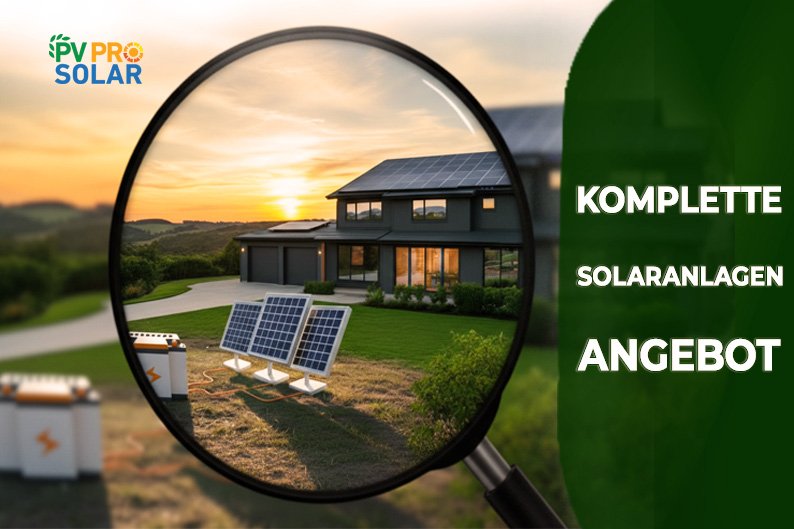
Complete Solar System Offers – Everything You Need to Know

A complete solar system offer allows homeowners and businesses to fully take advantage of photovoltaics and sustainably reduce energy costs. With the growing demand, many face key questions: Which components are included in the offer? How is the installation planned? When is an energy storage system worthwhile? This guide answers all the essential questions regarding complete solar system offers and provides a comprehensive overview of planning, installation, and maintenance for reliable electricity supply.
PVPro Solar GmbH
In 3 Schritten zur PV-Anfrage
Bedarf klären · Daten senden · Angebot erhalten
Jetzt Anfrage sendenBedarf klären
Schritt 1
Daten senden
Schritt 2
Angebot erhalten
Schritt 3
Why is a complete solar system offer worthwhile?
A complete solar system offer provides numerous advantages: all components are coordinated, installation is simplified, and efficiency is maximized. Moreover, a complete offer reduces planning errors and provides a transparent overview of the included services. This is particularly important for owners to ensure long-term stable and sustainable energy supply.
Which components are typically included in a complete solar system offer?
A complete solar system offer typically includes modules, inverters, mounting systems, cabling, safety components, and optionally an energy storage system. Each component plays a critical role in the system’s performance. The quality of the modules and the inverter significantly affects the efficiency and lifespan of the entire system.
What are the benefits of a turnkey solar system offer?
A turnkey offer saves time and effort since planning, delivery, and installation are handled by a single provider. Professional installation ensures correct wiring, optimizes energy flow, and reduces installation errors, while simultaneously securing maximum yields over the system’s lifetime.
How do complete solar system offers work?
Offers generally include a detailed list of included components, installation services, and any optional storage solutions. They also provide information on module performance, system sizing, and possible future expansions. This makes it easy for interested parties to compare and select the right solution.
What types of solar modules are used in complete offers?
Monocrystalline modules are popular due to their high efficiency and good performance even in low light. Polycrystalline modules are cheaper but offer lower efficiency, while thin-film modules are suitable for special applications like large flat roofs. The choice depends on roof area, orientation, and energy needs. High-quality modules ensure good long-term returns.
What role does the inverter play in the offer?
The inverter converts the DC power from the modules into standard AC electricity and also handles tasks such as energy management, monitoring, and optimization of self-consumption. Choosing a high-performance inverter is crucial to minimize losses and ensure stable electricity production over the years.
When is an energy storage system useful, and how is it integrated?
A storage system increases self-consumption by storing excess solar electricity for later use. Households with high evening consumption benefit the most. Lithium-ion batteries dominate the market due to their efficiency and long lifespan. Integration can be via the inverter or as a separate storage solution.
How is the size of a complete solar system determined?
Sizing depends on electricity consumption, roof area, and desired self-sufficiency. Average households typically require 4–10 kWp, while larger households or those with electric vehicles should plan for higher capacity. Careful planning prevents over- or undersizing and ensures efficient energy supply in the long term.
Which roof areas are suitable for a complete solar system?
South-facing roofs with slopes of 25–40° are ideal, though east- and west-facing roofs can also be used with proper planning. The roof must be largely free from shading, as even small shadows can significantly reduce the performance of individual modules.
Which mistakes should buyers avoid?
Typical mistakes include choosing unsuitable modules, incorrectly sized storage, or insufficient roof analysis. Future energy needs, such as electric vehicles or heat pumps, should also be considered to avoid adaptation issues later.
What documentation is included in a complete offer?
Every offer includes technical datasheets, warranties, circuit diagrams, and installation manuals. Modern systems also provide digital monitoring access. This documentation ensures long-term system efficiency and facilitates maintenance, expansion, or warranty claims.
How is the performance of a complete system monitored?
Most inverters offer real-time monitoring via apps or web portals. Users can view energy yields, consumption, battery status, and error messages at any time. Regular monitoring allows quick reactions to performance drops and supports intelligent energy management.
How long does a professionally installed solar system last?
High-quality solar modules have a lifespan of 25–30 years or more. Inverters usually need replacement after 10–15 years, and storage systems remain functional for 10–20 years, depending on technology. Regular maintenance increases lifespan and ensures stable energy yields over decades.
Can a complete system operate without storage and be expanded later?
Yes, a system without storage is useful if most electricity is consumed during the day. Storage can be added later, keeping the system flexible. Modular systems allow simple expansions with additional modules or larger batteries.
What expansion options does a complete solar system offer?
PV systems can be expanded with additional modules, storage, or intelligent control systems. Solid initial planning is crucial. Expansions increase self-sufficiency and allow the system to adapt to changing consumption patterns.
How much roof area is needed for a complete solar system?
Approximately 5–7 m² per kWp. High-efficiency modules can reduce space requirements.
Can a solar system be installed on an older roof?
Yes, if the roof structure and condition are sufficient. Renovation may be necessary.
How long does installation of a complete system take?
Usually 2–4 days for a single-family home, depending on roof type and number of modules.
Is a building permit required?
Rooftop systems are generally permit-free. Exceptions apply for listed buildings or special regulations.
Can the system be expanded later?
Yes, most systems are modular and allow retrofitting of modules, storage, or EV charging stations.
PVPro Solar GmbH
In 3 Schritten zur PV-Anfrage
Bedarf klären · Daten senden · Angebot erhalten
Jetzt Anfrage sendenBedarf klären
Schritt 1
Daten senden
Schritt 2
Angebot erhalten
Schritt 3