
Photovoltaic System VAT Calculation: How Operators in Germany Actually Calculate Taxes Correctly?
Diese Seite ist auch auf Deutsch verfügbar
Artikel auf Deutsch lesen
Many solar system owners understand that their installation generates electricity and reduces energy costs. What far fewer people fully grasp from the outset is the tax dimension. As soon as electricity is fed into the public grid, this constitutes a commercial activity under German tax law. As a result, VAT calculation for photovoltaic systems becomes an issue that should not be postponed. Those who handle their calculations properly from the beginning avoid complications with the tax office and maximize the financial return of their system.
The good news is that with a clear understanding of the fundamentals, photovoltaic tax calculations in 2026 are far less complicated than many assume.
PVPro Solar GmbH
Bedarf klären · Daten senden · Angebot erhalten
Jetzt Anfrage sendenBedarf klären
Schritt 1
Daten senden
Schritt 2
Angebot erhalten
Schritt 3
Why is VAT calculation for photovoltaic systems relevant?
Anyone operating a photovoltaic system and feeding electricity into the grid is considered an entrepreneur for tax purposes, unless they fall under the small business scheme. This means that VAT liability effectively begins with the first kilowatt hour that generates revenue. Feed in income is treated as taxable turnover, which is generally subject to VAT.
At the same time, this entrepreneurial status allows access to input VAT deduction. Those who calculate VAT correctly and make proper use of input VAT can recover a significant portion of their initial investment. The key lies in approaching VAT calculation in a structured way from the outset and ensuring that no relevant items are overlooked.
How does VAT calculation for a photovoltaic system work in practice?
VAT calculation for photovoltaic systems follows a clear and logical structure. Operators who opt for standard taxation must charge VAT on their feed in invoices and remit it to the tax office. In return, they can reclaim input VAT from installation costs, maintenance, and other operational expenses.
In practical terms, this means the installer issues an invoice that includes VAT. This amount is declared as deductible input VAT in the advance VAT return and is refunded by the tax office. Operators then offset input VAT against the VAT collected on their revenue. The resulting balance is either paid to the tax office or refunded. This is how VAT calculation works in practice: transparent, systematic, and applicable to all system sizes.
Small business scheme vs standard taxation: which option is more beneficial?
Choosing between the small business scheme and standard taxation is one of the most important decisions in VAT planning for photovoltaic systems. Under the small business scheme, operators whose annual revenue remains below the legal threshold do not need to charge VAT. This significantly reduces administrative effort and eliminates the need to submit advance VAT returns.
However, small businesses cannot reclaim input VAT on purchase invoices. For systems with high acquisition costs, this can be a substantial disadvantage. For that reason, the tax implications should be carefully evaluated before commissioning the system, ideally with the support of a tax advisor or an experienced solar provider. The optimal choice depends on system size, feed in volume, and the level of self consumption.
How do you correctly calculate annual photovoltaic revenue?
Calculating annual revenue is the first step in determining whether the small business threshold applies and how much tax will be due. Annual revenue includes all income from electricity fed into the grid, namely the feed in tariff paid by the grid operator. Self consumption is generally treated separately and follows its own tax rules.
A structured example for a standard taxed operator would look like this:
- Determine the total feed in remuneration for the year based on the grid operator statement
- Record the net amount as taxable revenue
- Calculate the VAT due and include it in the advance VAT return
- Offset input VAT from operational expenses
- Pay the difference to the tax office or claim a refund
This example shows that VAT calculation is not overly complex but rather a structured process that becomes manageable with proper preparation.
How is self consumption treated for VAT purposes?
Self consumption is often underestimated in VAT calculations. When electricity generated by the system is used directly by the operator instead of being fed into the grid, it is treated as a deemed supply for VAT purposes. Under standard taxation, this is generally subject to VAT.
In practice, the market value of the self consumed electricity is used as the basis for calculation, and the corresponding VAT is declared in the advance VAT return. Failing to account for this can result in additional tax assessments during an audit. Accurate measurement and documentation of self consumption are therefore essential.
How useful is a photovoltaic tax calculator?
A photovoltaic tax calculator can provide a helpful initial estimate. Online tools allow users to approximate their tax burden based on system size, electricity production, and feed in tariffs. However, they do not replace a detailed and individualized calculation.
A reliable calculator typically factors in feed in income, self consumption, potential input VAT refunds, and the chosen taxation method. While these tools offer a useful overview, their results should always be compared with actual figures from invoices and grid operator statements to ensure accuracy.
How is feed in remuneration treated for VAT purposes?
For operators under standard taxation, feed in remuneration is a central element of the annual VAT return. The grid operator issues a credit note that specifies both the net amount and the VAT due. This amount is included as taxable revenue.
It is important to note that such credit notes are legally treated as invoices if both parties have agreed to the arrangement. Operators should carefully archive these documents and include them in their advance VAT returns on a monthly or quarterly basis. Regular reporting helps maintain transparency and prevents unexpected tax liabilities at year end.
How do you calculate the actual profit from a photovoltaic system?
When calculating profit, many operators focus only on feed in income. In reality, taxable profit results from a broader calculation that includes revenue, deductible operating expenses, and depreciation. Deductible costs include maintenance, insurance, metering fees, and financing expenses.
VAT also plays a role here. Correctly reclaiming input VAT reduces the overall tax burden. In addition, the system’s effective output and classification for tax purposes can influence the final calculation. Those who systematically record all relevant factors can determine their actual profit with a high degree of accuracy and remain well prepared for any tax audit.
Photovoltaic tax calculation in 2026: what operators need to know
Tax rules for photovoltaic systems continue to evolve, with further simplifications expected in 2026. The increased threshold for the small business scheme allows more private individuals to operate without charging VAT. However, registration with the tax office remains mandatory, even for small business operators.
For those under standard taxation, advance VAT returns must still be submitted monthly or quarterly. Maintaining organized records, keeping track of annual revenue, and consistently applying VAT rules will help avoid unexpected issues at the end of the year. Photovoltaic tax calculation remains a dynamic area that requires ongoing attention.
Find the right partner for your solar project
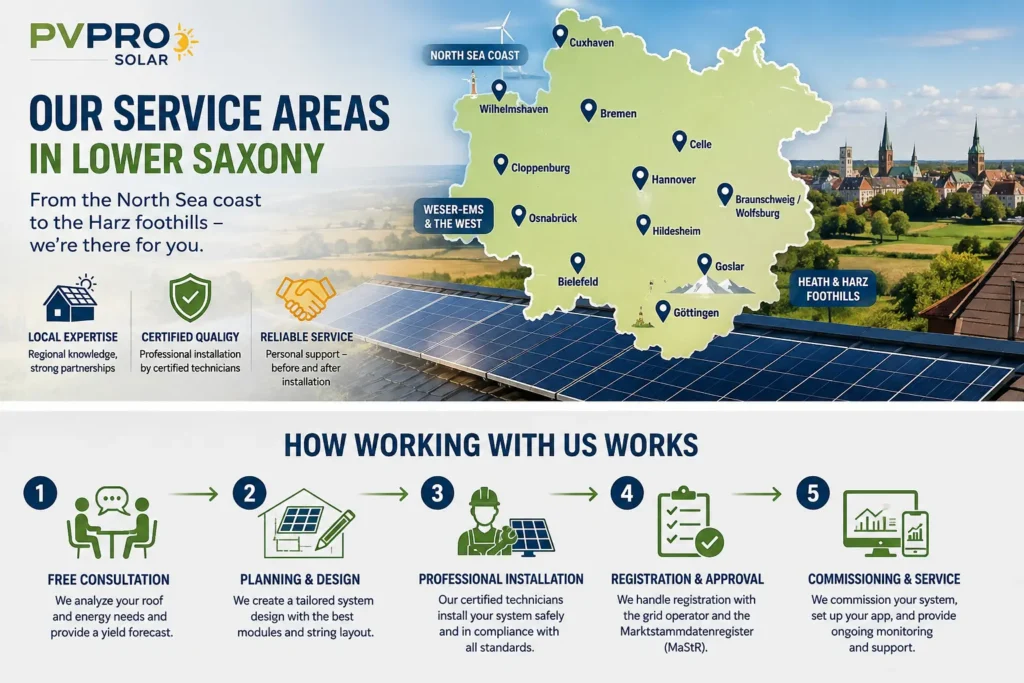
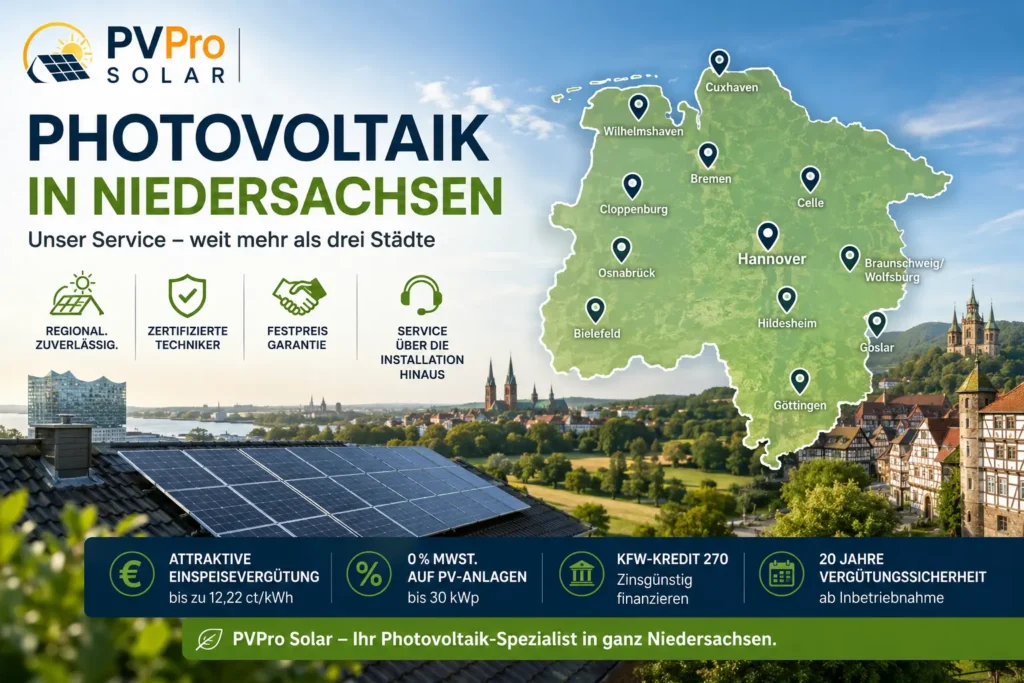
VAT calculation for photovoltaic systems does not have to become a burden. Working with an experienced solar provider who understands both the technical and tax aspects lays the foundation for a financially successful installation. PVPro Solar GmbH supports homeowners and businesses across Lower Saxony, Hanover, Bremen, and Wolfsburg from initial consultation through commissioning.
Request a free quote from PVPro Solar GmbH today and ensure your photovoltaic system is set up efficiently and in full compliance with tax regulations.
Do I need to calculate VAT for my photovoltaic system as a private individual?
Not necessarily. Those who opt for the small business scheme do not charge VAT and therefore avoid complex calculations. Operators under standard taxation should consult a tax advisor.
What is included when calculating annual photovoltaic revenue?
All income from electricity fed into the grid is included. Self consumption is treated separately as a deemed supply.
How often must advance VAT returns be submitted?
Depending on the tax liability, either monthly or quarterly. The tax office determines the reporting frequency after registration.
Does the zero VAT rate apply to retrofitted components?
Yes, provided that components such as battery storage are directly connected to the existing system and meet the legal requirements under Section 12 paragraph 3 of the German VAT Act.
What happens if I forget to include self consumption in my VAT calculation?
The tax office may assess the missing amount during an audit, including interest on any additional tax due.
Can I reclaim input VAT on repairs and maintenance?
Yes, all business related expenses that include VAT are eligible for input VAT deduction, provided you are registered under standard taxation.
How does a photovoltaic tax calculator help with planning?
It provides an initial estimate of the expected tax burden but does not replace a detailed calculation based on actual system data.
PVPro Solar GmbH
In 3 Schritten zur PV-Anfrage
Bedarf klären · Daten senden · Angebot erhalten
Jetzt Anfrage sendenBedarf klären
Schritt 1
Daten senden
Schritt 2
Angebot erhalten
Schritt 3