
Tax-Free Photovoltaic System 2026: How to Benefit Optimally from the New Regulations?

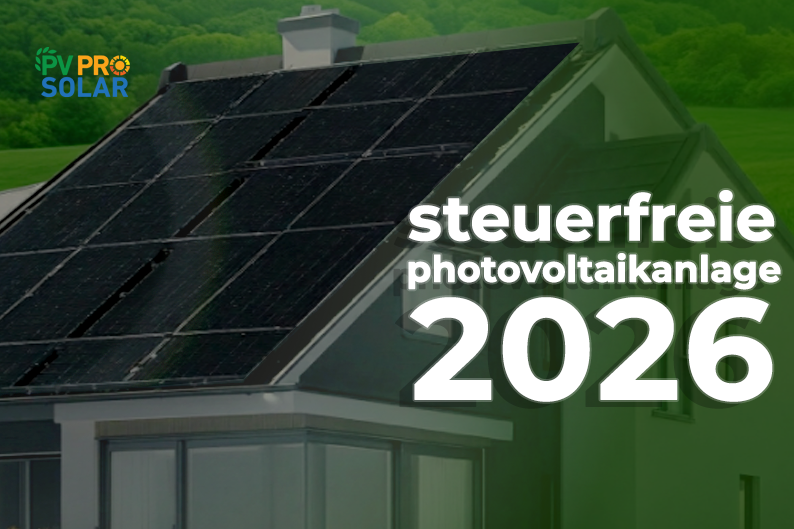
The tax treatment of photovoltaic systems has changed significantly in recent years, and especially in 2026, the topic of a “tax-free photovoltaic system” is gaining more attention. More and more homeowners and businesses are becoming interested in the tax advantages associated with operating a solar system. This development is closely linked to political goals aimed at promoting renewable energy, making investments more attractive, and reducing bureaucratic barriers. A tax-free photovoltaic system can significantly improve profitability and make entry into solar energy easier. In this comprehensive guide, you will learn everything about the key regulations, requirements, and strategic advantages in 2026.
PVPro Solar GmbH
In 3 Schritten zur PV-Anfrage
Bedarf klären · Daten senden · Angebot erhalten
Jetzt Anfrage sendenBedarf klären
Schritt 1
Daten senden
Schritt 2
Angebot erhalten
Schritt 3
Why is the tax-free photovoltaic system 2026 so important for homeowners and businesses?
Tax relief plays a central role in the decision to invest in a photovoltaic system. It reduces administrative effort and makes the investment more attractive. At the same time, access to solar energy is simplified due to fewer tax obligations.
What does a tax-free photovoltaic system 2026 actually mean?
The term refers to photovoltaic systems whose income and operation are exempt from certain tax obligations under specific conditions. This mainly applies to smaller systems on private properties. The goal is to promote the expansion of renewable energy and simplify entry.
What tax advantages are available in 2026?
One of the main advantages is the simplification of tax treatment. In many cases, complex tax declarations are no longer required. This saves time and significantly reduces administrative burden.
Who can benefit from tax exemption?
Both private individuals and small business owners can benefit from tax exemption, provided certain criteria are met. These regulations are designed to be as inclusive as possible.
What requirements must be met?
The requirements relate to factors such as system size and usage. Location and type of use also play a role. A detailed assessment is necessary.
Are there any limitations to tax exemption?
Yes, tax exemption does not apply to all systems and is subject to specific conditions. These limitations ensure targeted support.
How does tax exemption affect profitability?
Tax exemption significantly increases the profitability of a photovoltaic system. By eliminating certain taxes, a larger portion of the revenue is retained. This improves long-term financial planning.
What role does self-consumption play?
Self-consumption is an important aspect of tax considerations. A high self-consumption rate can provide additional benefits and optimize energy usage.
How does the tax treatment differ from previous years?
Compared to earlier regulations, tax treatment has been greatly simplified. This makes entry easier and reduces administrative workload.
What impact does tax exemption have on planning?
Tax benefits should be considered during the planning phase. They influence system sizing and usage strategy. Strategic planning is essential.
What role does system size play in tax exemption?
System size is a key factor in determining eligibility for tax exemption. Smaller systems are more likely to benefit. Proper sizing is therefore important.
How does system usage affect tax exemption?
The type of usage, especially self-consumption, influences tax treatment. A clear usage concept is therefore necessary.
What mistakes should be avoided in tax planning?
Common mistakes include insufficient information and incorrect assumptions. Ignoring requirements can also lead to problems. Thorough preparation is essential.
How can tax benefits be used optimally?
Strategic planning and compliance with all requirements are key to maximizing benefits. Regularly reviewing regulations is also advisable.
What role does professional consultation play?
Professional advice can help better understand complex regulations and support planning and implementation. This reduces the risk of errors.
How will tax-free photovoltaic systems develop after 2026?
The development remains dynamic and influenced by political decisions. Further simplifications are expected in the future.
Is a tax-free photovoltaic system 2026 a long-term investment?
Yes, it offers long-term benefits through reduced tax burdens and stable savings. At the same time, it contributes to environmental protection.
A photovoltaic system that is tax-advantaged or exempt under certain conditions.
Private individuals and small businesses can take advantage of these benefits.
Requirements relate to system size, usage, and location.
It increases profitability and reduces administrative effort.
Consultation can help optimize the use of regulations. What is a tax-free photovoltaic system 2026?
Who can benefit from it?
What requirements apply?
How does tax exemption help?
Is consultation necessary?
PVPro Solar GmbH
In 3 Schritten zur PV-Anfrage
Bedarf klären · Daten senden · Angebot erhalten
Jetzt Anfrage sendenBedarf klären
Schritt 1
Daten senden
Schritt 2
Angebot erhalten
Schritt 3