
Apply for 10 kWp Funding: Secure Grants in 2026
Diese Seite ist auch auf Deutsch verfügbar
Artikel auf Deutsch lesen
Anyone planning a photovoltaic system today thinks not only about electricity costs, but also about funding. The honest answer up front: there is no large federal grant for private PV systems in 2026. If you want to apply for 10 kWp funding, three levers actually matter: the zero VAT rate, the EEG feed-in tariff, and regional grant programs such as proKlima in the Hannover region. In this guide you’ll learn what funding is realistically possible for a 10 kWp system in 2026, how to apply correctly, and which mistakes cost money.
PVPro Solar GmbH
In 3 Schritten zur PV-Anfrage
Bedarf klären · Daten senden · Angebot erhalten
Jetzt Anfrage senden1
Bedarf klären
Schritt 1
2
Daten senden
Schritt 2
3
Angebot erhalten
Schritt 3
What Does a 10 kWp PV System with Storage Cost?
Prices have fallen significantly in recent years. As a market orientation (as of August 2026, individual cases vary depending on roof, technology, and effort):- 10 kWp PV system without storage: roughly €11,000 to €16,000
- 10 kWp with 8 to 12 kWh storage: roughly €17,000 to €25,000
How Much Funding Can You Get for a Solar System in 2026?
Funding is made up of several building blocks that work differently.Available Nationwide for Everyone
- 0 percent VAT on supply and installation (Section 12(3) UStG)
- EEG feed-in tariff for fed-in electricity, legally guaranteed for 20 calendar years plus the year of commissioning (Section 25 EEG 2023)
- Income tax exemption on earnings for systems up to 30 kW (peak) per residential or commercial unit, up to a maximum of 100 kW (peak) per taxpayer (Section 3 No. 72 EStG)
- Low-interest KfW loan 270 for the system and storage. This is a loan without a repayment subsidy; the application runs through your house bank and must be submitted before the project begins
Regional, Depending on Location
- Municipal and regional grant programs, for example proKlima in the Hannover region
- State programs in a few federal states, most notably Berlin with SolarPLUS
Feed-in Tariff: These Are the Current Rates
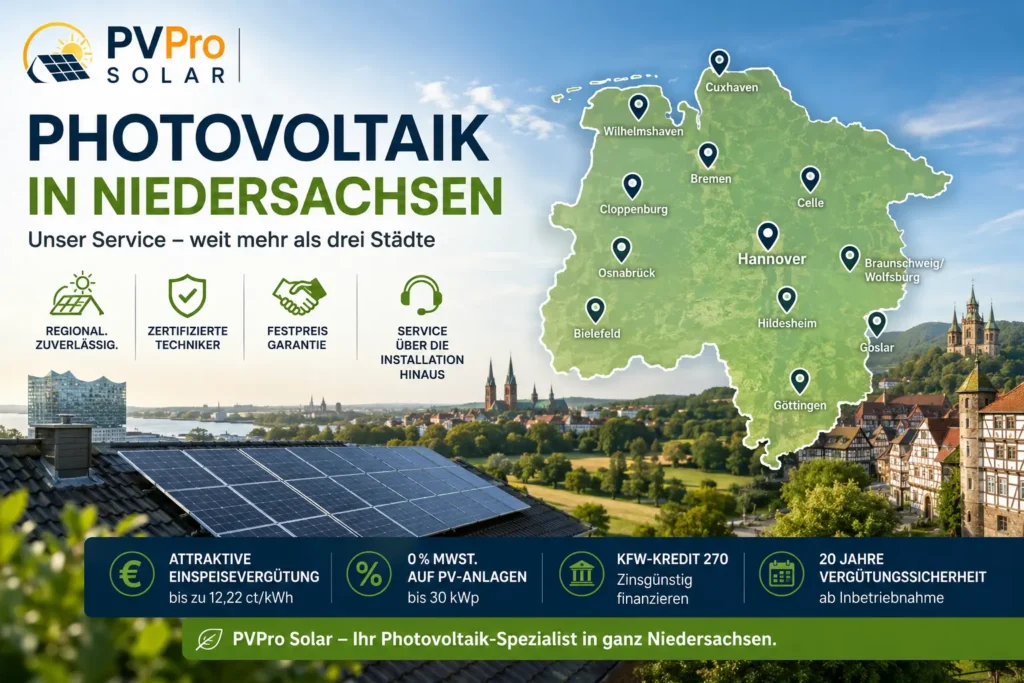
For systems commissioned between August 1, 2026 and January 31, 2027, the following rates apply according to the Bundesnetzagentur for the portion of the system up to 10 kWp:- Partial feed-in (self-consumption plus surplus feed-in): 7.70 ct/kWh
- Full feed-in: 12.22 ct/kWh
Two Limitations Many Comparison Calculations Leave Out
Since the Solarspitzengesetz (in effect since February 25, 2025), the following applies to new systems: in quarter-hours with negative exchange electricity prices, the feed-in tariff is forfeited from the first negative quarter-hour onward, once a smart metering system is installed. The lost periods are not simply cancelled but are added to the end of the remuneration period, though for solar systems only at half the rate. In addition, Section 9 EEG limits feed-in power at the grid connection point to 60 percent of installed capacity as long as a smart metering system and control device are not installed and controllability by the grid operator has not been successfully tested for the first time.This affects feed-in, not generation: whatever the house and storage consume directly does not count toward this. That is exactly why a storage system is more than a comfort feature for a 10 kWp system in 2026.Outlook: Planned EEG Amendment
On July 29, 2026, the Federal Cabinet approved a government draft for an amendment to the EEG. Under this draft, the fixed feed-in tariff for new systems would be abolished from January 1, 2027 and gradually replaced by direct marketing, cushioned by a transitional payment limited to a maximum of 36 months. Eligibility is staggered by year of commissioning and system size (2027 under 50 kW, 2028 under 25 kW, 2029 and 2030 under 7 kW). For systems under 25 kW, a time-limited direct marketing bonus is additionally planned. This is explicitly not yet applicable law. The Bundestag and Bundesrat have been deliberating since autumn 2026, and key provisions are also subject to state-aid approval by the European Commission. Until it takes effect, current law continues to apply.Under the draft, entitlements for systems commissioned before January 1, 2027 would remain unchanged. No retroactive reduction is planned. What the final version looks like will be decided by the parliamentary process.Funding in Hannover and Niedersachsen: What Applies in Our Region
There is currently no statewide grant program for private PV systems in Niedersachsen. NBank’s earlier storage program already expired in 2021. This makes the regional proKlima program, the enercity fund, all the more important.proKlima, Funding Module DachVollToll (2026 Guideline)
- €100 per kWp, up to a maximum of €2,000 per residential building
- At least 2 kWp of installed module capacity
- Funding covers full coverage of all roof areas with at least 650 kWh/kWp specific annual yield each. Roof areas below this value are not eligible
- The module applies to existing residential buildings. Buildings completed at least five years ago count as existing
- Balcony power stations are excluded
Bonus: SolarEnergieManagement
€500 per home energy management system, if the PV system is funded through another proKlima SolarStrom module and the system includes a battery storage unit, a smart metering system (iMSys), and an FNN control box, combined with a dynamic electricity tariff. A simple digital meter is not sufficient for this.Additional Modules
For solar facade systems, there is €100 per kWp for standard modules mounted in front of the facade (up to a maximum of €3,000), or €300 per kWp for facade-integrated modules (up to a maximum of €9,000). The combination of PV with a newly built green roof is funded at €200 per kWp, up to a maximum of €6,000.Conditions You Should Know
- The funding area covers exclusively Hannover, Hemmingen, Laatzen, Langenhagen, Ronnenberg, and Seelze
- The funding application must generally be submitted before the work is commissioned
- proKlima only accepts applications for the current calendar year until October 31. The 2026 guideline applies until revoked, but no later than October 31, 2026
- Self-performed work leads to exclusion from funding; the work must be carried out by specialist companies
- There is no legal entitlement; approval is granted within the framework of available funds. The current status is shown on the funding barometer at proklima-hannover.de
- On cumulation: combining with other programs is possible as far as their terms allow. The sum of all funding may not exceed the eligible, documented costs. If the federal funding for efficient buildings (BEG) is also used, proKlima will contribute at most up to the BEG cumulation ceiling
State Funding Overview: Where Grants Are Still Available in 2026
The funding landscape among the federal states has thinned out considerably. Many well-known programs have ended: the progres.nrw storage grant for private homeowners ended in 2022, Bavaria also ended its storage program in 2022, and Niedersachsen already did so in 2021. Notable programs for private households in 2026 exist mainly here: Berlin: the SolarPLUS program run by IBB Business Team GmbH was relaunched in a restructured form on January 8, 2026. Under the SolarPLUS S program segment for single-family, two-family, and terraced houses, there is a flat rate of €250 per full kWp, staggered from €500 (from 2 kWp) up to a maximum of €4,750 (from 19 kWp). A battery storage system is a funding requirement. An additional flat €750 is available for upgrading the meter cabinet if the cost is at least €1,160 gross. The guideline runs until December 31, 2026, with a program volume of €13 million. Baden-Württemberg: no direct grants for private individuals, but low-interest financing through L-Bank. Individual municipalities nationwide: cities such as Cologne or Bonn fund PV and storage through their own programs. Whether your municipality offers funding can be checked on the city’s climate protection or environmental page. Funding pots are often budgeted and can be exhausted during the year. Always check the current status immediately before placing an order.Step by Step: How Do I Apply for Funding Correctly?
1. Obtain Quotes
Get at least two to three comparison quotes. Make sure the zero VAT rate is correctly stated and that the meter cabinet, grid connection, and scaffolding are included. For the proKlima application you need at least one qualified quote from an installation company anyway.2. Check Eligibility
Clarify which programs are open at your location and whether your project meets the technical requirements. Also check the current budget status.3. Apply Before You Place the Order
This is the decisive point: grant programs generally require the application to be submitted before the order is placed, otherwise the entitlement is forfeited. You apply for grants directly with the funding body, in the Hannover region with proKlima, in Berlin with the IBB. The KfW loan 270 is not applied for directly with KfW, but through your house bank, likewise before the project begins. Not every bank passes it on to private customers, so ask specifically.4. Wait for Approval
Only start the installation after receiving the grant approval notice, unless the guideline allows an early start of the measure. proKlima offers its own procedure for this.5. Submit Proof of Use
After installation, submit the invoices and required documentation to receive payment. With proKlima, implementation should be documented within one year of approval; the deadline can be extended upon written request. Independent of grants: registration and notification. Before installation, the installation company submits the connection request under VDE-AR-N 4105 to the responsible distribution grid operator. Construction only begins after the grid technical assessment. VDE-AR-N 4100, along with the grid operator’s technical connection conditions, applies to the meter location and meter cabinet.For older buildings, upgrading the meter cabinet is often unavoidable and should be included in the quote. After commissioning, the system must be registered in the Bundesnetzagentur’s Marktstammdatenregister within one month. This obligation legally falls on the system operator, meaning you. At PVPro Solar we handle the grid registration and support you on request with the MaStR registration. If a battery storage system, wallbox, or heat pump is added, Section 14a EnWG also applies: controllable consumption devices with more than 4.2 kW of grid draw capacity newly connected since January 1, 2024 must be controllable by the grid operator in a grid-oriented way. In return, there are permanently reduced grid fees. A complete shutdown is excluded; the grid operator may only reduce down to at least 4.2 kW. For storage systems, what counts is the charging power drawn from the grid, not the storage capacity.Typical Mistakes When Applying
- Signing the contract before the funding application
- Using outdated funding information; many programs circulating online have been discontinued
- Missing the application deadline or budget cutoff, for example proKlima’s October 31 deadline
- Not checking cumulation rules
- Planning for self-performed work even though the guideline excludes it
Cost-Effectiveness: Is a 10 kWp System Worth It in 2026?
In many cases, yes, even without a large grant. The most important value driver is self-consumption: every kilowatt-hour you use yourself replaces grid electricity. The average household electricity price in 2026 is around 37 ct/kWh according to the BDEW, with favorable new-customer tariffs well below that. Realistically, you can expect savings of about 30 to 37 ct per self-consumed kilowatt-hour. That’s roughly four to five times the feed-in tariff. Sample calculation for the Hannover region. The following figures are a simplified guide, not a quote and not a return guarantee. Individual cases vary considerably depending on the roof, consumption profile, and electricity tariff.- 10 kWp system with 10 kWh storage: roughly €21,000 including 0 percent VAT
- proKlima grant if the DachVollToll criteria are met: up to €2,000, plus a possible €500 SolarEnergieManagement bonus
- Annual yield in the region: about 900 to 1,000 kWh per kWp with good south orientation, so roughly 9,000 to 9,700 kWh. With east-west roofs, shading, or a shallow pitch, yield is noticeably lower
- Self-consumption rate with storage: typically 45 to 70 percent depending on the consumption profile
- Feed-in tariff for the surplus: 7.70 ct/kWh for commissioning from August 1, 2026
Combining Storage and Funding
A storage system significantly increases self-consumption and is even a funding requirement for some programs, such as Berlin’s SolarPLUS or proKlima’s SolarEnergieManagement bonus. The zero VAT rate also applies to the storage system if it is supplied and installed together with the PV system. When planning, check whether the combination of system, storage, iMSys, and energy management unlocks additional bonuses at your location. On a related note: in our article Earning Money with Your Electric Car, you can read about the role an electric vehicle can play alongside a PV system, storage, and a dynamic electricity tariff.Strategic Tip: Why Timing Matters in 2026
The best time to apply is three to six months before the planned installation, ideally at the start of the year when new funding budgets become available. In the Hannover region, there’s also the October 31 deadline by which proKlima accepts applications for the current year. In 2026 there’s a second reason: under the government draft, the fixed feed-in tariff for new systems is to be replaced from 2027 by a direct marketing model with a time-limited transitional payment. Anyone commissioning a system in 2026 would, under the draft, fall under the current system. Since the legislative process is still ongoing, you should keep an eye on developments up to your commissioning date. More on this in our article on the 2027 EEG amendment.Check Your Funding Now and Benefit Long-Term
A 10 kWp photovoltaic system suits many single-family homes; with storage, self-consumption rises, and with the right programs, the investment falls further. If you go about it in a structured way, you should:- check the programs available at your location before signing a contract
- watch application deadlines and budget status
- plan storage, a smart metering system, and energy management in from the start
- commission the system still in 2026 to secure the current EEG remuneration under today’s legal situation
FAQs
How Long Does It Take to Apply for 10 kWp Funding?
The application process itself varies in effort depending on the program, but with a quote in hand it’s often done in under an hour. Processing takes anywhere from a few days to several weeks depending on the funding body. What matters is submitting the application before the order is placed. In the Hannover region, there’s the added factor that proKlima only accepts applications for the current year until October 31.Can I Combine Multiple Funding Programs?
Often, yes. The zero VAT rate, EEG remuneration, and the KfW loan 270 can generally be combined with regional grants. However, note the cumulation rules of each individual guideline. Under proKlima, the sum of all funding may not exceed the eligible, documented costs, and at most up to the BEG cumulation ceiling if additional BEG funding is used.Do I Get proKlima Funding for Photovoltaics as a New Building?
The DachVollToll module applies to existing residential buildings. Buildings completed at least five years ago count as existing. For new buildings, other modules or other programs may therefore apply. We check this as part of the planning process.As of: August 2026. Funding programs, budgets, and remuneration rates can change at short notice. What matters is the current guidelines of the respective funding bodies (Bundesnetzagentur, KfW, IBB, proKlima) as well as the applicable statutory provisions. Information on the planned EEG amendment refers to the government draft of July 29, 2026 and is not yet applicable law. This article does not replace individual tax or legal advice.PVPro Solar GmbH
In 3 Schritten zur PV-Anfrage
Bedarf klären · Daten senden · Angebot erhalten
Jetzt Anfrage senden1
Bedarf klären
Schritt 1
2
Daten senden
Schritt 2
3
Angebot erhalten
Schritt 3