
Apply for 10 kWp Funding: How to Secure Maximum Subsidies for Your PV System Now

Anyone planning a photovoltaic system today is thinking not only about electricity costs, but also about available subsidies. And this is where it gets interesting: if you apply for 10 kWp funding, you can save several thousand euros — provided you know the right programs, deadlines, and application procedures.
In this guide, you will learn step by step how to apply for 10 kWp funding, which programs will be relevant in 2026, and how to avoid common mistakes.
What Does a 10 kWp PV System with Battery Storage Really Cost After Subsidies?
The first question most homeowners ask is: What does a 10 kWp PV system with battery storage cost after subsidies?
As of 2026, current prices are approximately:
- 10 kWp PV system without storage: approx. €13,000–€17,000
- 10 kWp system with 10–15 kWh battery storage: approx. €20,000–€27,000
Subsidies can significantly reduce the required upfront investment. If you apply for 10 kWp funding, you can save between €1,000 and €6,000, depending on your federal state and the specific program in place.
Important: The funding amount depends heavily on your location, battery size, and the available funding budget. Therefore, you should always check which programs are currently available before signing a contract.
How Much Subsidy Can You Get for a Solar System?
The key question is: how much subsidy can you receive for a solar system?
There is no one-size-fits-all answer, as funding usually consists of a combination of:
- Federal funding
- State-level programs
- Municipal grants
- Battery storage subsidies
- Low-interest loans
If you apply for 10 kWp funding, you can typically expect:
- €300–€500 per kWp (varies by region)
- €100–€300 per kWh of storage capacity
- Tax advantages (0% VAT remains in effect)
Many property owners underestimate how much photovoltaic funding can actually be combined. With strategic planning, several programs can often be used in parallel.
Nationwide Funding Programs at a Glance
KfW offers low-interest loans for photovoltaic systems and battery storage. Even though direct grants fluctuate, combining financing options can still be a worthwhile approach.
Homeowners applying for 10 kWp funding frequently use:
- KfW Loan 270 (Renewable Energies)
- Additional programs for battery storage
These programs focus less on direct grants and more on favorable financing terms.
State-Level Programs: Where the Greatest Savings Potential Lies
Many German federal states offer attractive funding programs. This is often where the decisive difference is made in terms of how much photovoltaic funding you actually receive.
Examples of typical 2026 funding models:
- North Rhine-Westphalia (NRW): Battery storage funding
- Bavaria: Combination models with e-mobility
- Berlin: Grants for PV + storage
- Baden-Württemberg: Innovation funding
Anyone planning to apply for 10 kWp funding should regularly monitor when new funding rounds open, as budgets are often exhausted within just a few weeks.
Which Photovoltaic Funding Programs in 2026 Are Particularly Attractive?
Many builders and property owners are asking which photovoltaic funding programs will be especially relevant in 2026.
Key focus areas in 2026 include:
- Battery storage grants
- Grid-supportive systems
- Combination with a wallbox (EV charging station)
- Tenant electricity models
If you apply for 10 kWp funding in 2026, you will also benefit from:
- Continued 0% VAT
- Feed-in tariffs under the Renewable Energy Sources Act (EEG)
- Potential innovation bonuses
For new builds in particular, 2026 represents a strategically favorable time to invest.
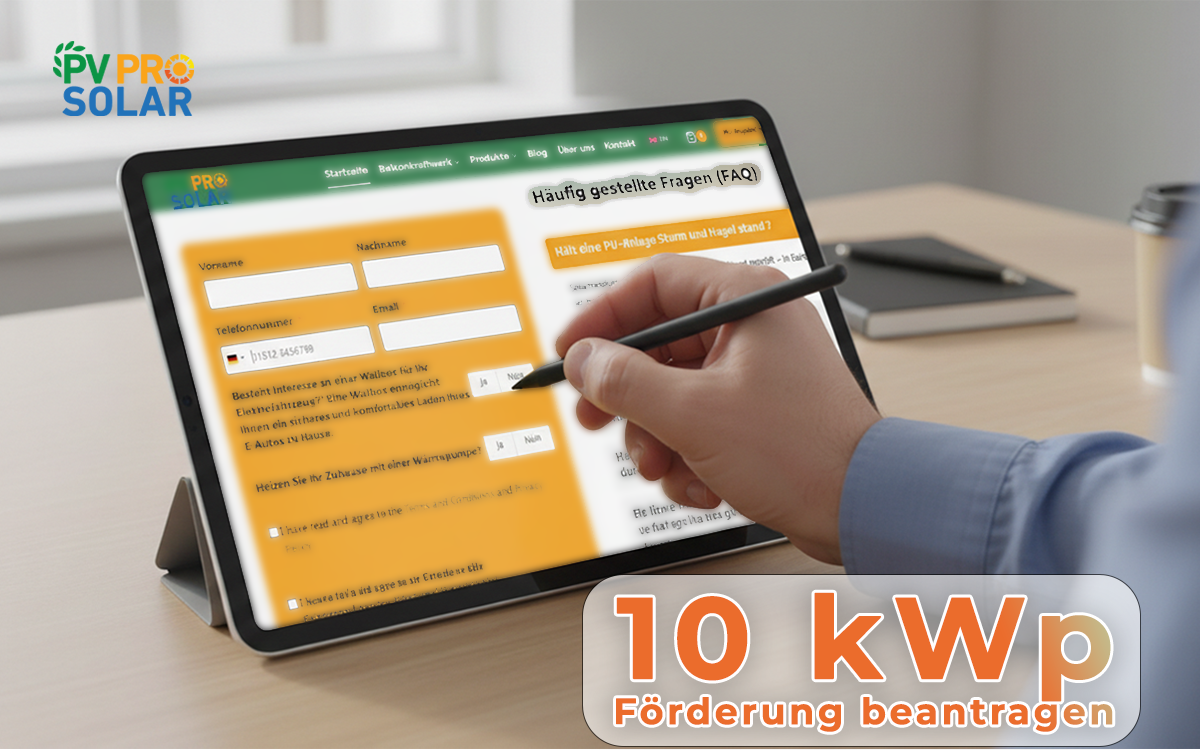
Step-by-Step: How Do I Apply for Photovoltaic Funding?
A common concern is: how do I apply for photovoltaic funding correctly?
Here is a clear step-by-step guide:
- Obtain quotes: Request at least two to three comparative offers for your 10 kWp system.
- Check eligibility: Before signing a contract, confirm that you qualify and can apply for 10 kWp funding.
Important: Many programs must be applied for before awarding the installation contract.
- Submit the application: Use the online portals of the respective funding institutions (KfW, state development banks, etc.).
- Wait for approval: Only begin installation after receiving official approval.
- Submit proof of use: Upload invoices and documentation to receive payment.
Following this process helps you avoid the most common mistake: applying too late.
Common Mistakes When Applying for 10 kWp Funding
Many applicants lose funding due to small oversights.
Frequent mistakes include:
- Signing the contract before submitting the application
- Specifying the wrong storage capacity
- Missing deadlines
- Failing to review possible funding combinations
If you intend to apply for 10 kWp funding, professional advice can be highly beneficial.
Financial Viability: Is the Funding Really Worth It?
Yes — absolutely.
Example calculation:
- Investment including storage: €24,000
- Subsidy: €4,000
- Tax savings: €2,000
- Effective investment: €18,000
With 70% self-consumption, the system pays for itself in approximately 8–11 years.
Applying for 10 kWp funding early significantly improves your return on investment.
Combining Battery Storage and Funding: Maximum Savings Potential
In 2026, battery storage systems offer the greatest leverage in terms of funding.
Many programs specifically support:
- Emergency power capability
- Grid stabilization
- Load management
- Combination with electric vehicles
If you apply for 10 kWp funding, you should always check whether adding storage unlocks additional bonuses.
This often determines how much total subsidy you can receive for your solar system.
How Much Photovoltaic Funding Can You Expect on Average?
National average figures for 2026:
- 10 kWp without storage: €1,500–€3,000
- With storage: €3,000–€6,000
- Combined with wallbox: in some cases up to €8,000
With careful planning and by combining multiple programs, you may secure significantly more. That is why it pays to systematically review all available 10 kWp funding options.
Strategic Tip: Timing Is Everything
Funding programs are limited. Waiting too long may mean missing out due to depleted budgets.
The best time to apply for 10 kWp funding:
- 3–6 months before planned installation
- At the beginning of the year (when new budgets are allocated)
- Immediately after a program is announced
2026 is expected to be particularly dynamic, as climate targets continue to tighten.
Apply for 10 kWp Funding Now and Benefit Long-Term
A 10 kWp photovoltaic system is ideally sized for single-family homes. Adding battery storage increases self-consumption, while subsidies significantly reduce the investment.
If you want to apply for 10 kWp funding in a structured and strategic way, you should:
- Combine funding programs
- Observe application deadlines
- Integrate storage strategically
- Verify eligibility before signing a contract
This is how you maximize the return on your investment.
Would you like to know which funding programs are currently available in your federal state and how to optimize your 10 kWp funding application?
Visit PVPro Solar GmbH today for a non-binding consultation.
Start your funding assessment now and secure your maximum solar subsidy!
Submitting the online application usually takes only 30–60 minutes. Approval can take anywhere from a few days to several weeks, depending on the program. It is crucial to apply for 10 kWp funding before signing the installation contract.
Yes, federal, state, and municipal grants can often be combined. If you want to strategically apply for 10 kWp funding, you should carefully review which programs can be used in parallel to secure the maximum funding amount. How long does it take to apply for 10 kWp funding?
Can I combine multiple funding programs?