
Solar System Cleaning: Cost, Methods & Timing
Diese Seite ist auch auf Deutsch verfügbar
Artikel auf Deutsch lesen
Do solar panels need to be cleaned at all? Here’s the honest answer upfront: in most cases, rain does most of the work. On a sufficiently pitched roof in our region, typical dirt and dust are naturally washed away, meaning professional cleaning is often unnecessary.
However, there are situations where a professional cleaning service genuinely pays off. As a regional photovoltaic specialist based in Hanover, we explain when cleaning is worthwhile, how much energy loss you can realistically expect from soiling, and what cleaning typically costs, without trying to sell you a service your system doesn’t actually need.
PVPro Solar GmbH
Bedarf klären · Daten senden · Angebot erhalten
Jetzt Anfrage sendenBedarf klären
Schritt 1
Daten senden
Schritt 2
Angebot erhalten
Schritt 3
Don’t Solar Panels Clean Themselves?
To a large extent, yes.
Solar modules are covered with smooth solar glass, and on roofs with a pitch of approximately 15 degrees or more, rainwater generally drains well, carrying away loose dust and pollen. For a typical residential rooftop system, this natural self-cleaning process is usually sufficient.
The situation changes when dirt adheres to the panels instead of washing away, or when water cannot drain properly. In those cases, contamination can accumulate and gradually reduce energy production.
When Professional Cleaning Is Actually Worthwhile
You should seriously consider cleaning your solar panels in the following situations:
- Flat-roof or low-pitch installations: Water drainage is limited, allowing dirt, moss, and debris to accumulate.
- Agricultural environments: Dust from fields, feed materials, harvesting activities, and ammonia from livestock facilities can create stubborn deposits.
- Industrial areas or locations near busy roads: Fine dust particles and exhaust emissions can form a sticky film that rain cannot remove.
- Properties surrounded by trees: Leaves, tree sap, and especially bird droppings can create localized shading.
- Persistent contamination: Moss, lichen, or heavy pollen deposits that remain visible after winter.
Bird droppings deserve special attention because they can completely shade individual cells and create so-called hot spots, potentially causing long-term damage. In many cases, these localized deposits are the primary reason for targeted cleaning.
How Much Energy Production Is Actually Lost Due to Dirt?
There are many exaggerated claims online.
A realistic assessment is this: for standard residential rooftop systems in our region, annual production losses caused by dirt are usually in the low single-digit percentage range—typically around 2–5%.
Higher losses generally occur only in the special circumstances mentioned above, such as:
- Flat-roof installations
- Agricultural environments
- Industrial locations
- Severe localized contamination
This means that for a typical residential system, the additional energy generated after cleaning is often relatively modest compared to the cleaning cost.
As a result, blanket marketing claims such as “up to 20% more energy production” are generally unrealistic for a reasonably clean pitched-roof installation.
What Does Solar Panel Cleaning Cost?
Cleaning costs depend on several factors:
- System size
- Roof pitch
- Accessibility
- Degree of contamination
As a general market guideline, professional cleaning typically costs approximately €2–€4 per square meter of module surface area.
For a typical 10 kWp residential system with around 50–55 m² of panel area, this equates to roughly €100–€220 per cleaning.
Whether this represents good value depends on the expected increase in energy production. For a relatively clean pitched-roof system, the financial benefit may be marginal. For heavily contaminated flat-roof or commercial installations, the economics are often much more favorable.
DIY Cleaning or Professional Service?
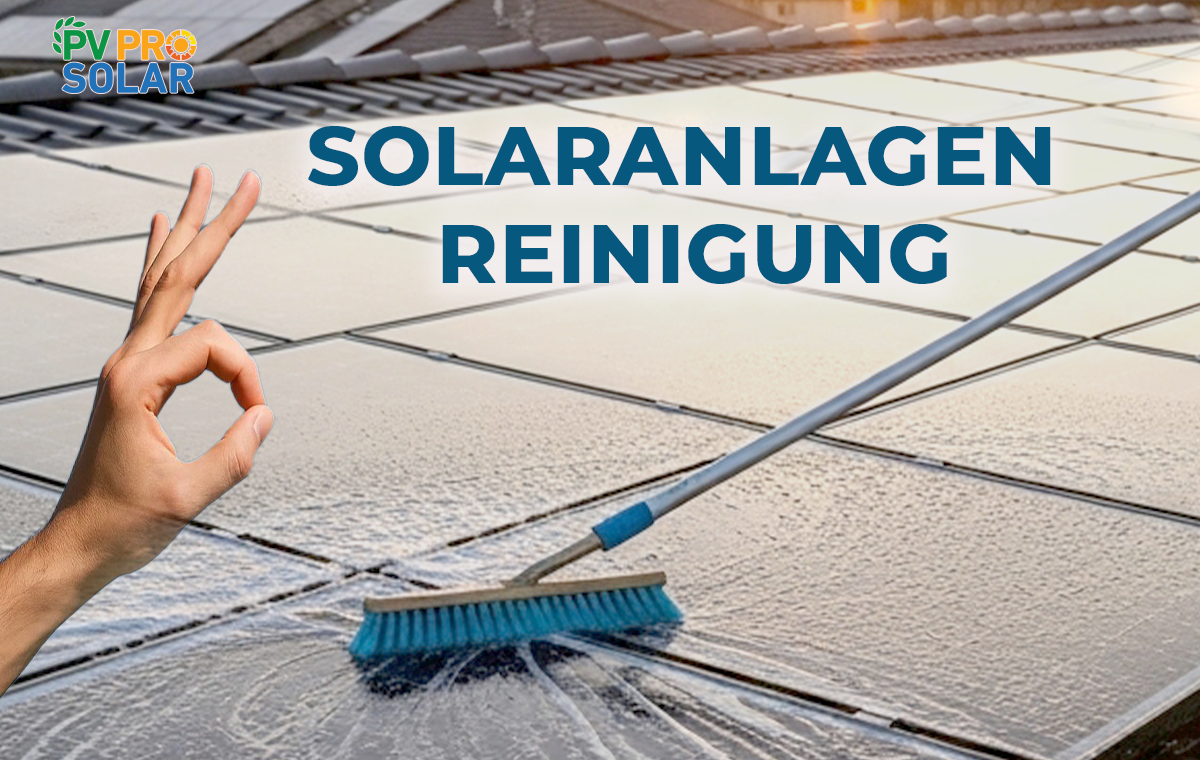
If your system is easy and safe to access, for example, from the ground or a stable platform—you may be able to remove light contamination yourself.
Important guidelines include:
- Use demineralized water only, as tap water can leave limescale deposits.
- Use a soft brush and avoid abrasive cleaning methods that could damage the anti-reflective coating.
- Do not use aggressive cleaning chemicals, as they may damage seals and coatings.
- Clean panels only when they are cool, preferably in the morning, evening, or on overcast days. Cold water applied to hot glass can cause thermal stress and cracking.
Do Not Climb onto the Roof
If the system can only be accessed by walking on the roof, is installed at significant height, or is located on a steep roof, cleaning should be left to qualified professionals.
Falls from roofs can be life-threatening.
Commercial and ground-mounted solar installations often use specialized cleaning robots and telescopic systems that eliminate the need to walk on the modules altogether.
Questions About Your Solar System?
Not sure whether your system actually needs cleaning?
We’ll provide an honest assessment as part of our maintenance and After-Sales Service.
- Phone: 0511 3360603
- Email: hallo@pvprosolar.de
Usually not on a regular basis, as rain handles most cleaning; professional cleaning is primarily worthwhile for flat roofs, agricultural or industrial locations, and systems affected by heavy localized contamination.
There is no universal schedule; cleaning should be based on actual system condition and performance data rather than fixed intervals.
For typical rooftop systems in our region, losses are usually only a few percent per year, with significantly higher losses occurring only under special circumstances.
As a general market guideline, expect approximately €2–€4 per square meter, or roughly €100–€220 for a typical 10 kWp residential installation.
Yes, provided the system is safely accessible and cleaned using demineralized water, soft brushes, and proper care.
Visible deposits such as moss, bird droppings, or persistent pollen, combined with unexplained performance declines in monitoring data, are the clearest indicators.
Yes; hard brushes, pressure washers, aggressive chemicals, limescale-rich water, or cleaning hot panels can damage coatings, seals, and glass surfaces.Do I need to clean my solar panels?
How often should solar panels be cleaned?
How much energy production is lost due to dirty panels?
How much does professional solar panel cleaning cost?
Can I clean my solar panels myself?
How can I tell whether cleaning is necessary?
Can improper cleaning damage solar panels?
PVPro Solar GmbH
In 3 Schritten zur PV-Anfrage
Bedarf klären · Daten senden · Angebot erhalten
Jetzt Anfrage sendenBedarf klären
Schritt 1
Daten senden
Schritt 2
Angebot erhalten
Schritt 3