
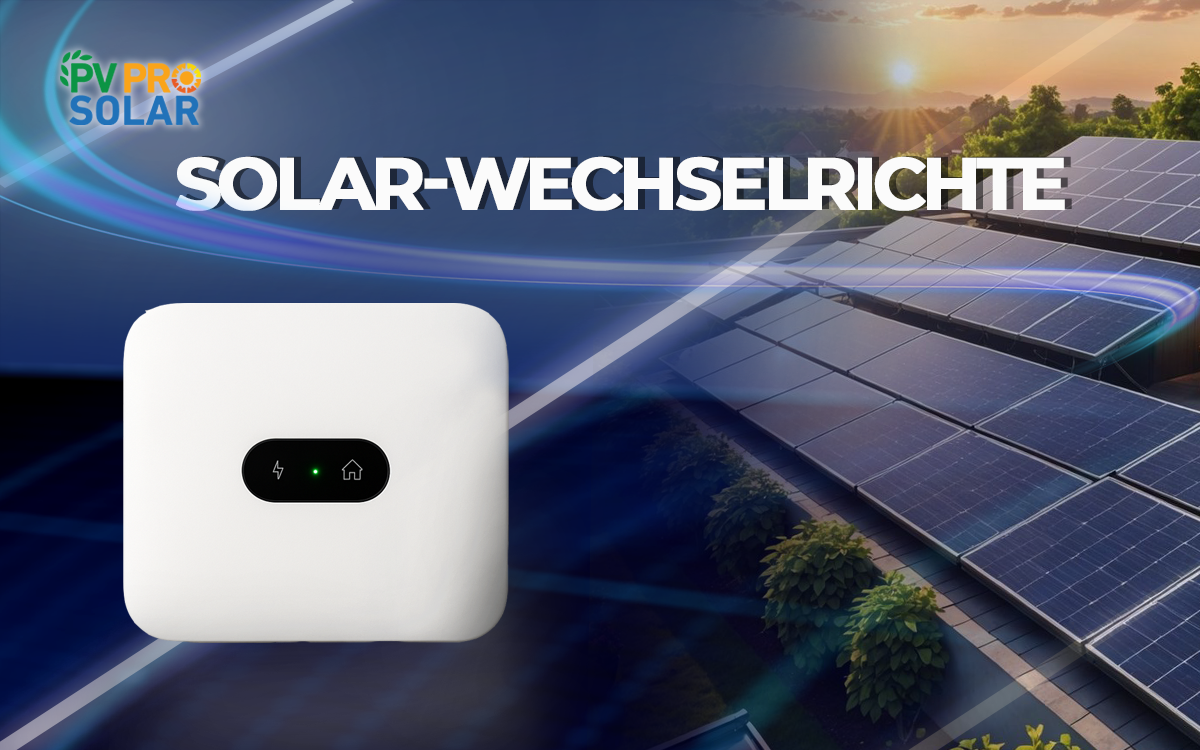
Solar Inverters Explained: Which Type Is the Best Choice?

Solar inverters are the technical core of any photovoltaic (PV) system. Without them, even the most advanced solar panels are ineffective, as only the inverter makes the generated solar power usable for households or businesses. Anyone seriously exploring solar energy must understand this central component.
PVPro Solar GmbH
In 3 Schritten zur PV-Anfrage
Bedarf klären · Daten senden · Angebot erhalten
Jetzt Anfrage sendenBedarf klären
Schritt 1
Daten senden
Schritt 2
Angebot erhalten
Schritt 3
Why Solar Inverters Are Crucial to Your System’s Efficiency?
Photovoltaic modules generate direct current (DC) electricity. However, household appliances, machinery, and the public electricity grid all operate using alternating current (AC). This is where solar inverters come in: they convert the DC electricity into usable AC and manage the entire flow of energy.
A high-quality PV inverter ensures:
- Minimal energy loss
- Optimised self-consumption
- Safe and stable operation
The better the inverter’s quality, the higher the actual yield of your entire solar system.
Solar Inverters in Everyday Use
Modern solar inverters do far more than operate quietly in the background. They monitor system performance, detect faults early, and intelligently adapt output based on changing conditions. Especially for households with high self-consumption or commercial users, this intelligent control is essential.
Users benefit from:
- Transparent performance data
- Improved control over electricity use
- Long-term operational reliability
In this way, solar inverters become an active part of your energy management strategy.
Types of Solar Inverters
Not all PV inverters are the same. The best type for your system depends on the system size, roof layout, and energy consumption habits.
Key types include:
- String inverters – Ideal for standard installations
- Hybrid inverters – Combine solar and battery storage
- Optimised systems – For complex or shaded roofs
Hybrid inverters are gaining popularity as they efficiently coordinate solar panels, storage systems, and the grid.
Solar Inverters in Hannover: Meeting Regional Demands
In areas like Lower Saxony, regional conditions must be considered. Solar inverters in Hannover, for instance, must cope with variable weather, partial shading, and non-uniform roof orientations.
A well-suited inverter for Hannover features:
- High adaptability
- Stable performance in low-light conditions
- Compatibility with battery storage systems
Even under less-than-ideal circumstances, this ensures consistently strong solar yields.
Understanding Solar Inverter Costs
Solar inverter costs vary based on several key factors:
- Size of the solar system
- Type of inverter
- Features such as battery integration
Although inverters make up only a portion of the overall system cost, they play an outsized role in system efficiency. A cheap inverter may end up being more expensive in the long run if it underperforms or doesn’t last.
Buying a Solar Inverter: What Really Matters
When buying a solar inverter, price alone shouldn’t be the deciding factor. What really matters is reliability, warranty coverage, and technical capabilities.
Key criteria include:
- Efficiency rating
- Manufacturer’s warranty
- Compatibility with battery storage
- Monitoring and control features
A quality inverter is a long-term investment that pays off for many years.
Hybrid Solar Inverters: The Future of Energy Independence
Hybrid inverters combine power generation, energy storage, and grid management in a single device. They’re the ideal solution for anyone looking to maximise self-consumption of solar power.
Advantages of hybrid inverters:
- Flexible use of solar energy
- Less dependence on the grid
- Ready for EV charging and heat pumps
For modern households and businesses alike, hybrid systems are a future-proof decision.
Inverters for Private Homes
The right inverter for a home PV system ensures solar power is used exactly when it’s needed. Smart systems prioritise self-consumption and reduce reliance on the grid.
Benefits include:
- Lower electricity bills
- Greater energy independence
- Improved predictability of energy use
This is where solar inverters can have a tangible, positive impact on everyday life.
Inverters for Commercial PV Systems
Businesses have different requirements. Commercial solar inverters must handle sustained high loads efficiently and cost-effectively.
Advantages for businesses:
- Stable power supply
- Reduced operating costs
- Stronger sustainability performance
A high-performance inverter can become a true competitive edge.
Comparing Inverters: Quality Over Brand Names
A thorough solar inverter comparison reveals a key insight: the most famous brand isn’t always the best choice. Technical specs, service availability, and long-term parts support are what truly count.
When comparing inverters, consider:
- Efficiency at partial load
- Software update capability
- Interfaces for energy management
This ensures you’ll find a solar inverter that perfectly fits your system.
Is There a “Best” Solar Inverter?
There’s no one-size-fits-all “best” inverter. What’s ideal for a single-family home might not work for a large business. The best inverter is always the one that fits your individual setup and goals.
What defines a “best” inverter:
- High efficiency
- Long service life
- Flexible upgrade options
Modern solar inverters are designed to meet diverse and evolving needs.
Safety and Longevity of Solar Inverters
One often overlooked factor is inverter lifespan. High-quality inverters are designed for continuous operation over many years. Built-in protections against overheating, voltage spikes, and grid fluctuations are now standard.
This ensures:
- Reliable operation
- Low maintenance costs
- Long-term investment security
Digital Monitoring and Control
Modern inverters provide detailed real-time data. Through apps or web portals, users can monitor energy yield, consumption, and battery status anytime.
This allows:
- Quick fault detection
- Smarter self-consumption
- Full system transparency
This turns the inverter into the digital control centre of your energy system.
Why the Right Inverter Choice Matters Long-Term?
A poorly sized or low-quality inverter can permanently limit the performance of an entire solar system. By contrast, a well-chosen inverter can extract the maximum value from every kilowatt hour.
With electricity prices on the rise, efficiency matters more than ever.
Your Path to High-Performance Solar Inverters
Whether for a private home or a business, choosing the right solar inverter directly impacts the economics, reliability, and future viability of your PV system. Expert consultation will help you find the ideal solution and enjoy long-term benefits.
Visit PVPro Solar GmbH to discover how modern inverters, hybrid systems, and smart energy solutions can take your solar installation to the next level.
Get personalised advice now and find the perfect inverter for your solar setup.
It converts the generated direct current (DC) into usable alternating current (AC) and manages the entire energy flow of the solar installation.
The best inverter matches your system size, supports energy storage, and offers high efficiency along with reliable monitoring and control functions. What does a solar inverter do in a PV system?
Which is the best solar inverter?
PVPro Solar GmbH
In 3 Schritten zur PV-Anfrage
Bedarf klären · Daten senden · Angebot erhalten
Jetzt Anfrage sendenBedarf klären
Schritt 1
Daten senden
Schritt 2
Angebot erhalten
Schritt 3