
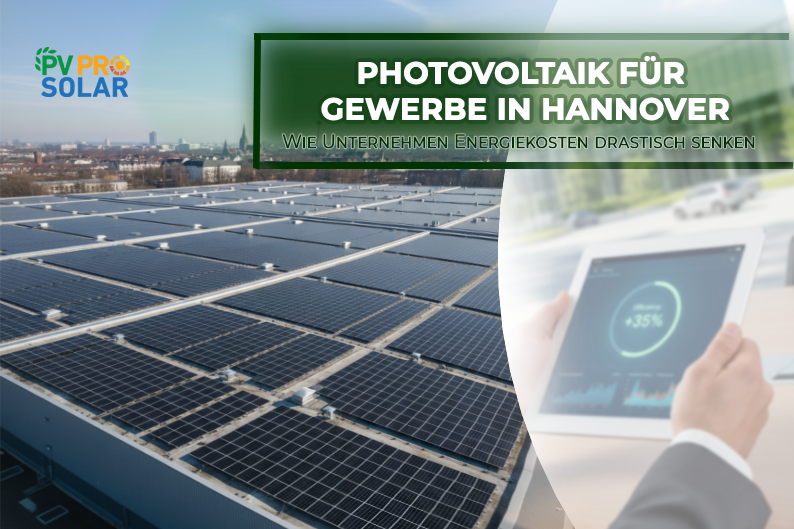
Commercial Photovoltaics in Hanover: How Businesses Can Dramatically Reduce Energy Costs

For most companies today, electricity is one of the largest ongoing operating expenses, and prices remain high. Businesses in Hanover that still rely entirely on grid electricity pay thousands of euros to utility providers every month, without any long-term cost certainty. Commercial photovoltaic systems in Hanover address this issue at its core: companies generate their own electricity, permanently reduce operating costs, and become less dependent on volatile energy markets. Businesses that invest in their own solar systems now also benefit from attractive subsidy programs and a return on investment that often outperforms many traditional capital investments.
PVPro Solar GmbH
In 3 Schritten zur PV-Anfrage
Bedarf klären · Daten senden · Angebot erhalten
Jetzt Anfrage sendenBedarf klären
Schritt 1
Daten senden
Schritt 2
Angebot erhalten
Schritt 3
Why Is Commercial Photovoltaics Especially Attractive in Hanover?
Hanover is not only the economic center of Lower Saxony, but also an ideal location for commercial solar energy systems. With approximately 1,600 hours of sunshine per year, the region offers reliable year-round solar power generation. In addition, extensive industrial and commercial zones such as Hanover-Linden, Vahrenheide, and the Expo Park area provide large rooftop surfaces on production facilities, logistics centers, and office buildings that are perfectly suited for solar installations.
The city itself is pursuing ambitious climate goals through 2035, creating a political and economic environment that actively supports commercial solar energy projects. For businesses, this offers two major advantages: access to local and regional funding programs, and the opportunity to position themselves as sustainable companies, an increasingly important factor for customers, business partners, and skilled professionals alike. A photovoltaic system in Hanover is no longer just an energy solution; it has become a genuine competitive advantage.
What Level of Savings Can Businesses Realistically Expect?
This is typically the first question every business owner asks, and the numbers are compelling. A commercial solar installation with a capacity of 100 kWp generates approximately 90,000 to 95,000 kWh of electricity annually in Hanover. With current industrial electricity prices ranging between €0.22 and €0.28 per kWh, this can translate into annual savings of up to €26,000 through direct self-consumption alone, without feeding any electricity back into the grid.
Companies that also install a commercial battery storage system can increase self-consumption rates from a typical 30–40% to as much as 70–80%. Excess solar energy generated during midday peak production is stored and used later when operational demand rises again in the morning or evening. Over a typical system lifespan of 25 years, the standard warranty period for modern high-performance solar modules, these savings can accumulate to several hundred thousand euros. At the same time, self-generated electricity protects businesses from future energy price increases, which remain more likely than any long-term decline in global energy markets.
What Funding Opportunities Are Available for Businesses in Hanover?
The funding landscape for commercial photovoltaic systems in 2025 is stronger than ever. At the federal level, Germany’s Renewable Energy Sources Act (EEG) guarantees feed-in tariffs for commercial systems over a 20-year period, ensuring predictable returns for surplus electricity fed into the grid. Businesses that prefer direct electricity marketing may even achieve higher revenues through energy trading models.
Germany’s KfW development bank also offers low-interest financing through Program 270, specifically designed for renewable energy projects, including commercial photovoltaic installations. In addition, the state of Lower Saxony provides supplementary subsidy programs that can significantly reduce investment costs depending on project size. There are also tax advantages: photovoltaic systems in Hanover are classified as business assets and can therefore be depreciated, reducing the company’s tax burden during the investment years. Businesses that strategically combine these incentives can reduce effective investment costs by 20–30%, significantly shortening the payback period.
What System Size Is Right for Your Business?
The ideal system size depends on three key factors: annual electricity consumption, available roof space, and the company’s load profile, that is, when and how consistently electricity is consumed throughout the day.
As a general guideline, approximately 1 kWp of installed solar capacity is required for every 1,000 kWh of annual electricity consumption. A medium-sized company using 200,000 kWh per year would typically benefit from a system between 150 and 200 kWp.
For larger industrial facilities or buildings with flat roofs, megawatt-scale systems may be appropriate, often utilizing bifacial solar modules and optimized inverters for maximum efficiency. Professional planning is essential: shading analysis, roof structural integrity, grid connection capacity, and self-consumption patterns must all be carefully aligned. Commercial photovoltaics in Hanover are not a one-size-fits-all solution, the most profitable system is always one tailored precisely to the company’s operational needs. Businesses that rely on generic package offers often leave substantial savings unrealized.
How Does Battery Storage Increase Self-Consumption?
Solar energy is generated when the sun shines, but business electricity demand often follows a different rhythm. During early morning production start-up and evening operations, solar generation is low, while midday solar production may exceed demand. This is where commercial battery storage systems provide significant value: they store excess solar energy generated during peak production periods and release it when electricity demand increases.
Modern commercial battery systems are available in capacities ranging from 50 kWh to well over 1,000 kWh and can be seamlessly integrated into existing energy management systems. Intelligent charging strategies allow businesses to use stored energy specifically during periods of high grid electricity prices, such as peak demand hours. Optimizing self-consumption in this way substantially improves the overall profitability of the solar installation. When combined with EV charging infrastructure for company fleets, businesses can create comprehensive energy ecosystems that significantly increase operational energy independence.
What Should Companies Look for When Choosing a Solar Installer in Hanover?
The success of a commercial solar project depends heavily on the quality and expertise of the installer. While the number of providers in Hanover continues to grow, not all companies have sufficient experience with large-scale commercial systems. Businesses should pay close attention to the following factors:
- Certifications: Only licensed electrical contractors with proven commercial photovoltaic experience should be considered.
- Regional references: Has the provider completed similar projects for businesses in Hanover or Lower Saxony?
- Comprehensive service: A provider that handles everything, from energy analysis and grid registration to funding consultation, saves time, costs, and administrative effort.
- Long-term support: Maintenance agreements and system monitoring ensure optimal performance for decades and protect against unexpected production losses.
- Transparent calculations: Reputable installers provide realistic performance forecasts and clear pricing structures without hidden costs.
An experienced commercial solar partner in Hanover will always begin with a detailed analysis of the company’s operational requirements before recommending a solution. Businesses should be cautious of providers offering standard packages without first assessing actual energy consumption and load profiles.
How Quickly Does a Commercial Photovoltaic System Pay for Itself?
Payback time is one of the most important factors in any business investment decision, and the figures strongly favor solar energy. A 150-kWp system with total investment costs of approximately €150,000 to €175,000 (net) and annual savings of €30,000 to €40,000 through reduced energy expenses typically achieves payback within four to six years. After that, the system can continue producing electricity at minimal cost for another 15 to 20 years.
Rising energy prices are likely to improve these projections even further over time: what is already profitable today is expected to become even more valuable in the future. Businesses investing in commercial solar systems today secure a long-term cost advantage over competitors that remain fully dependent on grid electricity. In the current market environment, this is not merely a theoretical benefit, it is a tangible competitive factor.
Take Action Now: Reduce Energy Costs Permanently
Choosing commercial photovoltaics in Hanover is no longer a question of if, but when. Between high electricity prices, attractive funding programs, short payback periods, and increasing pressure for sustainable corporate management, there has rarely been a better time to invest than 2025. The technology is mature, planning processes are streamlined, and the financial benefits begin from the very first day of operation.
Take the first step and consult experts who understand Hanover and specialize in commercial solar projects from planning through commissioning. Visit PVPro Solar GmbH and schedule your free initial consultation today, without obligation, fully customized, and based on concrete calculations tailored to your potential savings.
Yes, absolutely. Thanks to stable feed-in tariffs, low-interest KfW financing programs, and industrial electricity prices between €0.22 and €0.28 per kWh, commercial solar systems in Hanover currently achieve payback periods of just four to six years. The combination of Lower Saxony subsidy programs and tax depreciation incentives makes 2025 an especially attractive time to invest.
A common rule of thumb is 1 kWp of installed capacity for every 1,000 kWh of annual electricity consumption. A company with an annual consumption of 200,000 kWh would typically benefit from a system sized between 150 and 200 kWp. A professional load profile analysis by an experienced solar installer will determine the optimal configuration for your business.
Businesses in Lower Saxony can combine several incentives, including the EEG feed-in tariff (guaranteed for 20 years), KfW Program 270 low-interest loans, regional state subsidies, and tax depreciation benefits. Under favorable conditions, these incentives can reduce net investment costs by 20–30%.
The actual installation time for systems up to 200 kWp is generally between two and five working days. However, the planning and approval phase, including grid registration, typically takes four to eight weeks. An experienced installer coordinates all stages of the project and also assists with funding applications.
In most cases, yes. Businesses that are eligible for input tax deduction can generally reclaim the full VAT paid on the photovoltaic system as input tax. This immediately lowers the effective investment cost. For accurate tax classification, companies should always consult their tax advisor.
With self-consumption, the company directly uses the electricity it generates, reducing the need to purchase expensive grid electricity. With grid feed-in, surplus electricity is sold back to the public grid and compensated under the EEG feed-in tariff scheme. In most cases, maximizing self-consumption is financially more advantageous because the savings on electricity purchases exceed the feed-in compensation rates. Is commercial photovoltaics in Hanover worthwhile in 2026?
What system size does my business need for a cost-effective photovoltaic installation?
What funding options are available for commercial photovoltaic systems in Lower Saxony?
How long does it take to install a photovoltaic system for a commercial property?
Can my business reclaim VAT on a solar installation?
What is the difference between self-consumption and grid feed-in for commercial solar systems?
PVPro Solar GmbH
In 3 Schritten zur PV-Anfrage
Bedarf klären · Daten senden · Angebot erhalten
Jetzt Anfrage sendenBedarf klären
Schritt 1
Daten senden
Schritt 2
Angebot erhalten
Schritt 3