
Photovoltaic Lightning Protection: When It Is Necessary and What It Costs (2026)

An external lightning protection system (lightning rod) is generally not legally required for PV systems installed on standard residential homes. Internal surge protection, however, has been mandatory for new buildings since 2018 under DIN VDE 0100-443 and DIN VDE 0100-534. For systems of around 10 kWp and above, or where a property is located in an exposed position, industry associations recommend additional external lightning protection. In all cases, proper grounding and equipotential bonding are essential.
Disclaimer: This article is intended for general informational purposes only and does not replace a site-specific assessment in accordance with applicable standards. Whether your system requires lightning protection, and to what extent, can only be determined through an on-site evaluation by a qualified specialist contractor or certified lightning protection professional.
PVPro Solar GmbH
In 3 Schritten zur PV-Anfrage
Bedarf klären · Daten senden · Angebot erhalten
Jetzt Anfrage sendenBedarf klären
Schritt 1
Daten senden
Schritt 2
Angebot erhalten
Schritt 3
Does a PV System Increase the Risk of a Lightning Strike?
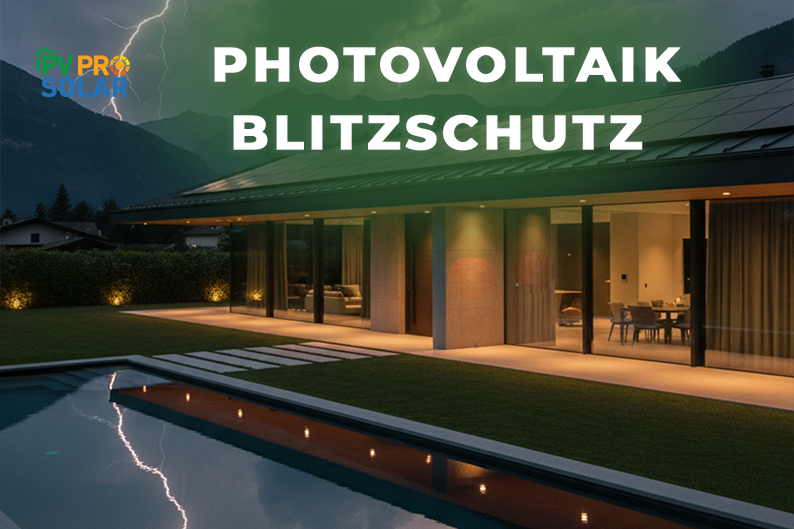
One of the most common concerns can be addressed immediately: No, a rooftop photovoltaic system does not attract lightning. Lightning generally strikes the highest point of a building, and a flush-mounted solar installation makes virtually no difference to that height.
What does change, however, is the potential extent of the damage. If lightning strikes a building, the absence of appropriate protection can result not only in the destruction of the costly PV system but also damage to household electrical equipment. There is also a risk of fire, and power surges can even propagate through the public electricity grid. The purpose of lightning protection is therefore not to address an increased likelihood of a strike, but rather to reduce the potentially significant financial consequences should one occur.
Is Lightning Protection Mandatory for Photovoltaic Systems?
It is important to distinguish between the two types of protection, as they are treated differently under regulations.
Internal Surge Protection – Mandatory for New Buildings
Surge protection within the AC electrical installation has been mandatory for newly planned buildings since 2018 under DIN VDE 0100-443 and DIN VDE 0100-534. It is typically installed in the meter cabinet and protects both the PV system and connected electrical devices against voltage spikes.
External Lightning Protection – Usually Optional for Residential Buildings
A traditional lightning rod system is generally not mandatory for PV installations on standard private residential properties.
Mandatory requirements do apply, however, to certain categories of buildings such as public buildings, assembly venues, and high-rise structures, which are subject to their own specific regulations.
Important for policyholders: Even where there is no statutory obligation, some insurers require proof of effective lightning protection when issuing photovoltaic insurance policies, including, in some cases, for smaller rooftop systems. It is therefore advisable to review your policy carefully. For more information, see our article on photovoltaic insurance.
From What System Size Does Lightning Protection Make Sense?
There is no universal threshold, and a definitive assessment can only be made on a case-by-case basis. However, the following guidelines provide useful orientation:
- Industry associations recommend external lightning protection particularly for systems of approximately 10 kWp and above.
- Additional protection is especially advisable where the building is in an exposed location, such as a freestanding property, a hilltop site, or a rural area.
- The need for protection also increases for flat roofs with elevated module mounting systems or where the PV installation forms the highest point of the building.
For non-specialists, determining the necessary scope of protective measures is difficult. The opinion of an independently advising qualified contractor is therefore essential.
External and Internal Lightning Protection Explained
A complete lightning protection system consists of two complementary components. They work together, they do not replace one another.
External Lightning Protection
External lightning protection, commonly known as a lightning rod system, is designed to prevent direct strikes to the solar modules.
Grounded air-termination rods intercept the lightning current and safely conduct it into the ground via down conductors. The modules, mounting structure, and cabling must all be located within the protective zone created by the air-termination system.
In modern installations using an isolated lightning protection system, a separation distance of approximately 0.5 to 1 metre is maintained between the lightning protection system and the PV installation to prevent flashover. The exact separation distance must be calculated for the specific installation.
Internal Lightning Protection and Surge Protection
Internal lightning protection safeguards the system against the effects of overvoltage.
Its central element is equipotential bonding, whereby all conductors and metallic components are connected to the main earthing terminal.
In addition, surge protective devices (SPDs) are installed. Type 1 and/or Type 2 surge arresters installed upstream and downstream of the inverter protect sensitive electronic components against voltage surges.
Grounding and Equipotential Bonding – The Minimum Requirement
Most residential properties do not require a separate external lightning protection system. In these cases, professionally executed grounding of the solar installation is the most important protective measure.
Even where no dedicated lightning protection system exists, equipotential bonding remains necessary to ensure both personal safety and equipment protection. To achieve this, the metallic mounting structure is connected to the building’s main earthing terminal.
What Does Lightning Protection for a PV System Cost?
Costs vary considerably depending on the measures required and the characteristics of the building. The following figures are non-binding estimates as of 2026 and do not constitute quotations or guarantees.
| Measure | Approximate Cost Range |
| Surge protection devices (SPDs) in the meter cabinet | approx. €100–500 |
| Grounding / equipotential bonding of the system | typically included as part of the installation |
| Complete external lightning protection system | approx. €1,000–5,000+ (highly dependent on the property) |
Actual costs may differ substantially depending on roof design, system size, and the structural characteristics of the property. A reliable quotation can only be provided following an on-site inspection.
Why Lightning Protection Should Be Left to Professionals
With lightning protection, more than with almost any other component, faults can be dangerous.
A poorly designed or improperly installed lightning protection system can actually increase the extent of damage during a lightning event, for example, if the separation distance is incorrect or components are connected improperly.
Calculating the required separation distance and ensuring installation in accordance with applicable standards should therefore always be entrusted to qualified professionals.
This is exactly where PVPro Solar can help. As a specialist solar contractor, we plan and install your photovoltaic system—including grounding, equipotential bonding, and surge protection—in full compliance with applicable standards and with complete documentation.
This ensures that your installation is not only technically safe but also well-positioned to meet insurance requirements.
Conclusion
External lightning protection is not mandatory for most residential PV systems, whereas internal surge protection has been required for new buildings since 2018.
Additional protection is advisable for systems of around 10 kWp or more, as well as for properties in exposed locations. The exact requirements, however, should always be assessed by qualified professionals.
By ensuring standards-compliant installation and proper documentation from the outset, you protect your investment and avoid potential issues with insurers.
Are you planning a new PV installation or would you like to review the lightning and surge protection measures for your existing system? Schedule a no-obligation consultation with PVPro Solar GmbH. We ensure safe, standards-compliant installations that protect both your system and your peace of mind.
No. Lightning generally strikes the highest point of a building, and a solar installation makes virtually no difference in this regard. However, it can increase the extent of potential damage if appropriate protection is not in place.
Internal surge protection has been mandatory for new buildings since 2018. External lightning protection is generally optional for standard residential properties but may be required by insurers.
Industry associations particularly recommend external lightning protection for systems of approximately 10 kWp and above, as well as for properties in exposed locations. A definitive assessment can only be made on an individual basis.
Surge protection installed in the meter cabinet generally falls within the lower three-digit euro range, while a complete external lightning protection system can cost significantly more depending on the property. Precise costs can only be determined following an inspection.
For many residential properties without dedicated lightning protection, professionally executed grounding combined with equipotential bonding represents the key protective measure. Whether this is sufficient depends on the size and location of the installation. Does a solar installation attract lightning?
Is lightning protection mandatory for PV systems?
From what system size is lightning protection recommended?
What does lightning protection for a PV system cost?
Is standard grounding sufficient?
PVPro Solar GmbH
In 3 Schritten zur PV-Anfrage
Bedarf klären · Daten senden · Angebot erhalten
Jetzt Anfrage sendenBedarf klären
Schritt 1
Daten senden
Schritt 2
Angebot erhalten
Schritt 3