
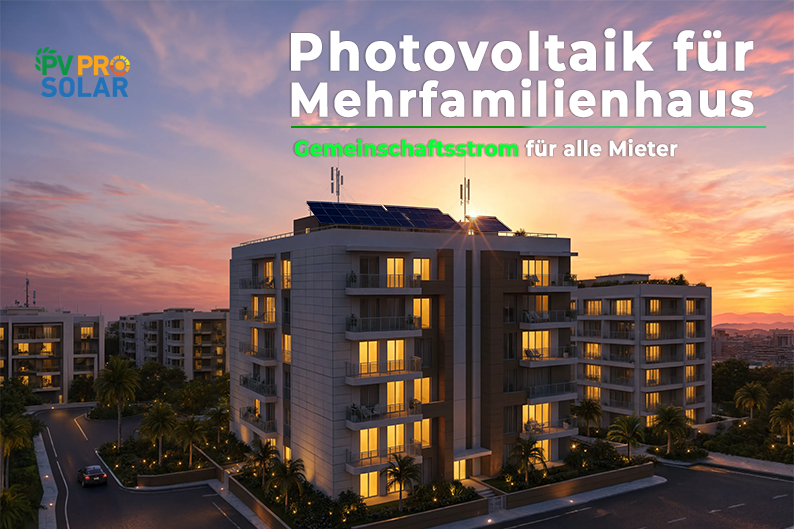
Photovoltaics for Multi Family Residential Buildings: Shared Solar Power for All Tenants
Diese Seite ist auch auf Deutsch verfügbar
Artikel auf Deutsch lesen
Solar energy is no longer limited to single-family homeowners. More landlords and homeowners’ associations are recognizing the potential of rooftop solar systems, while tenants benefit directly from lower electricity costs. Photovoltaic systems in multi family residential buildings provide more affordable electricity, increase property value, and, thanks to improved regulations in 2026, are easier to implement than ever before. This article explains the concept, how the tenant electricity model works, and the key factors to consider during implementation.
PVPro Solar GmbH
Bedarf klären · Daten senden · Angebot erhalten
Jetzt Anfrage sendenBedarf klären
Schritt 1
Daten senden
Schritt 2
Angebot erhalten
Schritt 3
What Is Photovoltaics for Multi Family Buildings and How Does It Work?
In a multi family residential building, a photovoltaic system is installed on the roof, and the electricity generated is supplied directly to tenants without passing through the public grid. The key advantage is that residents pay less than the standard utility rate, while landlords generate a stable additional source of income.
Definition: The Tenant Electricity Model
Under the tenant electricity model, the landlord or a service provider generates solar power on the building’s roof and sells it directly to tenants. The tenant electricity incentive under Germany’s Renewable Energy Sources Act makes this model financially attractive for both landlords and tenants.
A shared photovoltaic system typically supplies electricity for common areas such as stairwells, basements, and outdoor lighting, while also providing power to individual apartments if desired. Depending on the setup, battery storage can be added to make solar energy available during the evening or on cloudy days.
Why Is Solar Power Attractive for Landlords?
For landlords, solar energy is more than an environmental initiative. It is a sound financial investment with several advantages:
- Tenant electricity incentives provide government payments for each kilowatt hour supplied within the building.
- Increased property value, as buildings with solar installations often achieve higher sales prices and attract more tenants.
- Lower electricity costs for shared areas through self generated power.
- Greater energy security, as rising electricity prices make self consumption increasingly valuable.
- Stronger market appeal, since lower energy costs are an attractive selling point for prospective tenants, especially in major cities such as Hanover.
Landlords also contribute to the energy transition and can highlight this commitment as part of their sustainability strategy.
How Does the Tenant Electricity Model Work in 2026?
The tenant electricity model has become significantly simpler due to Solar Package I, which took effect in May 2024. A new concept known as shared building energy supply was introduced specifically for multi family buildings, reducing much of the previous administrative burden.
Step by Step Process
- A photovoltaic system is installed on the roof by a certified contractor.
- Electricity is distributed throughout the building using the existing grid connection.
- Smart meters are installed in each residential unit to measure consumption accurately.
- The metering operator manages allocation and billing, eliminating the need for landlords to handle these tasks.
- Tenants pay a reduced electricity rate, typically between 10% and 20% below local utility prices.
- Surplus electricity is fed into the public grid and compensated under current feed in tariff regulations.
The main benefit of this model is that landlords do not need to create their own electricity supply contracts or operate as energy providers. This significantly reduces administrative effort and makes the model economically viable even for smaller residential properties.
What Technical Requirements Are Needed?
Most residential buildings are suitable for photovoltaic projects, although a professional roof assessment is recommended.
Key Technical Requirements
- Roof Area: At least 30 to 50 square meters of usable space, preferably facing south, west, or east.
- Roof Condition: Remaining service life of at least 20 years. Renovation may be advisable before installation.
- Grid Connection: Sufficient network capacity, subject to utility approval.
- Smart Meters: Required for all residential units and installed by the metering operator.
- Battery Storage: Optional, but beneficial for increasing self consumption, especially in buildings with many tenants.
- System Size: Approximately 1 to 2 kilowatts peak per apartment. A building with 10 units would typically require a system between 10 and 20 kilowatts peak.
In Hanover and throughout Lower Saxony, average solar irradiation of approximately 1,000 kilowatt hours per kilowatt peak annually allows systems to achieve payback periods of roughly four to seven years.
Costs vary depending on building size, roof characteristics, and system design.
Typical Investment Costs
- Small system, 10 kilowatts peak, 4 to 6 units: approximately €12,000 to €18,000
- Medium system, 20 kilowatts peak, 8 to 12 units: approximately €22,000 to €32,000
- Large system, over 40 kilowatts peak, 15 to 25 units: from approximately €40,000
- Battery storage: approximately €8,000 to €20,000 depending on capacity
- Smart meter infrastructure: approximately €500 to €1,500 per residential unit
A 20 kilowatt peak system without battery storage in a 10 unit building typically achieves a return on investment within six to nine years, while offering an expected service life of 25 to 30 years.
What About Balcony Solar Systems for Tenants?
Not every tenant can wait for a shared building solution, and not every landlord is ready to invest. In these cases, balcony solar systems provide a simple alternative.
Since 2024, plug in solar devices with capacities up to 800 watts have been easier to install in Germany. Tenants only need to register them with the grid operator and inform the landlord.
While a balcony solar system does not replace a shared rooftop installation, it enables tenants to generate part of their own electricity. Typical savings range from €100 to €200 annually. However, a comprehensive shared building energy system generally delivers much greater long term savings.
What Incentives Are Available in 2026?
Support programs for photovoltaic projects in multi family buildings are more attractive than ever.
Available Programs
- KfW Program 270: Low interest loans for renewable energy projects, including residential photovoltaic systems.
- KfW Program 261: Additional support when combined with building energy renovations.
- BAFA Incentives: Depending on regional and program conditions, support may be available for battery storage and smart meter infrastructure.
- Regional Incentives in Hanover and Lower Saxony: Additional grants may be available for tenant electricity and photovoltaic projects.
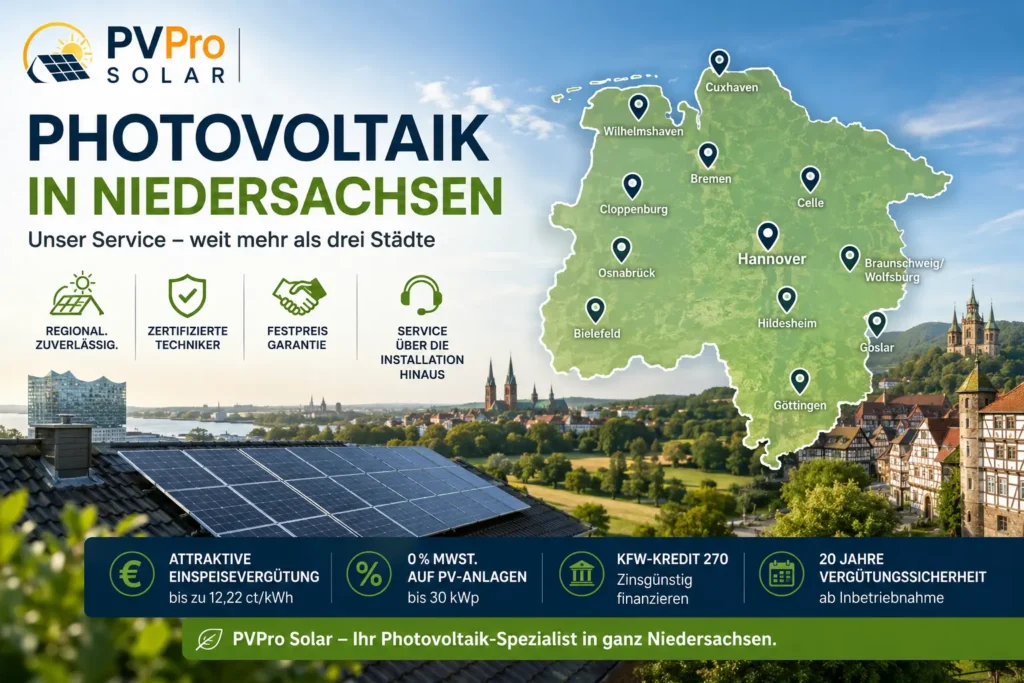
- Tax Benefits: Since 2023, photovoltaic systems up to 30 kilowatts peak on residential buildings qualify for a 0% value added tax rate, reducing upfront costs by up to 19%.
Landlords interested in entering the solar energy market should seek professional funding advice to maximize available incentives.
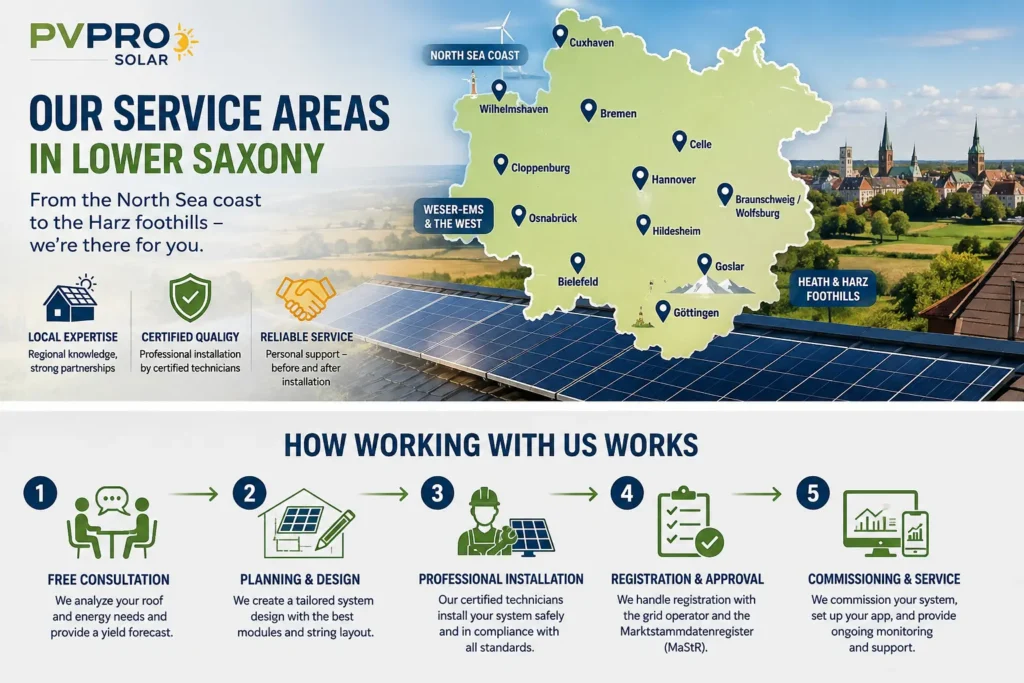
Why Are Residential Photovoltaic Projects Especially Attractive in Hanover?
Hanover and the wider Lower Saxony region offer excellent conditions for residential solar projects. Average solar irradiation reaches approximately 1,020 kilowatt hours per square meter annually, making photovoltaic systems financially attractive.
Cities such as Wolfsburg, Brunswick, Bremen, and Hanover are seeing strong growth in multi family solar projects because landlords increasingly recognize that lower energy costs are both a social benefit and a competitive advantage in challenging rental markets.
Conclusion
Photovoltaic systems for multi family residential buildings are among the most attractive investments available to landlords and property owners in 2026. They offer strong financial returns, access to incentive programs, and meaningful savings for tenants. Simplified tenant electricity regulations and the shared building energy supply model have made implementation easier than ever. Property owners who invest now can secure lower energy costs for decades while preparing their buildings for a more sustainable future.
PVPro Solar GmbH designs and installs photovoltaic systems for multi family residential properties across Hanover, Lower Saxony, Bremen, and Wolfsburg. Services include roof assessments, funding applications, and complete turnkey installations.
Request a free proposal today and bring shared solar energy to all tenants.
Do all tenants have to participate in the tenant electricity model?
No. Participation is voluntary. Tenants who choose not to join may keep their existing electricity provider. The shared building energy supply model remains economically viable even when only some tenants participate.
Does the landlord become an energy provider under this model?
Under the shared building energy supply framework introduced through Solar Package I, billing is handled by the metering operator. Landlords do not need an energy supplier license and face significantly less administrative work.
How Much Electricity Can a Photovoltaic System Generate?
A 20 kilowatt peak system in Hanover typically produces between 18,000 and 20,000 kilowatt hours annually. This is roughly equivalent to the yearly consumption of five to seven average households. In a 10 unit building, approximately 40% to 60% of total demand can be covered, depending on usage patterns.
Can I Install a Balcony Solar System if the Building Already Has a Rooftop Solar System?
Yes. However, technical integration should be coordinated to avoid overloading the building’s electrical infrastructure. Consultation with both the landlord and the installer is recommended.
What Is the Typical Contract Duration for Tenant Electricity Agreements?
Under current regulations, tenant electricity contracts may have a maximum term of one year and can only be extended for one additional year. This allows tenants to switch providers easily and prevents dependency on the landlord.
Yes, provided the roof remains in good condition. For buildings constructed before 1990, a combined roof renovation and photovoltaic installation strategy is often recommended. Many funding programs specifically support this approach.
PVPro Solar GmbH
In 3 Schritten zur PV-Anfrage
Bedarf klären · Daten senden · Angebot erhalten
Jetzt Anfrage sendenBedarf klären
Schritt 1
Daten senden
Schritt 2
Angebot erhalten
Schritt 3