
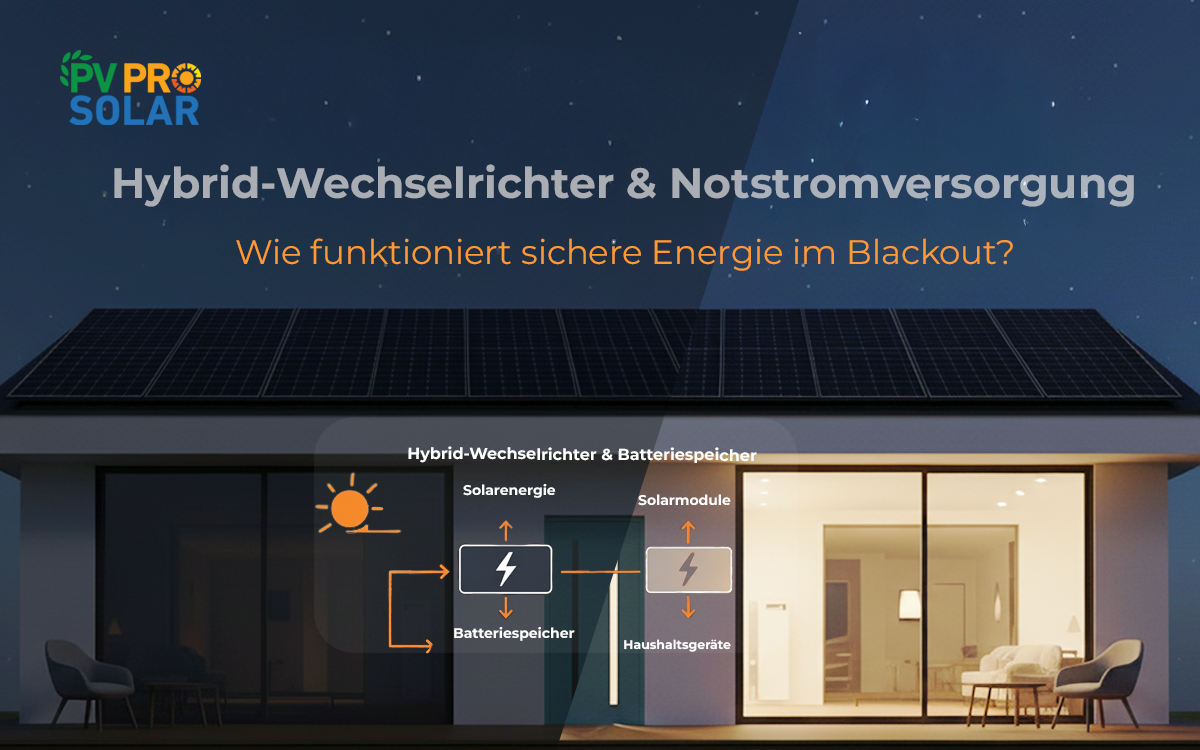
Hybrid Inverter with Backup Power: How to Stay Supplied During a Blackout
Diese Seite ist auch auf Deutsch verfügbar
Artikel auf Deutsch lesen
When the grid goes down, a normal solar system shuts off, for safety reasons it switches itself off. A hybrid inverter with backup power function changes that: it keeps supplying your house from the PV system and battery storage, even when the public grid is gone.But be careful, “backup power” isn’t just one thing. There’s a world of difference between a simple emergency-power outlet and a true full backup of the whole house. As a regional specialist company from Hannover, we’ll explain the differences, show you which devices qualify, and how the coupling with storage works, so it really holds up in an emergency.
Which solution suits you depends on what absolutely has to keep running in an emergency, and how much technology (and budget) you want to put into it. We’ll work that out specifically for your household in a consultation.
PVPro Solar GmbH
In 3 Schritten zur PV-Anfrage
Bedarf klären · Daten senden · Angebot erhalten
Jetzt Anfrage senden1
Bedarf klären
Schritt 1
2
Daten senden
Schritt 2
3
Angebot erhalten
Schritt 3
Emergency Power, Backup Power, UPS – What’s the Difference?
These three terms are often mixed up, but they mean very different things. This is exactly where most misunderstandings arise:- Emergency Power Supply (EPS): the simplest and most common variant. During a grid outage, the inverter supplies a defined backup outlet or a small circuit. There’s a brief interruption (often a few milliseconds to seconds) in which devices briefly switch off. Ideal for the fridge, router, lights, and phone charging.
- Backup Power / Full Backup: here an automatic transfer switch (ATS) disconnects the entire home network from the public grid and keeps it supplied. More comfortable, but technically more demanding, it requires a clean separation of all phases and the neutral conductor.
- UPS (Uninterruptible Power Supply): switches over with 0 ms interruption, for highly sensitive loads such as servers or medical equipment. A hybrid inverter is not a UPS in the sense of the standard. Anyone who needs “zero downtime” needs a separate UPS device.
When Does What Make Sense? A Quick Orientation
| You want to keep powered during an outage … | Suitable solution |
| Fridge, router, lights, laptop | Emergency power (EPS) is usually enough |
| Heat pump, stove, largely the whole house | Full backup with 4-pole ATS |
| Servers, IT, medical equipment (0 ms) | Additional UPS required |
Storage Coupling: Where the Backup Power Comes From
Backup power only works if energy is stored. The hybrid inverter connects the PV system and battery storage into one system: during the day the sun charges the storage, during an outage the storage supplies the critical loads, and as long as the sun shines, the PV system even keeps recharging in island mode.Important in practice:- Reserve capacity: in everyday use, the storage is used for self-consumption. For emergencies, a reserve can be defined that isn’t touched.
- Recharging in island mode: a well-planned system keeps using PV power even during an outage, significantly extending the bridging time during daylight.
- Watch inrush currents: motor loads such as a fridge, pump, or heat pump draw several times their rated power at startup. The inverter and storage must be sized for this, otherwise the system shuts down under load.
How Long Does the Battery Last in Backup Mode?
That depends on the usable capacity and your consumption. As a rough guide: a storage system with about 7 kWh of usable energy typically covers the base load (fridge, lights, router, communication) in a single-family home for several hours up to about a day. If it’s also recharged by PV during the day, this time extends considerably.Anyone wanting to run large loads such as a heat pump or stove during an outage needs correspondingly more power and capacity, and careful load planning with prioritization.Which Devices Qualify?
A hybrid inverter with backup power function isn’t a plug-and-play product. What matters is that the inverter, storage, and backup concept fit together and are installed to code.When selecting, we look for:- genuine backup/emergency-power capability (not just “backup-ready”),
- sufficient continuous and peak power for your critical loads,
- clean integration of a matched inverter and storage system,
- code-compliant protection and transfer switching technology.
Safely Installed: Standards and Protection Technology
Backup power reaches deep into the home’s electrical network, which is why professional, standards-compliant installation is mandatory. As a regional specialist company, we plan and install backup-capable hybrid systems in compliance with regulations:- Defined neutral conductor in island mode: for full backup, a 4-pole ATS cleanly separates all phases and the neutral conductor, this is the only way the protective devices function correctly in island mode and no feedback into the grid can occur.
- Surge and residual-current protection per the applicable VDE rules.
- Battery safety (installation location, fire protection) per the relevant requirements.
- Registration & documentation: grid operator registration, MaStR entry (storage registered separately from the PV system), and legally sound handover are all part of it, all from a single source with us.
Backup Power as Part of Your Blackout Protection
The question “What happens during a blackout?” concerns many homeowners, it also comes up in the FAQ on our homepage. A hybrid inverter with backup power is the technical answer to that: you stay supplied when others are sitting in the dark. We also show what a well-thought-out overall concept looks like in our article on backup power with a solar system.Get Advice on a Backup Power Solution Now
Want to know which backup power solution fits your house and which devices qualify? We plan and install backup-capable hybrid systems to code, all from a single source.Phone: 0511 3360603 Email: [email protected] Request a free quote, we’ll get back to you promptly.FAQs
What Is the Difference Between Emergency Power and Backup Power?
Emergency power (EPS) supplies a defined outlet or a small circuit during a grid outage, with a brief switchover interruption. Backup power in the sense of a full backup supplies the entire home network via an automatic transfer switch. Emergency power is simpler and sufficient for most households; full backup offers more comfort at higher cost.Do I Need a UPS for Sensitive Devices?
Yes. A hybrid inverter doesn’t meet the UPS standard and has a brief switchover time. For devices that can’t tolerate an interruption (servers, certain medical equipment), a separate UPS device is needed.Can the Entire Household Be Supplied During a Blackout?
Basically yes, but only with a full backup system including a correct 4-pole transfer switch and appropriate sizing. Large loads such as a heat pump or stove require correspondingly more power and capacity.How Long Does the Battery Last During a Power Outage?
Depending on storage size and consumption, usually several hours up to about a day for the base load. With PV recharging during the day, this time extends significantly. We give you a precise answer based on your consumption.Does the PV System Keep Charging in Backup Mode?
With a properly planned system, yes: as long as the sun shines, the PV system keeps recharging the storage even in island mode, extending the bridging time.Does the Storage Need to Be Registered?
Yes. The battery storage must be registered in the Marktstammdatenregister, separately from the PV system. We handle this registration as part of the installation.Can I Retrofit Backup Power?
Often yes, if the existing inverter is backup-capable or is replaced with a suitable hybrid device. We check your existing system and give you an honest answer on what’s practically feasible.PVPro Solar GmbH
In 3 Schritten zur PV-Anfrage
Bedarf klären · Daten senden · Angebot erhalten
Jetzt Anfrage senden1
Bedarf klären
Schritt 1
2
Daten senden
Schritt 2
3
Angebot erhalten
Schritt 3