
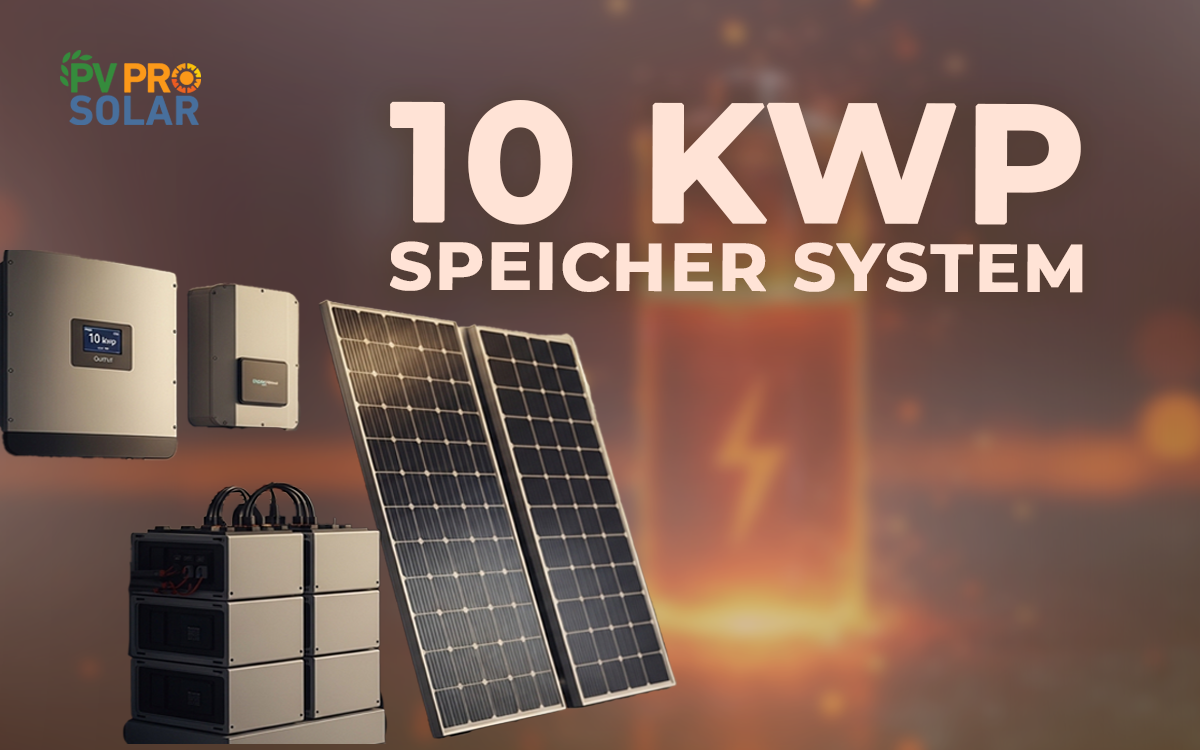
10 kWp Storage System – What Storage Capacity Truly Makes Sense?

A 10 kWp storage system has long since evolved beyond being a mere optional add-on to a photovoltaic (PV) installation. At this system size, the storage unit plays a decisive role in whether solar power is truly utilized—or largely wasted. Without smart storage, a significant portion of the solar energy produced during the day flows into the public grid, while costly electricity has to be bought back in the evening. A properly designed 10 kWp storage system closes this gap, transforming basic energy generation into intelligent energy management.
A modern 10 kWp storage system ensures that self-generated solar energy is available when it’s actually needed. This is especially important for households where peak energy consumption occurs in the morning and evening hours. As electricity prices continue to rise, storage systems are no longer a luxury—they’ve become a key economic component of any solar power setup.
PVPro Solar GmbH
In 3 Schritten zur PV-Anfrage
Bedarf klären · Daten senden · Angebot erhalten
Jetzt Anfrage sendenBedarf klären
Schritt 1
Daten senden
Schritt 2
Angebot erhalten
Schritt 3
Why a 10 kWp Storage System Is Indispensable Today?
A 10 kWp photovoltaic system generates approximately 9,000 to 10,000 kWh of electricity per year. Without storage, only about 25–35% of this energy can typically be used directly within the household. The rest is fed into the grid at feed-in tariffs that are significantly lower than the current retail electricity price. This is precisely where a 10 kWp storage system demonstrates its greatest advantage: it significantly boosts self-consumption and reduces dependence on utility providers.
With a well-matched storage system, self-consumption rates often increase to 60–80%. This not only cuts electricity costs but also improves the overall return on investment for the PV system. That’s why a 10 kWp storage system is no longer seen as an optional upgrade but as a fundamental part of modern PV planning.
Which Storage Capacity Makes Sense for 10 kWp?
Determining the ideal storage size for a 10 kWp system depends heavily on your actual electricity usage. Key factors include household size, consumption habits, and future developments such as e-mobility or heat pumps.
A practical rule of thumb is:
- Around 1 to 1.5 kWh of storage capacity per installed kWp
- For 10 kWp, that typically means 8 to 15 kWh of usable storage capacity
A storage system that’s too small won’t fully unlock the potential of your solar installation. One that’s too large will unnecessarily extend the payback period. So when considering which battery storage to install for a 10 kWp system, it’s better to aim for a balanced solution—rather than chasing maximum capacity.
The Optimal Storage Size for 10 kWp in Everyday Life
The storage capacity you choose determines how efficiently solar power can be used throughout the day. In a typical four-person household without an electric car, 8 to 10 kWh is often enough to cover evening and nighttime consumption primarily with solar energy.
If your electricity demand is higher, due to:
- An electric vehicle
- A heat pump
- Increased usage from home office setups or air conditioning
—then a larger battery size of 12 to 15 kWh is recommended. A well-planned 10 kWp storage system is based on real consumption data, not just theoretical peak values. This is what sets efficient systems apart from overpriced, off-the-shelf solutions.
10 kWp Solar + Storage as an Integrated Energy System
A 10 kWp PV system with storage isn’t just a collection of separate components. It functions as an intelligent, networked system. Modern energy management software monitors generation, consumption, and battery state in real-time—and automatically makes the most cost-effective decisions.
A high-quality 10 kWp storage system controls:
- When solar power is consumed directly
- When the battery charges or discharges
- When feeding energy into the grid is beneficial
This not only improves the efficiency of the system but also extends its lifespan by avoiding unnecessary charging cycles.
Realistic Assessment of the Economic Value
Yes, a 10 kWp storage system involves additional upfront investment—but it also significantly enhances the overall economic performance of the PV system. The more solar power you consume yourself, the less vulnerable you are to rising electricity prices.
Key financial benefits include:
- Lower electricity bills over the long term
- More predictable energy costs
- Increased property value
In practice, a well-designed 10 kWp storage system often pays for itself sooner than expected—especially as electricity prices continue to climb.
Future-Proofing with Modular Storage Solutions
Modern battery systems are designed for scalability. If you’re unsure about your long-term storage needs, modular solutions offer the flexibility to expand your system later—without having to replace the entire setup.
A future-proof 10 kWp storage system takes into account:
- Growing electricity demands
- New energy-consuming devices
- Ongoing technological developments
This keeps your system flexible and economically viable for years to come.
Focus on Technology, Efficiency, and Lifespan
Most modern 10 kWp storage systems use lithium-ion technology, which offers high efficiency, low charging losses, and a lifespan of up to 15 years. When combined with a 10 kWp PV system, this results in a low-maintenance, highly reliable energy setup.
But it’s not just about the technology itself—it’s about how well it’s integrated into the system as a whole.
Autonomy with Realistic Expectations
A 10 kWp storage system can significantly increase your household’s energy independence, though it won’t completely replace grid electricity. In summer, high levels of self-sufficiency are achievable; in winter, grid support remains necessary. Realistically, an energy autonomy rate of 60–80% is both economically sound and technically stable.
A well-designed 10 kW solar system with storage provides the ideal balance between self-sufficiency and grid connectivity.
Planning Is Key to Success
Whether or not your 10 kWp storage system reaches its full potential depends largely on proper planning. Roof orientation, usage patterns, battery size, and system compatibility must be carefully aligned. The earlier you address the question of which battery storage to choose, the more you can avoid costly mistakes.
Control, Efficiency, and Long-Term Value
A 10 kWp storage system transforms solar power into a manageable energy source. With the right battery size, an intelligent PV+storage setup, and a well-thought-out design, you get a system that cuts costs, boosts independence, and offers long-term security.
If you’d like to professionally plan or optimize your 10 kWp storage system, visit PVPro Solar GmbH.
Get a free consultation today and tailor your 10 kWp storage system to your household’s specific needs.
Most households benefit from a storage size of 8 to 15 kWh for a 10 kWp system. Key factors include energy usage patterns, household size, and any planned consumers such as EVs or heat pumps.
Yes, absolutely. A 10 kWp storage system significantly boosts self-consumption, reduces energy costs, and increases independence from rising electricity prices—even without an EV. What is the ideal battery size for a 10 kWp storage system?
Is a 10 kWp storage system worth it even without an electric car?
PVPro Solar GmbH
In 3 Schritten zur PV-Anfrage
Bedarf klären · Daten senden · Angebot erhalten
Jetzt Anfrage sendenBedarf klären
Schritt 1
Daten senden
Schritt 2
Angebot erhalten
Schritt 3