
What Truly Defines High-Quality Solar Modules Today?

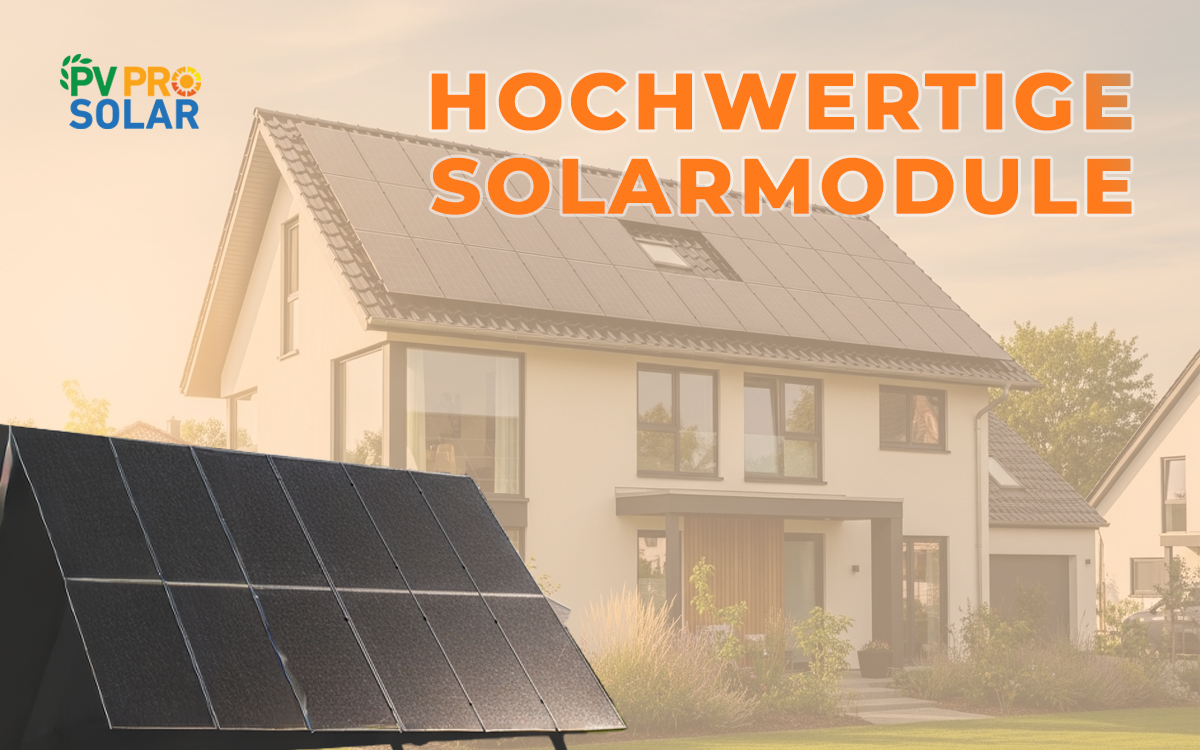
The market for high-quality solar modules has undergone significant changes in recent years. While price used to be the primary consideration, buyers today place greater emphasis on efficiency, long-term warranties, cell technology, and real-world performance. In regions such as Lower Saxony, Hanover, or Wolfsburg, expectations are clear: a photovoltaic system must deliver reliable output even under variable weather conditions.
High-quality solar modules are defined not merely by their high wattage ratings but also by their consistent performance in diffuse light, low degradation rates, and durable components. Those who think long term compare not only the unit price but also the Levelized Cost of Energy (LCOE) and warranty terms.
Many property owners want to purchase premium solar modules without compromising on technology. The focus is no longer on “the most powerful module,” but rather on the optimal interaction between module performance, inverter, and storage system. This is precisely where standard products differ from truly high-quality photovoltaic solutions.
PVPro Solar GmbH
In 3 Schritten zur PV-Anfrage
Bedarf klären · Daten senden · Angebot erhalten
Jetzt Anfrage sendenBedarf klären
Schritt 1
Daten senden
Schritt 2
Angebot erhalten
Schritt 3
What Technical Features Distinguish Premium Solar Modules from Standard Modules?
When comparing high-quality PV modules with lower-cost alternatives, several key differences become apparent:
1. Solar Cell Efficiency
Modern premium solar cells now achieve efficiencies of 21–23%. This translates into higher output per square meter—particularly important where roof space is limited.
2. Cell Technology (TOPCon, HJT, N-Type)
Technologies such as N-Type cells and HJT minimize performance losses and reduce light-induced degradation (LID). High-quality solar modules increasingly rely on these advanced technologies.
3. Temperature Coefficient
A low temperature coefficient means reduced performance losses in hot conditions—especially relevant for commercial and flat-roof installations.
4. Mechanical Durability
Premium photovoltaic modules are more resistant to snow loads, wind pressure, and microcracks.
5. Warranty & Degradation
While standard modules often offer a 12-year product warranty, manufacturers of high-quality solar modules now provide up to 25–30 years, including linear performance warranties.
Anyone looking to purchase premium solar modules should therefore look beyond watt-peak ratings and consider the overall package: quality, origin, and certification.
Why Do High-Quality Solar Modules Play a Central Role in Investment Returns?
A photovoltaic system is an investment spanning 20–30 years. Every percentage point of reduced degradation has a direct impact on overall return.
Premium solar modules provide:
- More stable yields on east-/west-facing roofs
- Lower performance losses in winter
- Better performance under partial shading
- Higher residual system value
With rising electricity prices and dynamic grid tariffs, self-consumption rates are becoming increasingly important. High-quality PV modules increase the share of self-generated electricity, especially when combined with storage solutions.
In regions such as Bremen or Hanover, where roof space is often limited, output per square meter is crucial. This is why more property owners are consciously choosing high-quality photovoltaic modules over low-cost imports.
How Can You Identify High-Quality Solar Modules in an Offer?
Not every quotation is transparent. The following criteria help with evaluation:
Technical Specifications:
- Efficiency ≥ 21%
- Degradation < 0.4% per year
- N-Type or TOPCon technology
- PID resistance
Certifications:
- TÜV
- IEC 61215 & 61730
- Fire classification
Manufacturer Bankability:
Established, financially stable manufacturers provide long-term security in case of warranty claims.
While premium solar modules may be slightly more expensive upfront, the cost of electricity generation decreases due to higher yields.
Anyone looking to buy high-quality solar modules should also request references from comparable projects—especially installations in Lower Saxony or Northern Germany with similar weather conditions.
What Role Do High-Quality Solar Cells Play Within the Module?
At the core, cell quality determines performance. Premium solar cells influence:
- Light absorption in low-irradiance conditions
- Module lifespan
- Stability under temperature fluctuations
- Reduction of hotspots
Modern high-quality solar modules frequently use N-Type cells, as they are less susceptible to light-induced effects. As a result, performance remains stable even after 20 years.
The qualitative difference often becomes visible only after 5–10 years of operation. This is why premium solar modules are more economical in the long term—even if the initial investment is slightly higher.
Are High-Quality Solar Modules Particularly Beneficial in Lower Saxony?
Northern Germany has fewer sunshine hours than Southern Germany—yet photovoltaics are still worthwhile. Module quality is the decisive factor.
Premium solar modules with strong low-light performance achieve better yields under diffuse conditions, making them particularly attractive in Hanover, Wolfsburg, or Bremen.
Many property owners underestimate the advantage of high-quality PV modules on east-/west-facing roofs. Thanks to improved temperature stability and optimized cell architecture, these modules deliver consistent output even in variable weather.
For commercial installations in Lower Saxony, high-quality photovoltaic modules ensure greater long-term stability—an important consideration for investors and financing partners.
Is the Higher Price of Premium Solar Modules Economically Justified?
A simple comparison illustrates the point:
- 10 kWp standard system
- 10 kWp system with premium solar modules
Even an additional 3–5% annual yield can amount to several thousand euros over 25 years.
Additional factors include:
- Lower replacement risk
- Higher feed-in revenues
- Better resale value
Premium solar modules reduce the risk of unplanned maintenance. For businesses, this predictability is essential.
Those who choose to buy high-quality solar modules, therefore, think beyond initial costs and focus on long-term energy efficiency.
What Trends Will Shape the Premium PV Module Market in 2026?
The market is evolving rapidly. Current trends include:
- N-Type technology is becoming dominant
- Larger module formats (up to 450–500 Wp)
- Glass-glass modules with enhanced durability
- Integration with storage and energy management systems
High-quality solar modules are increasingly viewed as part of a comprehensive energy system rather than as standalone products.
In the residential (B2C) segment, demand for complete solutions, including storage, is rising. Premium solar cells significantly increase energy autonomy.
How Do High-Quality Solar Modules Influence Storage Integration?
A battery system can only store the energy the roof produces. Premium solar modules, therefore, directly increase usable storage capacity.
Benefits include:
- Faster amortization
- Higher self-consumption rates
- Improved load shifting
High-quality solar modules generate sufficient energy even under low irradiation to charge storage systems efficiently.
In single-family homes with heat pumps or EV charging stations, the combination of premium photovoltaic modules and battery storage offers exceptional future security.
What Should Commercial Customers Consider When Choosing Premium Solar Modules?
Industrial and commercial installations have distinct requirements:
- Higher mechanical loads
- Long operating lifetimes
- Minimal failure rates
Glass-glass PV modules are particularly sought after in this sector, offering increased stability and reduced fire risk.
Premium solar modules also ensure stable yields in large-scale installations—essential for accounting and ESG reporting.
Companies planning to purchase high-quality solar modules should pay close attention to manufacturer bankability and proven project experience.
Why Proper Planning Matters More Than Module Price Alone
Even the best solar modules only reach their full potential with optimal system design.
Key factors include:
- Roof pitch and orientation
- Shading
- Inverter sizing
- Storage strategy
- Grid connection concept
Many performance issues result from incorrect system design rather than module selection. Premium solar modules deliver maximum returns only when the entire system is planned as an integrated solution.
Why Long-Term Thinkers Choose High-Quality Solar Modules
The difference between standard products and premium solar module solutions often becomes apparent not in the first year, but over decades. Higher efficiency, lower degradation, and stronger warranties ensure long-term stability and returns.
Anyone looking to purchase high-quality solar modules should combine expert consultation, advanced technology, and regional experience. In Lower Saxony and Northern Germany in particular, a focus on quality pays off.
Visit PVPro Solar GmbH for a personalized analysis of your roof. Our experts design your system using premium solar module solutions and optimal storage integration.
Request a non-binding consultation today and start securing your energy future.
Depending on technology and manufacturer, premium solar modules currently range between €250–€400 per module. However, the decisive factor is the overall return over 25 years.
Modern premium solar modules offer product warranties of up to 30 years and linear performance guarantees with minimal annual degradation. What do premium solar modules cost per kWp?
How long do high-quality solar modules last?
PVPro Solar GmbH
In 3 Schritten zur PV-Anfrage
Bedarf klären · Daten senden · Angebot erhalten
Jetzt Anfrage sendenBedarf klären
Schritt 1
Daten senden
Schritt 2
Angebot erhalten
Schritt 3