Skip to content
0511 3360603|WhatsApp: +49 176 2399 8536|★ 5,0/5 · Google-Bewertungen · regionaler Photovoltaik-Spezialist aus Hannover · Festpreis-Garantie
Photovoltaik Hannover | PV-Anlage vom Photovoltaik-Spezialisten | PVPro Solar GmbH
  • Projects
  • Products
  • About Us
  • Blog
  • Contact

  • DE

Kostenloses Angebot
Photovoltaik Hannover | PV-Anlage vom Photovoltaik-Spezialisten | PVPro Solar GmbH
Shopping Cart 0
Home / Products & Technology / How Are Solar Panels Connected?

How Are Solar Panels Connected?

Diese Seite ist auch auf Deutsch verfügbar

🇩🇪Artikel auf Deutsch lesen→
ByMahmoud Ghazy 4. September 2026 Products & Technology Reading Time: 3 minutes
Building a reliable and efficient solar power system requires careful planning and several key steps. By understanding how solar panels are interconnected, homeowners gain better insight into system complexity and can make informed decisions when investing in renewable energy. This guide outlines the essential steps for connecting solar panels, from initial installation to grid integration, covering key concepts such as renewable energy, photovoltaics, and more.

PVPro Solar GmbH

Table of Contents hide
1 Basics of Connecting Solar Panels
2 Connecting the Solar Panels
2.1 Series vs. Parallel Connection:
3 Installing the Inverter
3.1 Types of Inverters:
4 Connecting to the Power Grid
4.1 Off-Grid and Hybrid Systems:
5 Final Considerations
6 Conclusion
In 3 Schritten zur PV-Anfrage

Bedarf klären · Daten senden · Angebot erhalten

Jetzt Anfrage senden
1

Bedarf klären

Schritt 1

2

Daten senden

Schritt 2

3

Angebot erhalten

Schritt 3
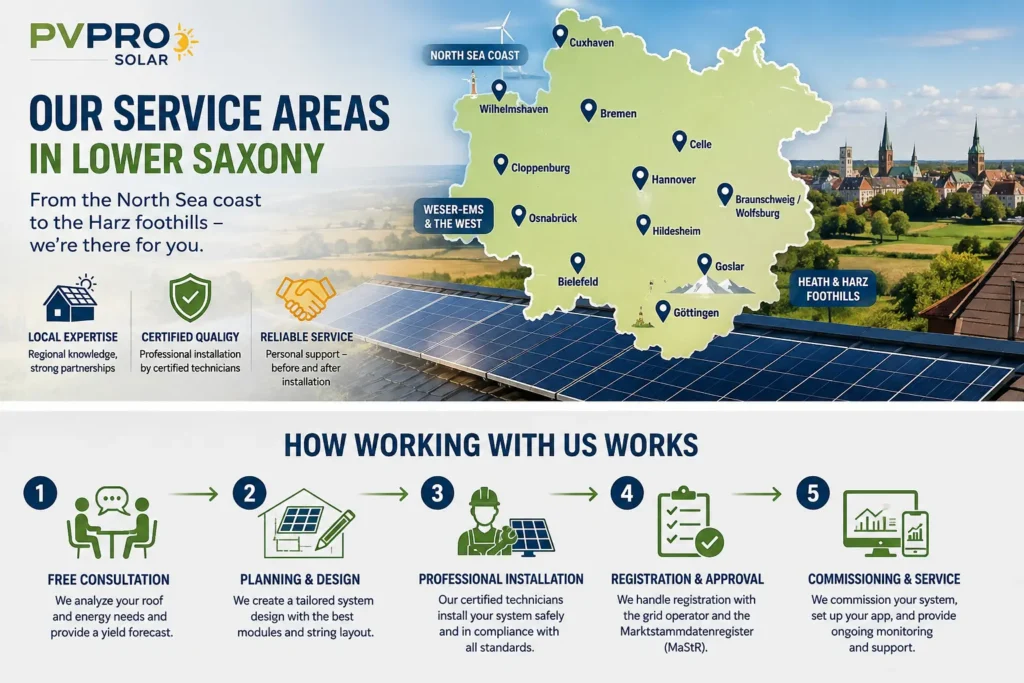
Basics of Connecting Solar Panels

Solar panels are made up of photovoltaic cells (PV cells) that convert sunlight into direct current (DC). To use this electricity in the home, it must be converted into alternating current (AC), which is what most household appliances use. Connecting solar panels involves wiring the modules together, installing an inverter, and connecting the system to the home’s electrical grid.

Connecting the Solar Panels

Series vs. Parallel Connection:

  • Series Connection: In a series connection, the positive terminal of one panel is connected to the negative terminal of the next. This method increases the total voltage while keeping the current constant. Series connections are often used when the system voltage needs to be matched to the inverter’s input requirements.
  • Parallel Connection: In a parallel connection, all positive terminals are connected to each other, and all negative terminals are connected to each other. This method increases the current while keeping the voltage constant. Parallel connections are ideal for maximizing output under shaded conditions, since a shaded panel doesn’t drastically affect the overall system performance.
  • Panel Combination: Depending on energy needs, both series and parallel connections can be combined to optimize system performance. This configuration is known as a series-parallel connection and helps match voltage and current to the inverter’s specifications.

Installing the Inverter

Once the solar panels are connected, an inverter is installed. The inverter is a crucial component that converts the direct current generated by the panels into alternating current.

Types of Inverters:

  • String Inverters: This is the most common type, in which all solar panels are connected in series (a string) and the inverter converts the combined output into alternating current. Although cost-effective, string inverters can be less efficient if some panels are shaded or dirty.
  • Microinverters: These are installed on each individual panel and convert direct current into alternating current directly at the panel level. This allows each panel to operate independently, making the system more efficient under varying conditions, although they are typically more expensive.
  • Power Optimizers: These are similar to microinverters but are combined with a string inverter. Power optimizers maximize each panel’s output before sending electricity to the inverter, striking a balance between efficiency and cost.

Connecting to the Power Grid

After the inverter is installed, the solar system must be connected to the home’s electrical panel and then to the power grid. This allows you to use solar power in your home and feed surplus electricity into the grid through the net metering system.Grid-Tied Systems: Most residential solar systems are grid-tied, meaning they are connected to the public power grid. With this setup, you can draw electricity from the grid when your solar panels aren’t producing enough power, and sell surplus electricity back to the utility through the net metering system.

Off-Grid and Hybrid Systems:

  • Off-Grid Systems: These systems operate independently of the public grid and require battery storage to supply electricity when solar production is low.
  • Hybrid Systems: Hybrid systems combine the advantages of grid-tied and off-grid systems through battery storage. This setup provides greater energy independence and backup power during outages.

Final Considerations

  • Safety Measures: Proper grounding and the use of safety switches are essential to protect both the system and the home from electrical faults or surges.
  • Costs and Incentives: The cost of a solar system can vary depending on the scope of the installation and the equipment used. It’s important to check existing incentives, such as the Renewable Energy Sources Act 2024, to help lower upfront costs.
  • Long-Term Efficiency: To ensure long-term efficiency, consider integrating your system with storage solutions such as a solar system with battery storage. This allows you to store surplus energy for use at night or on cloudy days, boosting both savings and energy independence.

Conclusion

Connecting solar panels involves a detailed process of wiring, inverter installation, and grid integration designed to maximize energy efficiency. Understanding these connections allows you to make more informed decisions.

PVPro Solar GmbH

In 3 Schritten zur PV-Anfrage

Bedarf klären · Daten senden · Angebot erhalten

Jetzt Anfrage senden
1

Bedarf klären

Schritt 1

2

Daten senden

Schritt 2

3

Angebot erhalten

Schritt 3
Post navigation

Previous Previous
Solar Systems in Extreme Weather Conditions: Performance in Heat, Cold, and Storms
NextContinue
Innovative Uses for Solar Panels: From Rooftops to Portable Power Supplies

Ähnliche Beiträge

  • Tax-Free Photovoltaic System: Conditions & Requirements

    Mehr erfahren → Tax-Free Photovoltaic System: Conditions & Requirements
    Reading Time: 4 minutes
  • Solar Panels in Lower Saxony

    Solar Panels in Lower Saxony: Our Service Areas Beyond Hannover

    Mehr erfahren → Solar Panels in Lower Saxony: Our Service Areas Beyond Hannover
    Reading Time: 5 minutes
  • Photovoltaik in Niedersachsen

    Photovoltaik in Niedersachsen: Unsere Servicegebiete im Überblick

    Mehr erfahren → Photovoltaik in Niedersachsen: Unsere Servicegebiete im Überblick
    Reading Time: 5 minutes
  • EEG-Reform 2026 Änderungen

    EEG Amendment 2027: Lock In Your Feed-in Tariff Before the End of 2026

    Mehr erfahren → EEG Amendment 2027: Lock In Your Feed-in Tariff Before the End of 2026
    Reading Time: 9 minutes
  • solarcarport mit speicher

    Solar Carport Costs 2026: What You’ll Really Pay

    Mehr erfahren → Solar Carport Costs 2026: What You’ll Really Pay
    Reading Time: 4 minutes
  • photovoltaik dachsanierung

    Solar Panels and Roof Renovation Combined: The Guide for Hannover and the Region

    Mehr erfahren → Solar Panels and Roof Renovation Combined: The Guide for Hannover and the Region
    Reading Time: 5 minutes
PVPro Solar GmbH – Ihr Partner für Photovoltaik HRB 227934, Amtsgericht Hannover
USt-IdNr. DE361555471
Geschäftsführer: Volker Bünger
Dein Investitionsschutz Festpreis-Garantie
Servicegarantie über die gesetzliche Gewährleistung hinaus
Qualität und Technik Premium-Komponenten: AIKO · JA Solar · Fronius · BYD · K2 Systems
Zertifizierte Monteure, VDE- und TAB-konforme Installation
Anlagenmonitoring inklusive
Anmeldung Netzbetreiber und MaStR aus einer Hand
Photovoltaik aus Hannover

Bereit für deine eigene Photovoltaikanlage?

Lass dein Projekt technisch prüfen und erhalte ein transparentes, individuell geplantes Angebot – von der Planung bis zur Inbetriebnahme.

Kostenloses Angebot anfragen Kontakt aufnehmen
PVPro Solar GmbH – Photovoltaik aus Hannover

PVPro Solar ist dein regionaler Ansprechpartner für individuell geplante Photovoltaikanlagen, Stromspeicher und Wallboxen in Hannover und Umgebung. Wir begleiten dein Projekt von der technischen Planung bis zur Inbetriebnahme.

★★★★★ 5,0/5 · Google-Bewertungen

Leistungen

  • Photovoltaikanlagen
  • Stromspeicher
  • Wallbox & E-Mobilität
  • Balkonkraftwerke
  • Solar-Rechner
  • Alle Produkte

Unternehmen

  • Über uns
  • Referenzen
  • Ratgeber
  • Häufige Fragen
  • Kostenloses Angebot
  • Kontakt

Kontakt

PVPro Solar GmbH
Eichstraße 51
30161 Hannover
  • 0511 3360603
  • [email protected]
  • WhatsApp: +49 176 2399 8536

Erreichbarkeit Mo.–Fr. 8:30–16:00 Uhr
Sa. 10:00–14:00 Uhr

© 2026 PVPro Solar GmbH. Alle Rechte vorbehalten.

  • Impressum
  • Datenschutz
  • AGB
  • Widerrufsbelehrung
  • Cookie-Richtlinie

Review Cart

No products in the cart.

Zustimmung verwalten

Wir verwenden Cookies, um unsere Website besser und sicherer zu machen. Deine Daten werden vertraulich behandelt und nicht ohne deine Einwilligung an Dritte zu Werbezwecken weitergegeben.

Mit deiner Zustimmung hilfst du uns, unsere Website und Angebote weiter zu verbessern.

Funktional Always active
Die technische Speicherung oder der Zugang ist unbedingt erforderlich für den rechtmäßigen Zweck, die Nutzung eines bestimmten Dienstes zu ermöglichen, der vom Teilnehmer oder Nutzer ausdrücklich gewünscht wird, oder für den alleinigen Zweck, die Übertragung einer Nachricht über ein elektronisches Kommunikationsnetz durchzuführen.
Präferenzen
Die technische Speicherung oder der Zugriff ist für den rechtmäßigen Zweck der Speicherung von Präferenzen erforderlich, die nicht vom Abonnenten oder Benutzer angefordert wurden.
Statistiken
Die technische Speicherung oder der Zugriff, der ausschließlich zu statistischen Zwecken erfolgt. Die technische Speicherung oder der Zugriff, der ausschließlich zu anonymen statistischen Zwecken verwendet wird. Ohne eine Vorladung, die freiwillige Zustimmung deines Internetdienstanbieters oder zusätzliche Aufzeichnungen von Dritten können die zu diesem Zweck gespeicherten oder abgerufenen Informationen allein in der Regel nicht dazu verwendet werden, dich zu identifizieren.
Marketing
Die technische Speicherung oder der Zugriff ist erforderlich, um Nutzerprofile zu erstellen, um Werbung zu versenden oder um den Nutzer auf einer Website oder über mehrere Websites hinweg zu ähnlichen Marketingzwecken zu verfolgen.
  • Manage options
  • Manage services
  • Manage {vendor_count} vendors
  • Read more about these purposes
Einstellungen ansehen
  • Cookie-Richtlinie
  • Datenschutzerklärung
  • Impressum

über WhatsApp kontaktieren

Search

  • DE

  • Projects
  • Products
  • About Us
  • Blog
  • Contact
Kostenloses Angebot
Search