
Why Is the Best Direction for Solar Panels in Germany So Important?
 Uncategorized
Reading Time: 4 minutes
Uncategorized
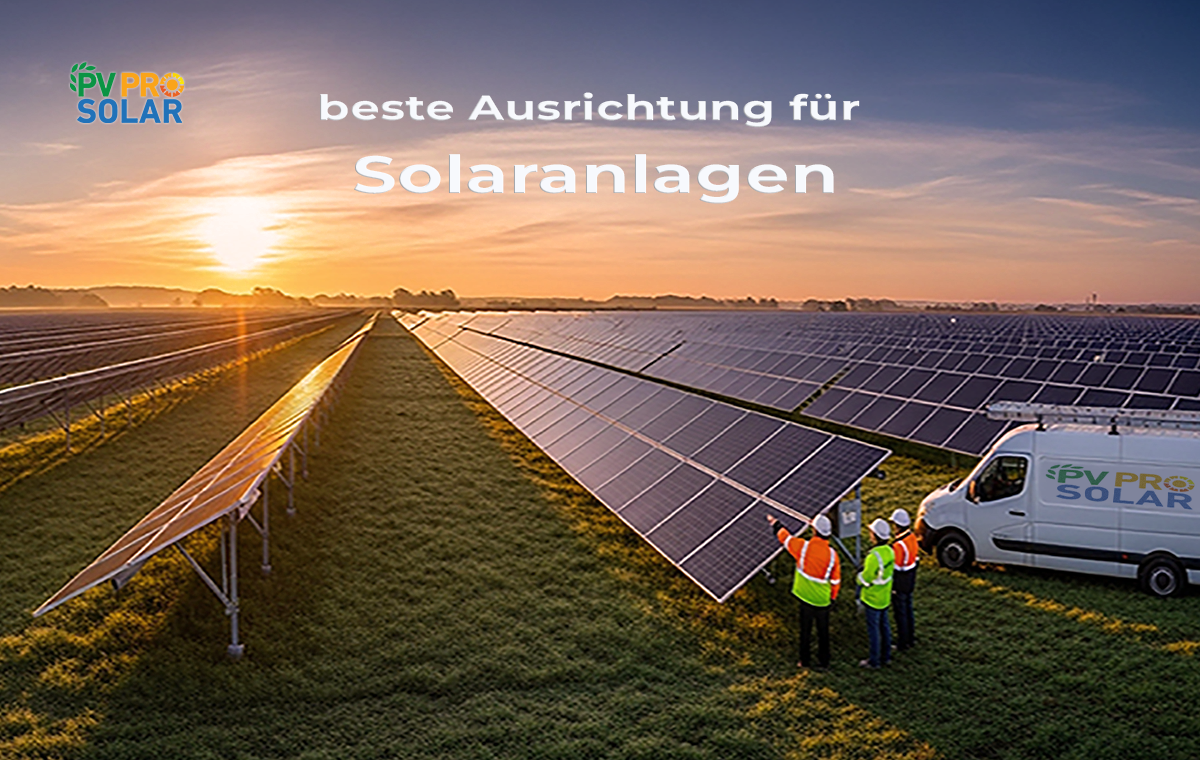
Reading Time: 4 minutes The orientation of your photovoltaic system has a greater impact on energy output than many people realize. The position of your solar panels determines how much sunlight they can capture throughout the year — and how efficiently that sunlight can be converted into solar power.
Especially in a country like Germany, with its varying latitudes, unpredictable weather, and seasonal fluctuations, careful site-specific planning is essential.
You might be wondering: Is a perfect south-facing roof always the best option? Could an east-west orientation be a viable alternative? Do flat roofs offer specific advantages? This guide provides clear answers to these questions — supported by scientific data, real-world performance comparisons from cities like Hannover, Bremen, and Munich, and practical recommendations for residential homes, businesses, and industrial customers.
PVPro Solar GmbH
In 3 Schritten zur PV-Anfrage
Bedarf klären · Daten senden · Angebot erhalten
Jetzt Anfrage sendenBedarf klären
Schritt 1
Daten senden
Schritt 2
Angebot erhalten
Schritt 3
Key Factors That Influence the Best Direction for Solar Panels in Germany
1. Geographic Location
Germany spans a range of latitudes, and solar radiation levels differ significantly between northern and southern regions.
Examples:
- Freiburg / Munich: ~1150–1200 kWh/m² per year
- Hamburg: ~1050 kWh/m² per year
A roof in Bavaria, for instance, generally offers the highest energy potential for a PV system.
2. Seasonal Variation
- Summer: The sun is high in the sky — shallow panel angles offer better performance.
- Winter: The sun is lower — steeper angles improve efficiency.
Even small deviations from the optimal tilt can noticeably affect annual output.
3. Shading
Chimneys, trees, and neighboring buildings can significantly reduce solar performance.
- For photovoltaic modules wired in strings: one shaded panel can reduce the efficiency of the entire string.
- Just 10% shading can cause up to 20% performance loss.
4. Roof Type
- Gable Roof (Satteldach): Typically oriented south or east-west.
- Hip Roof (Walmdach): Multiple smaller surfaces facing different directions.
- Flat Roof: Maximum flexibility — panels can be mounted freely at the optimal angle.
5. Consumption Profile
- Private households with peak demand in the morning and evening: East-west orientation is usually advantageous.
- Commercial operations with high midday demand: South-facing panels provide optimal performance.
How Does Roof Tilt Affect Solar Performance?
- Optimal tilt: 30–35° for south-facing panels → maximum annual yield
- Shallow tilt (10–20°): Advantage in summer, but higher risk of dirt accumulation
- Steep tilt (40–50°): Better performance in winter, helps snow slide off
Example – Hannover (10 kWp system, south-facing):
- 30° tilt: ~10,200 kWh/year
- 50° tilt: ~9,700 kWh/year
- Difference: approx. 5%
Which Orientation Provides the Best Solar Yields?
- South-facing: 100% potential yield
- Southeast/Southwest: ~5% lower
- East or West: ~15–20% lower, but production peaks are time-shifted
- North-facing: Rarely viable, only in special cases (e.g. elevated flat roofs)
Real-World Comparison Data:
- Southern Germany (10 kWp):
- South-facing: ~11,200 kWh/year
- East-west: ~9,700 kWh/year
- Northern Germany (10 kWp):
- South-facing: ~9,800 kWh/year
- East-west: ~8,900 kWh/year
What Are the Returns from East-West or Flat Roof Installations?
East-West Systems
- Output: 90–95% of a south-facing system
- Advantage: More consistent power generation throughout the day
Example – Bremen (10 kWp):
- South-facing: ~9,800 kWh/year
- East-west: ~9,100 kWh/year
Flat Roofs
- Offer maximum design flexibility
- Panels can be freely mounted facing south or in an east-west configuration
- Ideal for larger rooftops and space-efficient installations
Key considerations: Wind load, ballast requirements, and waterproofing must be factored in.
How Do Modern Systems Adapt to Different Orientations?
- Power optimizers: Each panel operates independently → better performance under partial shading
- Microinverters: Convert electricity directly at each module → ideal for mixed orientations
- Tracking systems: Solar panels follow the sun → up to 25% more yield, especially for ground-mounted systems
- Battery storage: Stores surplus energy, balances generation and consumption, and improves self-consumption rates
How to Determine the Best Direction for Solar Panels in Germany?
- Digital tools like PVGIS or PV*SOL can simulate and assess energy yields
- On-site analysis by professional installers (including drone surveys) ensures precise planning
- Consulting with PVPro Solar GmbH: We evaluate your location, compare layout options, and assess the economic viability of your PV system.
The best orientation for your solar system depends on a range of factors. While a south-facing setup ensures the highest annual yield, east-west configurations can be especially efficient for homes with high morning and evening electricity usage. Flat roofs offer the most flexibility and are ideal for larger-scale solar systems.
Thanks to modern technology like power optimizers, microinverters, and battery storage, even less-than-ideal orientations can achieve high yields and stable self-consumption.
Careful planning pays off — those who invest time into optimizing their system’s direction will achieve long-term energy savings and strong returns.
A tilt angle between 30 and 35 degrees is ideal. A deviation of up to 10 degrees only slightly reduces output. More important are optimal orientation and minimal shading.
Yes. It produces more consistent power throughout the day, which increases self-consumption — particularly attractive for households with higher usage in the morning and evening. What is the ideal roof pitch for solar panels in Germany?
Is an east-west orientation worth it despite lower yields?
PVPro Solar GmbH
In 3 Schritten zur PV-Anfrage
Bedarf klären · Daten senden · Angebot erhalten
Jetzt Anfrage sendenBedarf klären
Schritt 1
Daten senden
Schritt 2
Angebot erhalten
Schritt 3