
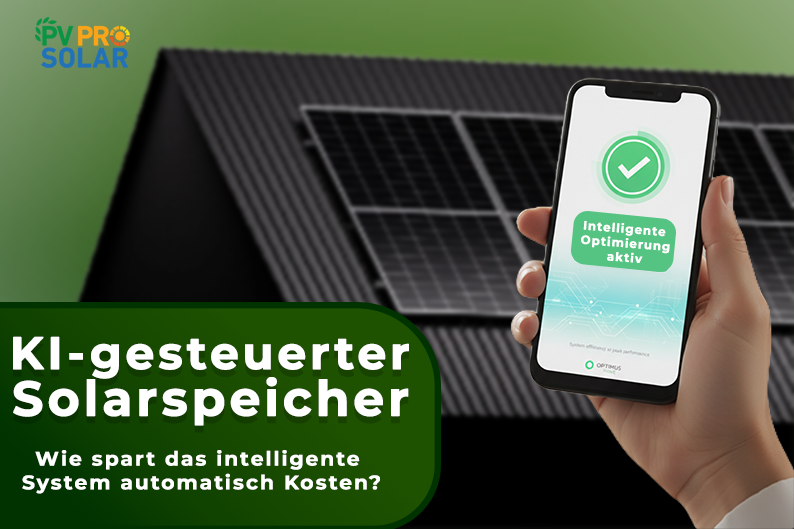
AI-Controlled Solar Storage: How Does the Intelligent System Automatically Reduce Costs?

Rising electricity prices, fluctuating feed-in tariffs, and a household that consumes energy around the clock can feel like a complicated equation. This is exactly where an AI-controlled solar storage system comes into play. While a conventional battery storage system simply charges during the day and discharges in the evening, an intelligent solar storage system actually “thinks.” It analyzes, learns, and optimizes everything automatically in the background without requiring any manual intervention.
But what exactly is behind this technology? And is the additional investment really worth it compared to a standard storage system? This article answers those questions in detail.
PVPro Solar GmbH
In 3 Schritten zur PV-Anfrage
Bedarf klären · Daten senden · Angebot erhalten
Jetzt Anfrage sendenBedarf klären
Schritt 1
Daten senden
Schritt 2
Angebot erhalten
Schritt 3
What Is an AI-Controlled Solar Storage System?
At its core, an AI-controlled solar storage system combines two components: the physical battery that stores and delivers electricity, and software that acts as the “brain” of the system. This software uses artificial intelligence algorithms to make real-time decisions that a standard storage system simply cannot handle.
The intelligent solar storage system learns from your energy consumption habits. It recognizes when you typically shower in the morning, cook dinner in the evening, or run the washing machine. At the same time, it incorporates weather forecasts to predict how much solar energy will be generated the next day. If you are using a dynamic electricity tariff, the system also monitors real-time market electricity prices and automatically charges the battery during the cheapest hours, even from the grid if it makes financial sense.
As a result, the AI-controlled solar storage system works proactively rather than reactively. That is the key difference.
How Much Can an Intelligent Solar Storage System Actually Save?
Let’s look at the numbers. An average four-person household with a 10 kWp photovoltaic system generates around 9,000 to 11,000 kWh of solar electricity annually. Without a storage system, only about 30% of that energy is consumed directly, while the rest is fed back into the grid at a relatively low compensation rate of approximately €0.0778 per kWh. Evening grid electricity, on the other hand, costs around €0.35 to €0.40 per kWh. The price gap is significant.
With a conventional battery storage system, self-consumption increases to around 60–70%, which translates into annual savings of approximately €400 to €550. An AI-controlled solar storage system goes even further by intelligently taking advantage of dynamic tariff fluctuations and coordinating energy flow between connected devices. Studies indicate that AI-optimized systems can increase self-consumption rates to as much as 80–85%, creating a noticeable reduction in annual electricity costs.
There is also another important advantage that many homeowners overlook: AI technology helps protect the battery itself. By optimizing charging cycles and avoiding unnecessary full charges, the lifespan of the battery can be significantly extended, providing long-term financial benefits over the lifetime of the solar system.
Heat Pump and Wallbox Integration: Where the Real Value Appears
An AI-controlled solar storage system reaches its full potential when it works together with other energy devices. In particular, combining it with a heat pump and an EV wallbox transforms the system into a true energy management hub for the entire household.
Here is a real-world example: The AI predicts a sunny day tomorrow. Because of this, it prioritizes charging the electric vehicle overnight using a low-cost dynamic electricity tariff. The following afternoon, when the photovoltaic system is producing electricity at maximum capacity, the energy management system automatically directs surplus solar power first into the battery, then into the heat pump, and only afterward into the grid. This sequence is chosen because it represents the most economically efficient strategy.
This is no longer science fiction. It is the current state of technology in 2026. Smart systems such as those offered by PVPro Solar GmbH operate exactly according to this principle: real-time dynamic tariff adjustment, consumption learning, and fully automated control of major household energy consumers. Homeowners who install an AI-controlled solar storage system while also operating a heat pump or EV charging station achieve the maximum economic benefit from their investment.
Dynamic Electricity Tariffs: The New Opportunity for AI Storage Users
Since 2024, electricity providers in Germany have been legally required to offer dynamic electricity tariffs. This may sound like a technical detail, but for owners of AI-controlled solar storage systems, it is a true game changer.
Dynamic tariffs follow fluctuations in the electricity market. During periods of high solar generation and low demand, electricity prices can fall close to zero cents or even become negative. An intelligent AI-controlled storage system automatically recognizes these periods and charges the battery precisely at those moments. The homeowner benefits from extremely cheap or even free grid electricity without having to make any decisions manually.
The system then discharges the stored energy during high-price periods when electricity from the grid becomes expensive. This process is known as energy arbitrage, and it works completely automatically in the background.
Platforms such as Heartbeat AI from 1KOMMA5° demonstrate how advanced this technology has already become. According to company data, 40% of connected customers were able to cover their electricity demand at an average cost of zero cents or less during a three-month period. This illustrates the direction in which the market is moving.
Who Benefits Most from an AI-Controlled Solar Storage System?
In short, anyone who already owns a photovoltaic system or plans to install one and wants more than basic electricity storage.
The investment is especially worthwhile if you:
- Have a household with high evening electricity consumption
- Operate or plan to install a heat pump or EV wallbox
- Use or intend to switch to dynamic electricity tariffs
- Want to achieve long-term energy independence
The additional investment cost of an AI-controlled solar storage system compared to a conventional storage solution is typically recovered faster than many people expect, thanks to greater savings and extended battery lifespan. Anyone planning a solar installation today should ideally integrate intelligent storage from the beginning, as retrofitting later is usually more expensive.
Intelligence Is No Longer Optional, It Is the Standard
An AI-controlled solar storage system is no longer a luxury product designed only for technology enthusiasts. In 2026, it represents the economically superior choice for homeowners who want to maximize the value of their photovoltaic system.
Anyone aiming to permanently reduce electricity costs, intelligently integrate a heat pump and EV charging station, and benefit from dynamic electricity tariffs will find that an intelligent storage system is becoming essential.
At PVPro Solar GmbH in Hannover, homeowners can receive a future-ready energy solution designed by engineers, installed in less than eight weeks, and supported through long-term after-sales service. Request your free consultation today and begin your journey toward a smarter energy future.
What is the difference between a normal solar storage system and an AI-controlled solar storage system?
A conventional storage system simply charges during the day and discharges at night without considering external factors. An AI-controlled solar storage system, however, analyzes weather forecasts, consumption patterns, and electricity prices to continuously make the most economically beneficial decision. The result is significantly higher self-consumption and lower electricity costs.
How much money can I save annually with an AI-controlled solar storage system?
Savings depend on the size of the photovoltaic system, electricity consumption, and tariff structure. In a typical single-family home with a 10 kWp solar system and a 10 kWh battery, annual savings between €600 and over €900 are realistic, especially when dynamic electricity tariffs are used.
Does an AI-controlled storage system work during a power outage?
Yes, provided the system includes a backup or emergency power function. In such cases, the system automatically disconnects from the grid and continues supplying selected household devices with electricity. However, not every storage system includes this feature, so homeowners should specifically ask their installer about it.
Can an AI-controlled storage system be integrated with an existing photovoltaic system?
In most cases, yes. Modern AI-controlled storage systems are compatible with many common inverter brands and can usually be retrofitted into existing photovoltaic systems. However, a professional assessment is recommended to ensure optimal integration.
What do I need to use dynamic electricity tariffs with an AI-controlled storage system?
You need an intelligent metering system (smart meter) and an electricity provider that offers dynamic tariffs. Since 2024, German energy providers have been required to offer these tariff models. The AI-controlled solar storage system then automatically manages optimization without additional manual input.
How long does the installation of an AI-controlled solar storage system take?
With a certified specialist company such as PVPro Solar GmbH, the entire process from planning to commissioning usually takes less than eight weeks. This includes grid registration, installation, energy management setup, and final customer instruction.
PVPro Solar GmbH
In 3 Schritten zur PV-Anfrage
Bedarf klären · Daten senden · Angebot erhalten
Jetzt Anfrage sendenBedarf klären
Schritt 1
Daten senden
Schritt 2
Angebot erhalten
Schritt 3