
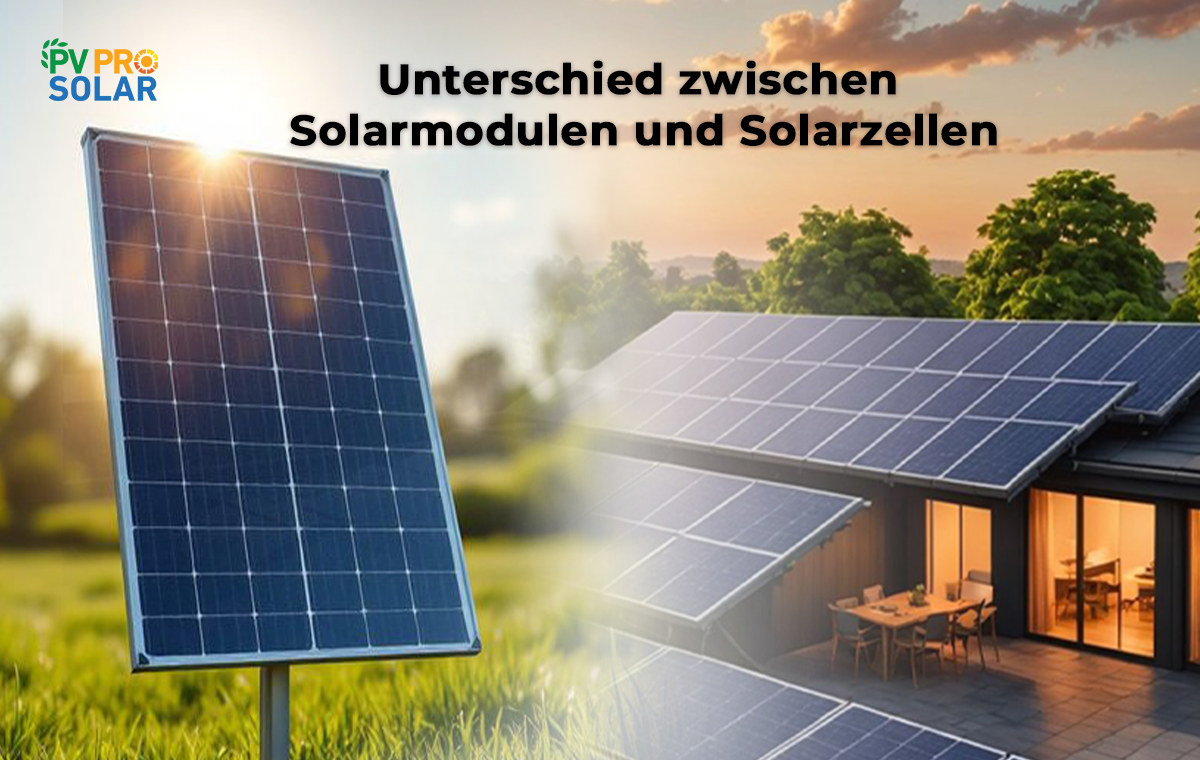
Difference Between Solar Panels and Solar Cells – What Should You Really Know in 2025?
Diese Seite ist auch auf Deutsch verfügbar
Artikel auf Deutsch lesen
Many people confuse solar cells and solar panels, yet the difference between solar panels and solar cells is simple: the solar cell is the smallest building block that turns light into electricity and delivers only about 0.5 to 0.7 volts. A solar panel connects many of these cells in series, protects them with glass and a frame, and is the component we actually mount on your roof. Several panels form a string, and all strings together form the PV array. This article explains technology, voltage, efficiency and what it means for your solar panels.
PVPro Solar GmbH
Bedarf klären · Daten senden · Angebot erhalten
Send request nowBedarf klären
Step 1
Send details
Step 2
Get your quote
Step 3
Difference Between Solar Panels and Solar Cells: Key Facts
| Level | What it is | Typical order of magnitude |
|---|---|---|
| Solar cell | smallest silicon building block, generates direct current | about 0.5–0.7 V, usually 182 mm edge length (often halved) |
| Solar panel | many cells in series, with glass, frame and junction box | e.g. 108 half cells, about 420–445 Wp, about 1.7 × 1.1 m |
| String | several panels in series on one inverter input | voltages add up to several hundred volts |
| PV array | all panels and strings of a system | e.g. our Rethen reference system: 10.2 kWp with 24 panels |
What is a Solar Cell?
A solar cell is the smallest functional unit of a photovoltaic system. Today it is almost always made of monocrystalline silicon and directly converts sunlight into electrical energy.
- Size: current cells usually have an edge length of 182 mm (M10 format) and are halved in many panels
- Material: monocrystalline silicon, today mostly n-type cells (TOPCon, heterojunction or back-contact)
- Function: generates direct current (DC) through the photovoltaic effect
One solar cell alone provides only a low voltage (approx. 0.5–0.7 volts). This is why many cells are electrically interconnected.
Voltage and output: the difference between solar cells and solar panels
A rule-of-thumb calculation shows the jump: a silicon cell delivers just under 0.7 volts at open circuit. In a panel with 108 half cells, 54 cell sections are connected in series, which gives an open-circuit voltage of just under 40 volts. A cell with a few watts becomes a panel with more than 400 watts that can be connected to an inverter. The exact value is stated in the panel datasheet.
Technical Background of the Solar Cell
- Photovoltaic effect: photons excite electrons in silicon
- Bandgap: only photons with enough energy are used, the rest becomes heat
- Efficiency: series-production cells reach about 25–27% today; the lab record for monocrystalline silicon is 27.9% according to Fraunhofer ISE
What is a Solar Panel?
A solar panel is a finished product consisting of many solar cells that are interconnected and protected by glass, a frame and a backsheet or a second glass pane.
- Size: on home roofs often about 1.7 × 1.1 m, e.g. 1,722 × 1,134 mm with 108 half cells
- Weight: about 20–25 kg; the JA Solar DeepBlue 4.0 Pro glass-glass panel weighs 21.5 kg (datasheet)
- Power: typical rooftop panels today deliver about 420–500 Wp
- Protection: weather-resistant with a glass cover, encapsulant and an aluminum frame
The panel is the building block installed on rooftops. It provides enough voltage and current for an inverter to turn it into alternating current for the household or the grid.
What Is the Main Difference Between Solar Panels and Solar Cells?
- Solar cell = the smallest unit, generates electricity, but only at a very low voltage
- Solar panel = a combination of many cells that generates usable power and is weatherproof
Without panels, a solar system would be impractical since you would need to wire thousands of fragile single cells. The panel makes the technology installable, robust and safe. That is why you buy panels, not individual cells, for your roof.
Solar Cells, Solar Panels, Strings: the Difference Between the Levels
- Cell: the building block, about 0.5–0.7 volts.
- Panel: cells connected in series, voltages add up to a few dozen volts.
- String: several panels in series, for example ten to fifteen panels on one inverter input. Voltages add up again, to several hundred volts.
- PV array: all strings together, the entire panel area of your system. On east-west roofs each side usually gets its own string.
The string voltage must match the inverter. On cold, sunny winter days the panel voltage rises, and even then it must stay below the inverter’s permitted input voltage. More about the devices in our guide to solar inverters.
Bypass diodes: in a series circuit the weakest cell limits the current. If shade falls on one cell, a large part of the panel would be slowed down without protection. That is why the junction box usually contains three bypass diodes, each bridging a cell group when it is shaded.
Half-cut cells: many panels use halved cells and connect two panel halves in parallel. The current per cell is halved, resistive losses drop, and if one half is shaded the other keeps working.
Power classes: manufacturers sort finished panels by measured output, usually in 5-watt steps. The JA Solar DeepBlue 4.0 Pro, for example, ranges from 420 to 445 Wp.
How Does a Solar Cell Work in Detail?
- Sunlight hits the cell
- Photons excite electrons
- Electrons move through the silicon crystal lattice
- The p-n junction creates a voltage
- Current flows when a load is connected
How Are Solar Panels Manufactured?
- Cell production: crystal pulling, wafer cutting, doping and contacts
- Interconnection: connecting cells into cell strings with fine connectors
- Lamination: embedding cells between encapsulant (e.g. EVA or POE) and glass
- Framing: aluminum frame for stability and mounting
- Junction box: with bypass diodes and connectors for cabling
What Types of Solar Cells Exist?
- PERC: the former standard, now being phased out
- TOPCon: n-type cell, today’s mainstream on home roofs
- Heterojunction (HJT): very good temperature behaviour, less common and more expensive
- Back-contact: all contacts on the rear, highest efficiencies in series production
- Polycrystalline and thin-film: practically no longer used on new home roofs
- Perovskite tandem cells: over 30% in labs, not yet market-ready
Which panel types result from this is explained in What types of solar panels are used in Germany?.
What Types of Solar Panels Exist?
- Glass-film panels: lighter, standard on many roofs
- Glass-glass panels: more robust and heavier, often bifacial
- Bifacial panels: also use light on the rear, but only a small gain on pitched tiled roofs
- Flexible panels: special uses such as RVs and boats
What Are the Differences in Cost and Profitability?
Individual solar cells are not an end product and make no sense for private buyers. You always pay for a complete system of panels, inverter, mounting, electrical work and registration. As a guide we calculate 1,450 to 1,750 € per kWp:
- 10 kWp system without storage: about €14,500–17,500
- with storage (BYD HVS 10.2): an additional €7,700–9,200
- Savings: about €1,340 per year without storage in our worked example, at an assumed electricity price of €0.32/kWh
How these figures are calculated is shown in our funding calculation example; all cost factors are on our page on solar panel costs.
How Do Lifespan and Durability Differ?
- Solar cell: thin and fragile, usable only inside a protected panel
- Solar panel: robust, typically 25–30 years and often longer; many manufacturers give 25–30 years of performance warranty, e.g. 30 years for the AIKO Neostar 3P54
What Role Does Efficiency Play?
- Cell efficiency = how much sunlight a single cell converts into electricity
- Panel efficiency = slightly lower, because cell gaps, frame, glass and connectors cost area and output
Efficiency: the difference between solar cells and solar panels in figures
For the Longi Hi-MO X10 back-contact panel, the manufacturer states 26.6% cell efficiency and 24.8% panel efficiency (Longi), so the panel value is about 2 percentage points lower. What counts for your roof is the panel value. Top back-contact panels reach up to about 25% according to manufacturers, e.g. the AIKO Neostar 3P54 with up to 25.0%.
What Role Do Solar Cells and Panels Play in Germany 2025?
- At the end of 2025, Germany had about 117 GW of solar capacity installed (Bundesnetzagentur)
- About 16.4 GW were added in 2025, just under half of it on buildings (Bundesnetzagentur)
- Crystalline silicon held about 98% of the world market in 2025; PERC cells were down to about 14% of cell production (ITRPV)
Are There Differences in Environmental Impact?
- Cell production is the most energy-intensive step. According to Fraunhofer ISE, a PV system recovers the energy needed to make it after about one year, depending on location
- Panels last 25 years and more, so the climate balance is clearly positive
- End-of-life panels fall under the German Electrical and Electronic Equipment Act (ElektroG, Annex 1) and must be disposed of and recycled properly
More in our article on the environmental impact of solar panels.
How Will Costs Develop by 2030?
- Panel efficiencies keep rising: according to Fraunhofer ISE, commercial silicon panels improved from about 17% to almost 25% in ten years
- Panel prices fluctuate, but they are only part of the system cost; installation, electrics and inverter remain a fixed block
- Waiting rarely pays off: every year without a system costs you that year’s savings
What Does This Mean for Homeowners?
- Buying cells = not useful for your roof
- Buying panels = the right choice, ideally as a planned system with a matching inverter
- Since 1 January 2023, 0% VAT applies to systems on residential buildings (§ 12(3) UStG); income from systems up to 30 kWp is generally tax-free (§ 3 No. 72 EStG)
- The KfW 270 programme is a loan, not a grant. There is no federal grant for private PV systems. In the Hannover region, proKlima pays up to €2,000 while funds last and only if you apply before placing the order
Solar cells and solar panels are closely related but not the same. The cell is the heart, the panel is the finished product, and many panels in strings make up your system. Understanding the difference between solar panels and solar cells helps you read datasheets and quotes. An overview of all panels is in our guide to photovoltaic modules.
Want to know which panels and how many strings fit your roof? We plan your system with our own electricians, including string design and registration. Request your free quote, call us on 0511 3360603 or message us on WhatsApp at +49 176 2399 8536.
FAQ: Difference Between Solar Panels and Solar Cells
Which is more expensive – a solar cell or a solar panel?
Individual solar cells are cheap but unusable alone. A panel contains many cells plus glass, frame and junction box, so it costs more, but it is the product you actually buy. As a guide, a complete system costs 1,450 to 1,750 € per kWp with us.
Can you build a system with only solar cells?
Practically not. Single cells are fragile, not weatherproof and deliver only about 0.5 to 0.7 volts. You would need to wire and protect thousands of cells. That is exactly what the panel does.
How long do solar panels really last?
Typically 25 to 30 years and often longer. Many manufacturers give 25 to 30 years of performance warranty. The guaranteed minimum output is stated in the panel datasheet.
Which is more efficient – a solar cell or a panel?
The cell has the higher efficiency. For the Longi Hi-MO X10 it is 26.6% for the cell and 24.8% for the panel. For your roof, the panel value is what counts.
What subsidies are available in Germany for solar panels?
There is no federal grant for private PV systems. There is the KfW 270 loan, 0% VAT, the income-tax exemption up to 30 kWp and the EEG feed-in tariff. In the Hannover region proKlima adds up to 2,000 € while funds last and only if you apply before placing the order.
What is a string in a solar system?
A string is a row of panels connected in series on one inverter input. Their voltages add up, and the string voltage must stay below the inverter's permitted input voltage even on cold days.
Note: This article gives a general overview (as of November 2026) and is not tax or legal advice. Technical values come from manufacturer data and may vary by panel variant.
PVPro Solar GmbH
Your PV quote in 3 steps
Bedarf klären · Daten senden · Angebot erhalten
Send request nowBedarf klären
Step 1
Send details
Step 2
Get your quote
Step 3