
What is KfW photovoltaic system funding and how can you benefit from it optimally?
Diese Seite ist auch auf Deutsch verfügbar
Artikel auf Deutsch lesen
KfW photovoltaic system funding today mainly means one thing: the promotional loan 270 «Erneuerbare Energien – Standard» (Renewable Energies – Standard). KfW funding for your photovoltaic system is not a grant but a loan that can cover up to 100 % of the eligible costs, including the battery. Private individuals qualify if they feed at least part of their solar power into the grid. You apply through a bank or savings bank, and you must do so before you sign the order. This guide explains who gets the loan, which conditions apply, how the application works and how it combines with the feed-in tariff, proKlima and tax benefits.
PVPro Solar GmbH
Bedarf klären · Daten senden · Angebot erhalten
Jetzt Anfrage sendenBedarf klären
Schritt 1
Daten senden
Schritt 2
Angebot erhalten
Schritt 3
KfW Photovoltaic System Funding: Key Facts
| Question | Answer |
|---|---|
| Which programme? | KfW loan 270 «Erneuerbare Energien – Standard» |
| Grant or loan? | Loan. There is no federal grant for private PV systems or batteries. |
| Who can apply? | Companies, freelancers, farmers, non-profits and private individuals who feed part of their power into the grid |
| What is financed? | PV system incl. planning and installation, battery storage (also as a retrofit), a roof renovation if required |
| Loan amount | Up to 100 % of eligible costs, no minimum, maximum €150 million per project |
| Term | 2 to 30 years, up to 5 repayment-free start-up years |
| Interest rate | Risk-based: your bank places you in a price class according to creditworthiness and collateral |
| When to apply? | Before the project starts, i.e. before the binding order |
| Combinable with the EEG feed-in tariff? | Yes |
Why is KfW photovoltaic system funding so important for the expansion of solar energy?
KfW is Germany’s federal development bank. For private solar systems its contribution is not a gift but capital: if you do not have the money for a system in your account, the promotional loan still lets you build it and spread the cost over many years. The real state benefits for households lie elsewhere, namely in the zero VAT rate, the income tax exemption and the feed-in tariff. You will find an overview of all options in our guide Are there subsidies for solar panels in Germany?
What is the KfW loan 270 «Renewable Energies – Standard»?
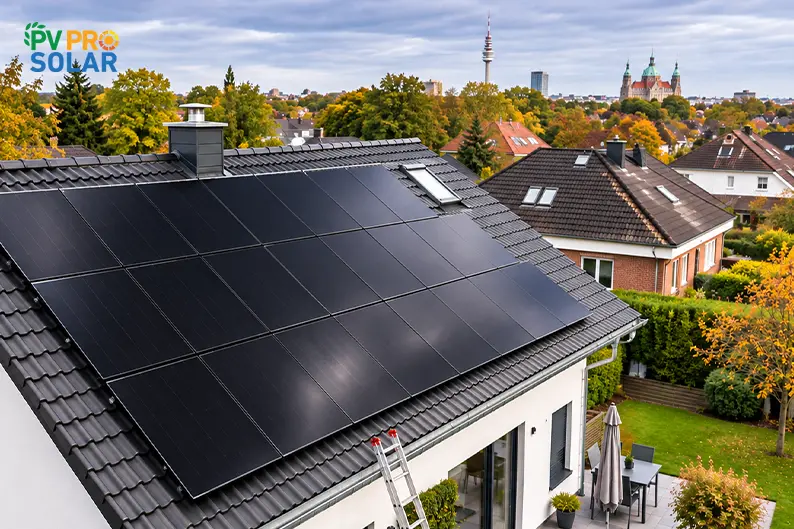
Loan 270 finances systems that generate electricity and heat from renewable energy, plus grids and storage. For homeowners, photovoltaics on the roof or façade is what matters. According to the KfW information sheet (Merkblatt), the systems must meet the technical requirements of the Renewable Energy Sources Act (EEG). Planning, project design and installation are financed too. The loan does not come directly from KfW but through a financing partner, i.e. a bank or savings bank of your choice. You also repay it through that bank.
What programs does KfW offer for photovoltaic systems?
For a private rooftop system, loan 270 is the only suitable KfW programme today. The former grant programme KfW 442 «Solarstrom für Elektroautos» (solar power for electric cars) has ended and no longer accepts applications. If you read online about a «20 % KfW subsidy» for solar panels, the information is outdated or wrong. When asked about grants, KfW itself refers to the state development banks, the federal funding database and local authorities. Businesses will find their options on our page solar funding for businesses.
Who Can Get KfW Funding for a Photovoltaic System?
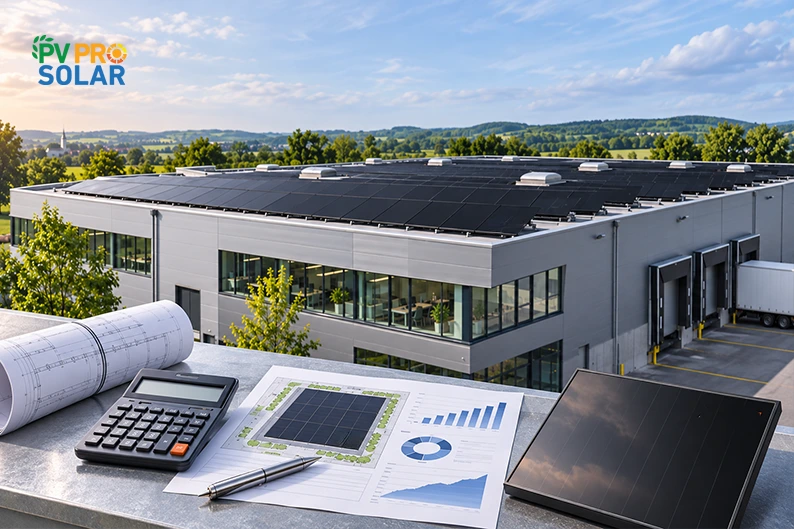
KfW funding for a photovoltaic system is open to companies of any size, freelancers, farmers, non-profit organisations and public bodies. Private individuals are eligible if they feed in or sell at least part of the electricity they generate. KfW treats this as a commercial activity. That is why you submit a «commercial confirmation for the application» (gBzA) with your application, either online yourself or together with your bank. According to KfW, a feed-in contract with the grid operator is not required.
Balcony power plants and plug-in solar devices are not eligible, because according to KfW they are not designed to feed electricity into the public grid. More on these devices in balcony photovoltaic system.
What Is Financed: System, Battery and Roof
- The PV system with modules, inverter, mounting system, planning and installation, also as an extension of an existing system.
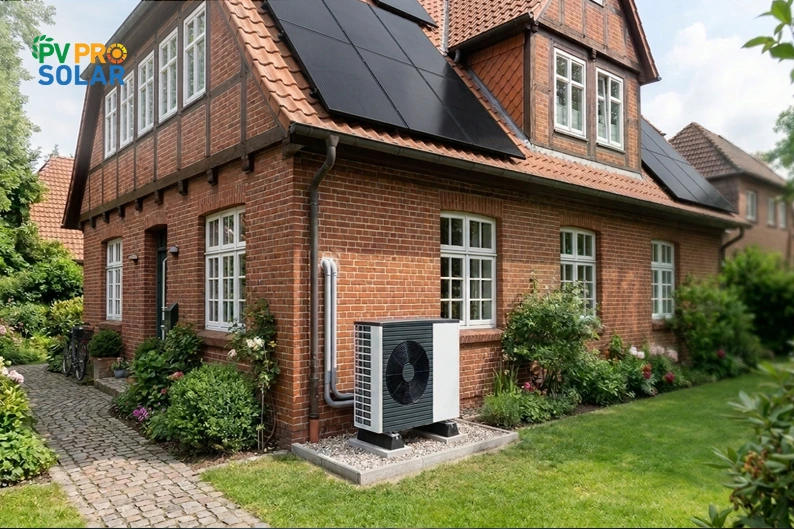
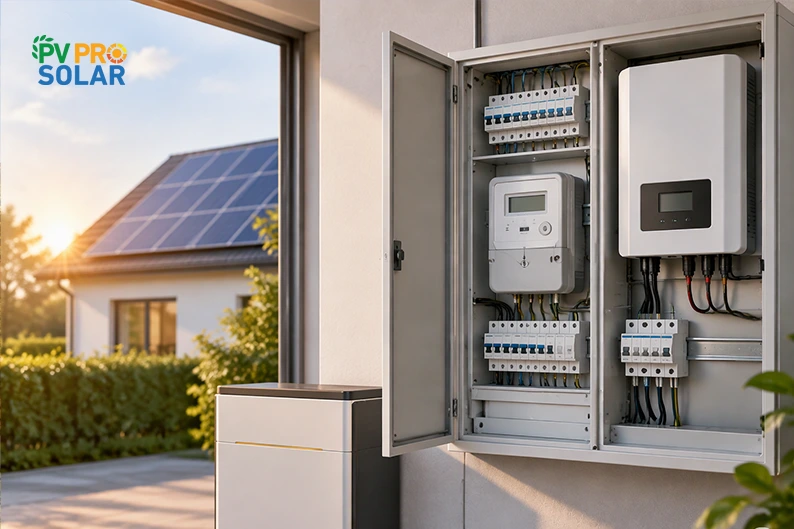
- The battery together with the new system as part of the same project. According to the Merkblatt you can also apply for a battery as a retrofit to an existing system if you feed in part of your power. More in retrofitting a solar battery.
- A roof renovation can be co-financed according to KfW if it is part of the project.
- Used systems are eligible. If the system was already financed with a KfW loan, that loan must be fully repaid when you apply.
Refinancing and follow-up financing of projects that have already started or been completed are excluded. There is no legal entitlement to the funding. KfW decides within the limits of the available funds.
Conditions: Loan Amount, Term and Interest
Up to 100 % of the eligible costs are financed, with no minimum amount. The ceiling of €150 million per project is irrelevant for a single-family home. For orientation: with us, a 10 kWp system costs a guide price of €14,500–17,500 without storage and €22,200–26,700 with a BYD battery (HVS 10.2). Details are on our page 10 kWp photovoltaic system cost.
Terms and Repayment-Free Years
| Term | Repayment-free start-up years | Fixed interest period |
|---|---|---|
| up to 5 years | max. 1 | full term |
| up to 10 years | max. 2 | full term |
| up to 15 years | max. 3 | full term |
| up to 20 years | max. 3 | 10 years or full term |
| up to 30 years | max. 5 | 10 years |
The minimum term is 2 years. During the repayment-free years you only pay interest. After that you repay in equal quarterly instalments plus interest on the outstanding balance. The longer the repayment-free period, the higher the later instalments.
How High Is the Interest Rate for KfW Photovoltaic System Funding?
There is no single rate for everyone. Your bank assigns you to one of nine price classes (A to I) based on your creditworthiness and the value of your collateral. For each class KfW publishes a maximum rate, and your bank may go below it. The rate is fixed on the day of approval and then applies for the whole fixed-interest period.
An example from the KfW conditions overview (as of 29 Oct 2026, valid from 22 Oct 2026): for the purpose «PV-Aufdach» (rooftop PV) with a 10-year term, 2 repayment-free years and 10 years of fixed interest, the maximum rates range from 4.50 % nominal (4.58 % effective) in price class A to 10.90 % (11.36 % effective) in price class I. The conditions change constantly, so always check the current KfW overview before you decide. KfW recommends paying part of the cost from your own funds, because this can improve your rating and therefore your rate.
Commitment Fee, Early Repayment and Collateral
- Drawdown: you draw the loan within 12 months of approval, in one sum or in parts. The period can be extended.
- Commitment fee: for amounts not yet drawn, 0.15 % per month is charged starting 6 months and 2 bank working days after approval. Plan the drawdown around your installation date.
- Early repayment: unscheduled repayments are only possible against a prepayment penalty.
- Collateral: the bank requires the usual banking collateral. You agree type and amount with your bank.
How to Apply for KfW Funding for Your Photovoltaic System
With KfW funding for your photovoltaic system, the order of the steps is crucial:
- Get a quote. You need a written quote showing output, components and price. Requesting a quote is not yet a binding contract.
- Talk to a bank. Ask your bank specifically for KfW loan 270. Not every bank offers it to private customers. You can also choose another bank, savings bank or cooperative bank.
- Fill in the gBzA. You create the commercial confirmation in the KfW gBzA centre or with your bank. The bank takes over the data via the gBzA ID.
- Wait for approval. Only after KfW approval do you sign the loan agreement with your bank.
- Place the order and build. Now you sign the order. After installation, the system is registered with the grid operator and in the Marktstammdatenregister (MaStR).
- Draw the loan. Within the drawdown period, ideally in line with the payment dates.
General tips on funding applications are in our article on the photovoltaic system funding application.
When should the application be submitted?
Always before the project starts. KfW defines this as signing a legally binding contract, for example a purchase or works contract for the system. If you sign first and apply for the loan afterwards, you will not receive KfW funding for this photovoltaic system, because follow-up financing of projects that have already started is excluded. There is, however, no fixed calendar deadline for applications.
What documents are required for the application?
Most information is requested automatically by the bank. Typical documents are the quote for the system, the gBzA and KfW’s data list «Subventionserhebliche Tatsachen» (facts relevant to the subsidy). For the credit check your bank will also ask for its usual evidence, for example on income and collateral. Exactly which documents are needed is up to your bank.
What mistakes should be avoided during the application process?
- Signing the order before the bank has submitted the application.
- Assuming KfW pays a grant. It is a loan that is repaid in full.
- Asking only one bank. The price class, and therefore the rate, can differ between banks.
- Planning the drawdown too late and paying commitment fees.
- Missing the separate deadline of a regional grant, since most grants also have to be applied for before the order.
Can multiple funding programs be combined?
In principle, yes. According to the Merkblatt, loan 270 can be combined with other funding as long as the permitted state-aid ceilings are respected. For solar systems there is one important special rule.
KfW Loan and Feed-in Tariff
If you claim the EEG feed-in tariff for your system, it may only be financed with a KfW loan that contains no state aid. That is exactly how loan 270 is designed: KfW offers it at an aid-free interest rate. The feed-in tariff and the loan therefore fit together. In this case, other KfW products can only be combined if they also contain no state aid. For systems up to 10 kWp commissioned from 1 August 2026, the tariff is about 7.70 ct/kWh for partial feed-in and 12.22 ct/kWh for full feed-in. Systems commissioned by 31 December 2026 keep the fixed tariff for 20 years. The planned EEG 2027 amendment is so far only a government draft. More in EEG law for photovoltaics and EEG amendment.
Regional Funding for Your Photovoltaic System in Hannover
In Hannover and the neighbouring municipalities of Hemmingen, Laatzen, Langenhagen, Ronnenberg and Seelze, proKlima pays €100 per kWp, up to €2,000, through its «DachVollToll» programme. Requirements include at least 2 kWp and full coverage of all roof surfaces that each reach at least 650 kWh/kWp per year. You must apply before placing the order, and the grant is only available while funds last. Whether and how a grant can be combined with your KfW loan depends on the conditions of the respective programme, so clarify this with your bank and the funding body in advance. All programmes in the region are explained in solar systems Hannover funding.
Taxes: 0 % VAT and Tax-Free Income
This has nothing to do with KfW, but a lot to do with your loan amount: since 1 January 2023, the supply and installation of PV systems and batteries on or near residential buildings is subject to a zero VAT rate under § 12 (3) UStG. So you are not borrowing any VAT. Income from systems up to 30 kWp per residential or commercial unit is exempt from income tax under § 3 No. 72 EStG. Details in photovoltaic system VAT and tax-free photovoltaic system.
Is KfW Funding Worth It for Your Photovoltaic System?
Whether KfW funding pays off for your photovoltaic system depends mainly on the interest rate your bank offers. Every euro of interest extends the payback period. An example without a loan: our reference system in Rethen (10.2 kWp with BYD battery, €21,400) pays for itself in about 9.7 years on paper, at an assumed electricity price of €0.32/kWh. With financing, the interest costs come on top.
The loan makes sense above all if you lack the equity or do not want to tie it up, and if your creditworthiness puts you in a good price class. With a battery, self-consumption rises from about 25–35 % to 55–70 %, which increases the annual savings. How a KfW loan, a bank loan and savings compare, with a worked example, is shown on our page financing solar panels. Whether a system pays off in general is covered in is photovoltaics worth it?
PVPro Solar: Your Quote as the Basis for the Loan Application
Your bank needs a reliable quote for the application. We plan your system after a free roof analysis and prepare a written fixed-price quote listing all components: modules from AIKO, JA Solar or Longi, inverters from Fronius, batteries from BYD and mounting systems from K2. Payment follows the 30/70 model, i.e. 30 % with the order and 70 % after installation, which fits well with the loan drawdown. Installation and registration with the grid operator and the Marktstammdatenregister are handled by our own technicians.
Planning a system and want to finance it through KfW? Request your free, no-obligation quote now. You can also call us on 0511 3360603 or message us on WhatsApp at +49 176 2399 8536.
Sources:
- KfW: Erneuerbare Energien – Standard (270), product page with FAQ (German)
- KfW: Merkblatt Kredit Nr. 270 (as of 05/2025, German)
- KfW: conditions overview for end borrowers, programme 270 (German)
- § 12 UStG (zero VAT rate, para. 3)
- proKlima Hannover: DachVollToll (German)
Does KfW offer a grant for photovoltaic systems?
No. KfW supports private photovoltaic systems with loan 270 «Erneuerbare Energien – Standard», not with a grant. There is no federal grant for private PV systems or batteries. Grants are offered by some federal states, local authorities and programmes such as proKlima in Hannover.
Can I get KfW loan 270 as a private individual?
Yes, if you feed at least part of the electricity you generate into the grid or sell it. KfW treats this as a commercial activity, so you submit a commercial confirmation for the application (gBzA). A feed-in contract is not required.
When do I have to apply for the KfW loan?
Before the project starts, i.e. before you sign a binding contract for the system. Only after KfW approval do you place the order. Applications for projects that have already started are excluded.
Can I finance the battery through KfW?
Yes. The battery can be financed together with the new PV system. According to the KfW Merkblatt this is also possible as a retrofit to an existing system if you feed in part of your power.
What is the interest rate on KfW loan 270?
It depends on your creditworthiness and collateral. Your bank places you in one of nine price classes, for each of which KfW publishes a maximum rate. According to the conditions overview of 29 Oct 2026, the maximum rates for rooftop PV with a 10-year term ranged from 4.58 % to 11.36 % effective. The rate is fixed on the day of approval.
Can I combine the KfW loan and the feed-in tariff?
Yes. If you claim the EEG tariff, the system may only be financed with a KfW loan without state aid. Loan 270 is offered at an aid-free interest rate and therefore fits.
Does KfW fund balcony power plants?
No. According to KfW, balcony power plants and plug-in solar devices are not eligible because they are not designed to feed electricity into the public grid.
Does the KfW 442 programme for solar power and electric cars still exist?
No. The KfW 442 programme «Solarstrom für Elektroautos» has ended. For a PV system and battery, KfW loan 270 remains. A wallbox is not listed as a separate eligible measure in the Merkblatt.
Note: This article gives a general overview (as of November 2026) and does not replace tax, legal or financing advice. The current KfW Merkblatt and conditions are authoritative.
PVPro Solar GmbH
In 3 Schritten zur PV-Anfrage
Bedarf klären · Daten senden · Angebot erhalten
Jetzt Anfrage sendenBedarf klären
Schritt 1
Daten senden
Schritt 2
Angebot erhalten
Schritt 3