
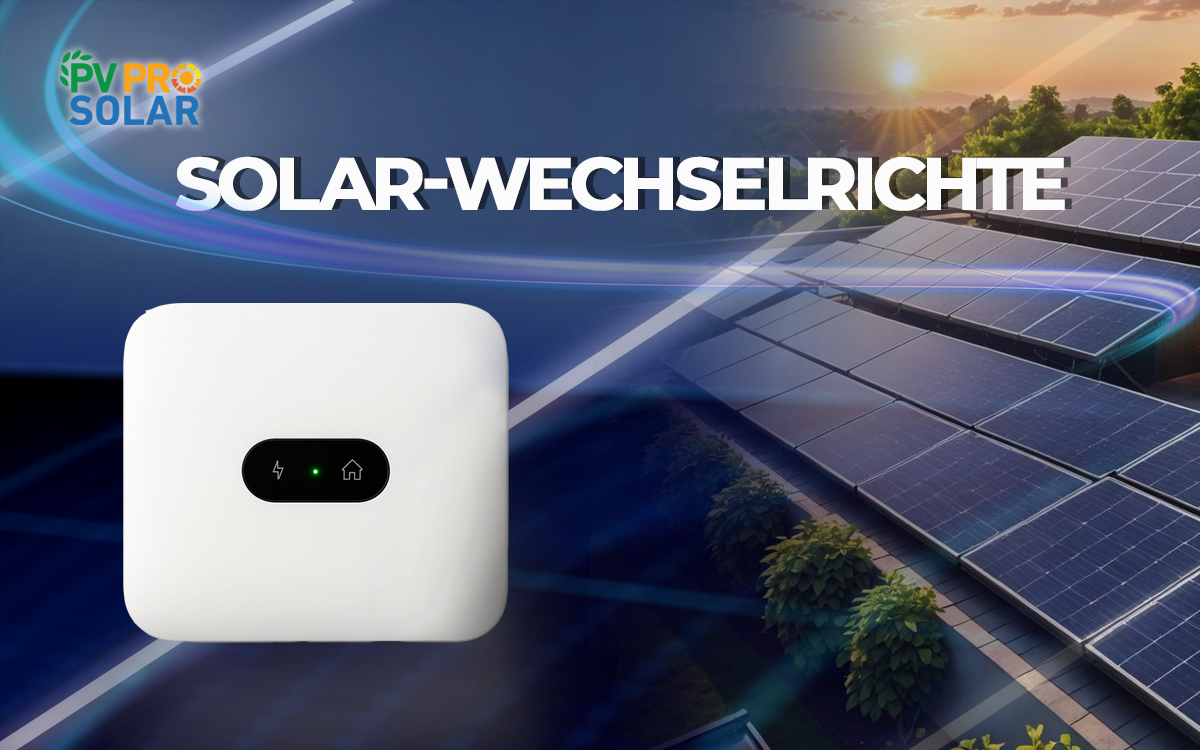
Solar Inverters: Types, How to Choose and Which Is Best
Diese Seite ist auch auf Deutsch verfügbar
Artikel auf Deutsch lesen
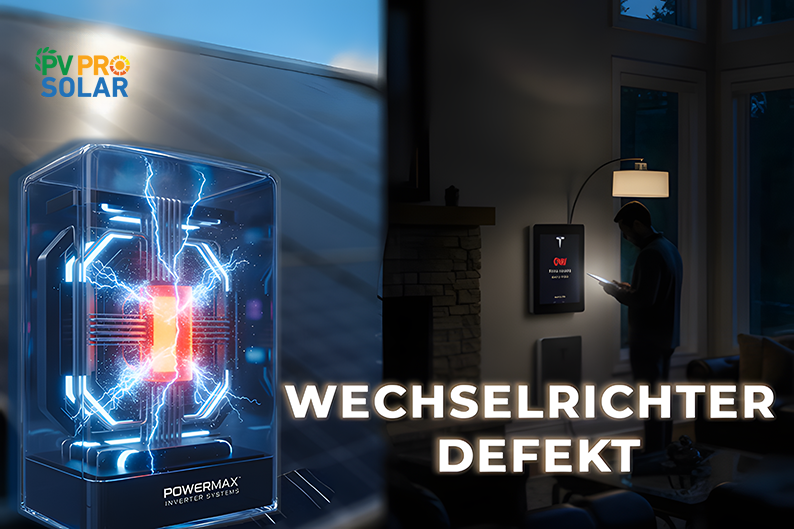
The inverter is the heart of every photovoltaic system. The modules produce direct current, while your household and the grid need alternating current. The solar inverter sits in between: it converts the power, gets the maximum output from the modules, controls the battery in hybrid models and supplies the data for your app. Here you’ll learn which types exist, what to look for when choosing one and which inverter we install.
Planning a PV system with the right inverter? Request your free, no-obligation quote now.
PVPro Solar GmbH
Bedarf klären · Daten senden · Angebot erhalten
Jetzt Anfrage sendenBedarf klären
Schritt 1
Daten senden
Schritt 2
Angebot erhalten
Schritt 3
What Does a Solar Inverter Do?
- Conversion: it turns the modules’ direct current into grid-compliant alternating current.
- MPP tracking: it continuously finds the operating point at which the modules deliver the most power (the maximum power point). With several MPP trackers, different roof sides can each be run optimally.
- Grid and system protection: it automatically disconnects the system from the grid during faults and monitors voltage and insulation.
- Control and data: it regulates feed-in, communicates with the battery and energy management, and supplies the yield data for the app.
Which Types of Inverter Are There?
String Inverters
The classic choice for rooftop systems: several modules are connected in series to form a string and linked to a central inverter. It’s proven and inexpensive. With partial shading, however, one weak module can slow down the whole string. Good string design largely compensates for this.
Hybrid Inverters
A hybrid inverter can also charge and discharge a battery directly on the DC side. That saves a second device and conversion losses. For new systems where a battery is added now or retrofitted later, it’s usually the best choice today. Many hybrid inverters also offer a backup power function.
Microinverters and Power Optimisers
Microinverters sit directly on one or two modules, while power optimisers work module by module ahead of a string inverter. Both are an option for heavily shaded or complex roofs, but they put more electronics on the roof and cost more. Microinverters are standard for balcony power stations.
What to Look For When Choosing an Inverter
- Efficiency: don’t just look at the peak value but at partial-load efficiency, because for most of the year the system doesn’t run at full load. How well the inverter and battery work together is measured by HTW Berlin with the System Performance Index (SPI). Read more under best battery storage.
- Sizing: the inverter output must match the module output. As a rule of thumb, it is about 0.8 to 1.1 times the module output, so usually 8 to 10 kW for a 10 kWp system. Slightly undersized inverters are common and sensible, because the modules rarely reach their peak output. We determine this in the string design.
- Single-phase or three-phase: because of the unbalanced-load limit, single-phase inverters may feed in at most 4.6 kVA per phase. For single-family home systems from about 5 kWp, a three-phase inverter is therefore usually the right choice.
- Feed-in control: under the Solar Peak Act, new systems without a smart metering system may feed in at most 60% of their module output. The inverter handles this. With self-consumption and a battery, it costs hardly any yield.
- MPP trackers: for east-west roofs or surfaces with different pitches, you need at least two separate inputs.
- Battery capability: if you want a battery now or later, choose a hybrid inverter that suits your battery. Not every battery works with every inverter.
- Backup power: decide beforehand whether you want a backup socket or a whole-house backup system.
- Warranty and service: how long is the manufacturer’s warranty, and is the manufacturer likely to still be around in ten years?
- Monitoring and interfaces: a good app and open interfaces matter for energy management, a wallbox and a heat pump.
Which Inverter Is the Best?
There’s no single best inverter for everyone. It has to suit the roof area, modules, battery and your plans. We usually install the Fronius GEN24 Plus hybrid inverter, combined with a BYD battery, for these reasons:
- it’s a hybrid inverter, so a battery can be connected straight away or later
- two MPP trackers for east-west roofs and different roof surfaces
- backup power built in via the PV Point function, plus whole-house backup with a switchover device on request
- app and web portal (Fronius Solar.web) for system monitoring
- Fronius gives a 10-year manufacturer’s warranty when you register in Solar.web
Read more about how it works with the battery under BYD battery storage, and more about backup power under solar backup power systems.
How Long Does an Inverter Last?
Modules last 25 to 30 years or more, but an inverter usually has a shorter life. Expect 10 to 15 years, because components such as capacitors and fans age under heat. So plan for the inverter to be replaced once during the system’s lifetime. Based on our experience, a replacement costs about €1,500 to €3,000 including installation. After the replacement, the change must be entered in the Market Master Data Register within one month. A good location helps: cool, dry and well ventilated, not in direct sun or a hot loft. The app shows whether the system is running normally. If the yield drops for no obvious reason, have the system checked by a specialist.
How Much Does an Inverter Cost?
For a new system, the inverter is included in the package price. In our cost breakdown for a 10 kWp system, the Fronius GEN24 Plus including monitoring accounts for about €1,700 to €2,400, roughly an eighth of the system cost. On the market, hybrid inverters of 5 to 10 kW cost about €2,000 to €4,000 as a device alone, and larger devices get cheaper per kW. As a guide, we calculate about €1,450–1,750 per kWp for the complete system without a battery, including the Fronius inverter, installation and registration. A 10 kWp system therefore costs about €14,500–17,500. For supply and installation on or at residential buildings, you pay 0% VAT. You’ll find more on costs under solar panel costs.
Want to know which configuration suits your roof? Request your free, no-obligation quote now.
Adding a Battery to an Existing Inverter?
If you have an older system without a hybrid inverter, there are two ways to add a battery: an AC-coupled battery with its own battery inverter alongside the existing device, or replacing it with a hybrid inverter. Which makes sense in your case depends on the age of the inverter. You’ll find more under retrofitting a solar battery.
How We Plan Your System
At PVPro Solar, you don’t get the inverter on its own but as part of a matched system. That includes a free initial consultation with roof analysis and yield forecast, string design to suit your roof and modules (AIKO, JA Solar or Longi), a Fronius GEN24 Plus, an optional BYD battery, installation with K2 Systems mounting by our own certified technicians, and registration with the grid operator and in the Market Master Data Register. You get a fixed price and pay using the 30/70 model.
Request your free, no-obligation quote now, or call us on +49 511 3360603 or message us on WhatsApp at +49 176 2399 8536.
Frequently Asked Questions About Solar Inverters
What does a solar inverter do?
It converts the modules' direct current into alternating current, continuously finds the operating point with the highest output, disconnects the system from the grid during faults and supplies the data for monitoring. A hybrid inverter also controls the battery.
Which inverter is the best?
There's no single best one; it has to suit the roof, modules and battery. We usually install the Fronius GEN24 Plus hybrid inverter with a BYD battery: two MPP trackers, a backup function and good monitoring.
Do I need a hybrid inverter?
If you want a battery now or later, a hybrid inverter is usually the best choice. It charges the battery directly and saves a second device.
How long does an inverter last?
Usually 10 to 15 years, so less than the modules. Plan for it to be replaced once during the system's lifetime. A cool, dry location extends its life.
What is an MPP tracker?
An MPP tracker continuously finds the operating point at which the modules deliver the most power. With two separate trackers, an east and a west roof, for example, can each be run optimally on their own.
How much does a solar inverter cost?
A hybrid inverter of 5 to 10 kW costs about €2,000 to €4,000 as a device. In our 10 kWp system, the Fronius GEN24 Plus including monitoring accounts for about €1,700 to €2,400. A later replacement costs about €1,500 to €3,000 including installation.
How big does the inverter need to be for 10 kWp?
Usually 8 to 10 kW, i.e. about 0.8 to 1.1 times the module output, and three-phase, because single-phase devices may feed in at most 4.6 kVA per phase. We determine the exact size in the string design.
PVPro Solar GmbH
In 3 Schritten zur PV-Anfrage
Bedarf klären · Daten senden · Angebot erhalten
Jetzt Anfrage sendenBedarf klären
Schritt 1
Daten senden
Schritt 2
Angebot erhalten
Schritt 3