
How Germany Supports Renewable Energy – Programs, Laws, and Opportunities
Diese Seite ist auch auf Deutsch verfügbar
Artikel auf Deutsch lesen
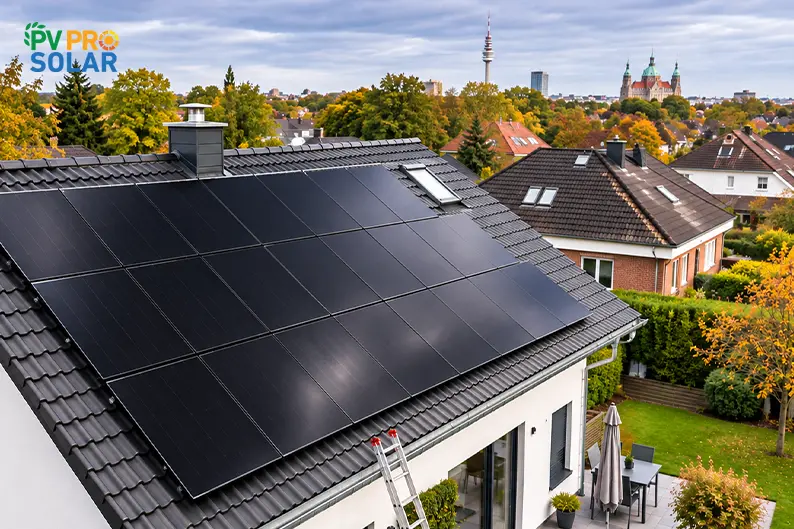
How Germany supports renewable energy cannot be answered with a single programme: the state uses a mix of law, tax rules, loans, grants and obligations. The Renewable Energy Sources Act (EEG) gives operators fixed feed-in tariffs or market premiums, while large plants compete in tenders run by the Federal Network Agency (Bundesnetzagentur). On top of that come 0% VAT and income tax exemption for small solar systems, the KfW 270 loan, the heating grant for heat pumps, lower grid fees under § 14a EnWG, the solar mandates of the federal states and regional programmes such as proKlima in the Hannover region. Here you will learn how each instrument works, who pays for it and what applies to your home.
For the share of wind, solar and biomass in the electricity mix, see our overview of renewable energies and our article on solar power in Germany. This article is about the support instruments.
PVPro Solar GmbH
Bedarf klären · Daten senden · Angebot erhalten
Jetzt Anfrage sendenBedarf klären
Schritt 1
Daten senden
Schritt 2
Angebot erhalten
Schritt 3
How Germany supports renewable energy: key facts
| Instrument | What it gives you | For whom |
|---|---|---|
| EEG feed-in tariff | Fixed rate per kWh for 20 years, up to 10 kWp currently 7.70 ct (partial feed-in) or 12.22 ct (full feed-in) | Systems up to 100 kW, e.g. your roof |
| Market premium and direct marketing | Premium on top of the exchange revenue | Mandatory from 100 kW |
| Tenders (Bundesnetzagentur) | Competition for the lowest support level per kWh | Large solar, wind and biomass plants |
| 0% VAT (§ 12(3) UStG) | No VAT on purchase and installation of PV and storage | Since 1 Jan 2023, on or near residential buildings |
| Income tax exemption (§ 3 No. 72 EStG) | Income from feed-in and self-consumption is tax-free | Up to 30 kWp per unit, max. 100 kWp per person |
| KfW 270 | Promotional loan up to 100% of the investment, no grant | Private persons and companies |
| KfW 458 (BEG) | Grant for the heat pump, 30% base rate plus bonuses | Owners of residential buildings |
| § 14a EnWG | Lower grid fees for heat pump, wallbox, storage | Controllable devices above 4.2 kW |
| Solar mandate (§ 32a NBauO) | Obligation, not funding: at least 50% of the roof with PV | New builds and roof renovations in Lower Saxony |
| proKlima DachVollToll | €100 per kWp, max. €2,000 | Hannover and five neighbouring towns, while funds last |
Important for households: there is no federal grant for your own photovoltaic system or battery storage. Anyone promising you a «BAFA solar grant» is wrong. The benefits come through the tariff, taxes, loans and regional funds.
What goals does Germany pursue with the promotion of renewable energy?
The goals are set by law: under § 1(2) EEG, the renewable share of gross electricity consumption is to rise to at least 80% by 2030. § 4 EEG sets expansion paths for this, for example 215 gigawatts of solar and 115 gigawatts of onshore wind in 2030. The Climate Protection Act (§ 3 KSG) requires greenhouse gas neutrality by 2045.
To achieve these goals, Germany follows three core strategies:
- Expansion of renewable electricity sources such as solar, wind, and hydropower.
- Promotion of storage solutions and flexible consumers so that the grid and supply remain stable.
- Decarbonization of industry, mobility, and heating.
The reasons are not only ecological: power from wind and sun reduces dependence on energy imports and, for new plants, is now one of the cheapest ways to generate electricity. To reach these goals, Germany supports renewable energy on several levels at once, as the following sections show.
What role does the Renewable Energy Sources Act (EEG) play?
The Renewable Energy Sources Act (EEG), introduced in 2000, remains the backbone of German energy policy. It replaced the Electricity Feed-in Act of 1991 and has been amended many times since.
Key mechanisms of the EEG:
- Feed-in tariff: systems up to 100 kW receive a statutory rate per kilowatt hour fed into the grid (§ 21 EEG).
- Market premium: from 100 kW, the electricity must be sold directly. The operator receives a premium on top of the exchange revenue up to the «applicable value».
- Tenders: large plants only get their support rate through an award from the Bundesnetzagentur: ground-mounted solar above 1 MW, rooftop systems above 750 kW (§ 22 EEG).
- Grid priority: grid operators must connect renewable plants and take their electricity with priority.
How much capacity has been connected since the EEG started is shown in our overview of renewable energies. All rules specifically for solar operators, from registration to the tariff, are in our article on the EEG for photovoltaics.
Who pays when Germany supports renewable energy?
Until mid-2022, all electricity customers paid for the support through the EEG levy on their bills. Since 1 July 2022 it is no longer charged, and the Energy Financing Act abolished it completely from 1 January 2023. Since then, the federal government balances the EEG account of the transmission system operators from public funds, initially via the Energy and Climate Fund. The support itself continues; only the financing has changed. It no longer appears on your electricity bill.
How does the feed-in tariff work in Germany?
The feed-in tariff guarantees operators a fixed payment per kilowatt hour for 20 years (plus the year of commissioning). The rate on the commissioning date applies.
- Systems up to 10 kWp commissioned since 1 August 2026 receive 7.70 ct/kWh for partial feed-in and 12.22 ct/kWh for full feed-in (Bundesnetzagentur).
- Rates for new systems fall in fixed steps every six months; existing systems keep their rate.
- Since the Solar Peak Act, new systems receive no tariff during negative exchange prices. Without a smart meter, feed-in is limited to 60% of the module capacity.
Despite declining tariffs, a system can pay off because every kilowatt hour you use yourself replaces expensive grid power. Without storage, a household typically uses 25–35% of its solar power itself, with storage 55–70%. Whether it pays off for you is covered in is photovoltaics worth it.
Outlook: with the EEG 2027, the federal government plans to restructure support for new small systems. So far this is only a government draft (Bundestag document 21/7867), not law. Systems commissioned by 31 December 2026 keep the fixed tariff for 20 years. Details on the status: EEG amendment.
Tenders: how Germany supports large renewable energy plants
For solar parks, wind farms and large biomass plants, the support rate is set by competition, not by law. Developers bid at the Bundesnetzagentur with the value per kilowatt hour they need. The cheapest bids win. For ground-mounted solar, the volume-weighted averages of the last three rounds were 5.00 ct (December 2025), 4.94 ct (March 2026) and 4.79 ct/kWh (July 2026). Citizen energy companies may build solar projects up to 6 MW without a tender. How a solar park works from site to grid connection is explained in how solar farms work in Germany.
What funding programs does KfW Bank offer for renewable energy?
KfW (Kreditanstalt für Wiederaufbau) is the federal development bank. For electricity from sun and wind it provides loans; for new heating systems it provides grants.
A loan, not a grant: KfW 270 for renewable energy in Germany
- KfW 270 «Renewable Energies – Standard»: promotional loan for photovoltaics, battery storage, wind, hydropower, biomass and heat pumps. It covers up to 100% of the investment costs, with terms of up to 30 years and fixed interest for up to 20 years. Your bank sets the interest rate based on your credit rating.
- Apply before signing: you apply through your bank, before you sign a binding purchase contract.
- No repayment grants for storage: a separate KfW storage programme with repayment grants no longer exists. Storage is financed through KfW 270 as a normal loan.
What the loan costs in practice and how to combine it with your own funds is explained in KfW funding for photovoltaic systems and financing solar panels.
What government grants are available for solar systems?
For the private photovoltaic system itself: none from the federal government. The Federal Funding for Efficient Buildings (BEG) does not fund solar power systems but heating, insulation and efficient houses. The former Market Incentive Program (MAP) no longer exists; its heating support became part of the BEG. Direct grants for PV only come from states, regions or municipalities, see below. For a complete overview of all funding routes for your system, see are there subsidies for solar panels in Germany.
Heating grants: where Germany supports renewable energy with subsidies
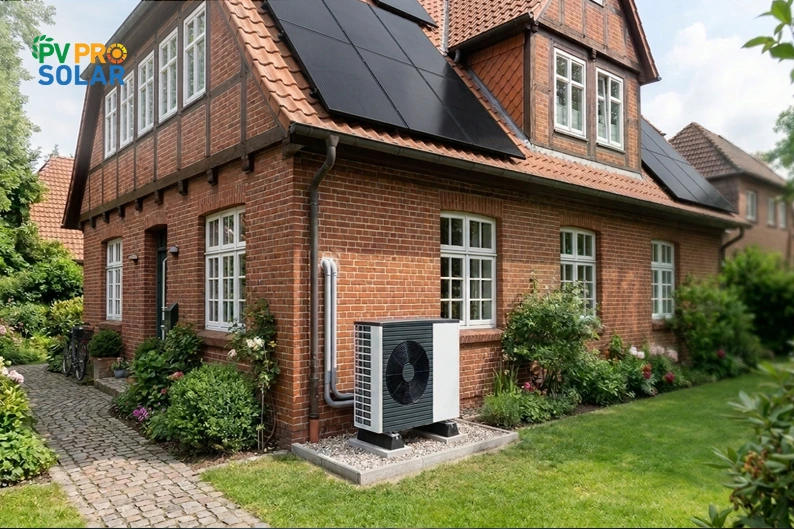
A real grant exists for the heat pump: KfW programme 458 (heating subsidy for private persons). According to KfW, applications since 21 July 2026 get:
- 30% base funding
- 16% climate speed bonus if you replace an old oil, coal, night-storage or gas floor heating, or a gas or biomass heating at least 20 years old, in your own home. This bonus falls every six months from 1 February 2027.
- Income bonus of up to 40% for taxable household income up to €30,000 (staggered up to €50,000)
- A maximum of 70% of eligible costs, up to 80% in the lowest income bracket. Eligible costs for a single-family house are up to €28,000.
Important: the heat pump is not zero-rated; it is invoiced with 19% VAT. How a solar system and heat pump work together is explained in combining a PV system with a heat pump. We install heat pumps for private homes and can plan them together with your solar system.
How does Germany support the expansion of battery storage?
Battery storage is a key technology for the energy transition, but there is no federal grant for home storage. For storage, Germany supports renewable energy indirectly:
- 0% VAT on storage supplied and installed together with or for a photovoltaic system on or near a residential building.
- KfW 270 as a low-interest loan.
- Lower grid fees under § 14a EnWG if the storage is registered as a controllable device.
Regional storage grants exist only occasionally and are usually time-limited. Many state programmes of recent years have ended. How to find the right storage size is explained in power storage for your home.
§ 14a EnWG: lower grid fees for heat pump, storage and wallbox
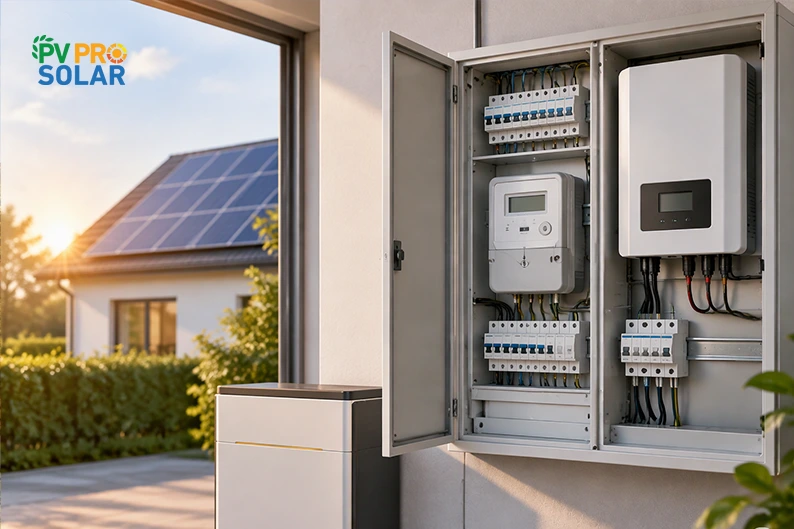
Since 1 January 2024, new heat pumps, private wallboxes, air conditioners and battery storage with more than 4.2 kW connection capacity must be controllable. The grid operator may briefly reduce their consumption to 4.2 kW in case of imminent overload. Household power and PV feed-in are not affected. In return, grid fees fall. According to the Bundesnetzagentur there are three options:
- Module 1: flat-rate reduction of roughly €110 to €190 per year, depending on the grid area
- Module 2: the grid energy price falls by 60%; you need a separate meter
- Module 3: since 1 April 2025, additional time-variable grid fees, only with a smart meter and only combined with Module 1
Whether your supplier passes on the full saving depends on your electricity contract. A dynamic electricity tariff may also be worth a look.
What tax advantages exist for investing in renewable energy?
Since 2023, two major tax benefits apply to small solar systems:
- Zero VAT rate (§ 12(3) UStG): since 1 January 2023, the supply and installation of photovoltaic systems and storage on or near residential buildings is charged at 0% VAT. For systems up to 30 kWp the conditions are deemed met automatically. It is not limited to owner-occupied homes; a rented house qualifies too. More: photovoltaic system VAT.
- Income tax exemption (§ 3 No. 72 EStG): income from feed-in and self-consumption is tax-free, for systems from 2025 up to 30 kWp per residential or commercial unit, max. 100 kWp per taxpayer. Details: tax-free photovoltaic system.
- Depreciation for businesses: companies can write off larger systems, for example via the investment deduction under § 7g EStG (up to 50%) or the temporary 30% declining-balance depreciation for purchases between 1 July 2025 and 31 December 2027.
The first two rules lower the purchase price and save paperwork: for typical home systems, a tax return for the system is usually no longer needed. Wallboxes and heat pumps are not zero-rated.
What funding options exist for companies and industry?
Businesses benefit from specific programs:
- Federal funding for energy and resource efficiency in industry (EEW) via BAFA and KfW, for example for process heat from renewable energy and efficient equipment.
- Support for innovation projects, e.g. under the National Hydrogen Strategy.
- Relief on electricity price components for energy-intensive companies.
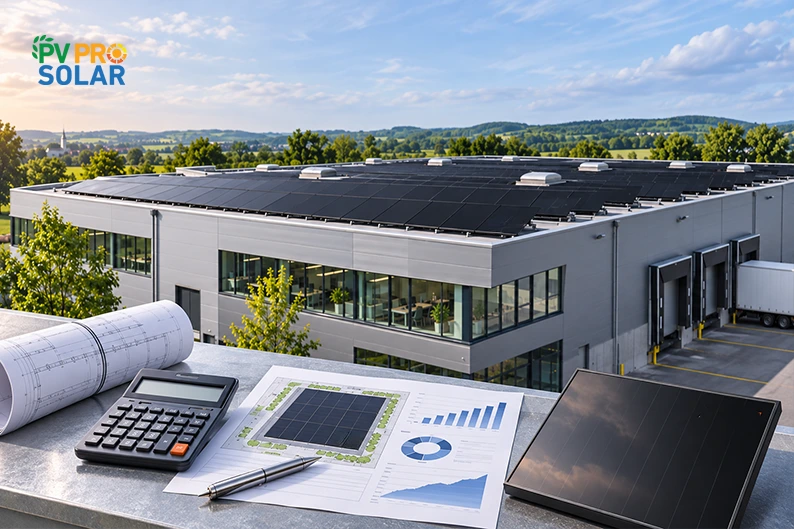
A company’s own rooftop solar system follows the same EEG rules as everyone else: feed-in tariff up to 100 kW, direct marketing above that, plus the depreciation rules. Our page on commercial photovoltaics in Hanover goes into detail.
What differences exist between funding for individuals and businesses?
| Individuals | Businesses | |
|---|---|---|
| Solar system | No federal grant, but 0% VAT, tax exemption, feed-in tariff | Feed-in tariff or direct marketing, depreciation |
| Loan | KfW 270 | KfW 270 and other business loans |
| Grants | KfW 458 for the heat pump, regional programmes | EEW, innovation and hydrogen programmes |
| Grid fees | § 14a EnWG for heat pump, wallbox, storage | Depending on grid connection and consumption |
In short: households save mainly through taxes, the tariff and self-consumption; grants are mostly for heating. Businesses have more depreciation and programme options, but also more obligations such as direct marketing.
What role do states and municipalities play in funding?
At state level, Germany supports renewable energy more through rules than through money: the federal states mainly set requirements such as solar mandates in building law. State grant programmes change often, and many earlier storage and PV programmes have ended. The federal funding database (Förderdatenbank des Bundes) gives a current overview of federal, state and EU programmes.
Solar mandates: how German states require renewable energy
In Lower Saxony, § 32a NBauO sets the solar mandate. Since 1 January 2025 it also applies to new residential buildings: if a new building has at least 50 m² of roof area, at least 50% of it must be covered with photovoltaics. The same applies when the roof covering is renewed down to the water-bearing layer. Solar thermal can count, and there are exemptions, e.g. if a system is technically impossible or economically unreasonable. What this means for a new build is explained in solar panels on a new build. An overview of all solar laws: solar energy laws in Germany.
proKlima: how the Hannover region supports renewable energy on top
One example of regional funding is the proKlima fund. Its «DachVollToll» programme pays €100 per kWp, up to €2,000, for existing residential buildings in Hannover, Hemmingen, Laatzen, Langenhagen, Ronnenberg and Seelze. Conditions include at least 2 kWp and a fully covered roof surface. The grant is only available while funds last, and you must apply before placing the order. More on funding in the region: solar system funding in Hannover.
How does Germany promote the expansion of wind energy?
Wind power is the most important renewable energy source in Germany.
- Bundesnetzagentur tenders for new onshore wind farms; offshore under the Offshore Wind Energy Act.
- Area targets: under the Wind Energy Area Requirements Act, each state must designate a fixed share of its land for wind by the end of 2032, together around 2% of Germany’s area.
- Easier rules for citizen energy projects and support for grid expansion.
Local benefits: what municipalities gain when Germany expands renewable energy
Under § 6 EEG, operators of onshore wind turbines (above 1 MW) and ground-mounted solar plants may pay the affected municipalities 0.2 ct per kilowatt hour fed in. For EEG-funded plants, the grid operator reimburses this amount. This way, municipalities benefit directly from the expansion on their doorstep.
What support exists for biomass and biogas plants?
Biogas and biomass are also supported under the EEG, but only the electricity fed in, not the heat. New plants above 150 kW take part in tenders. Flexibility payments reward plants that deliver power when wind and sun are lacking. Existing plants can bid for follow-on support after their first support period ends (Federal Environment Agency).
What role do hydrogen and Power-to-X technologies play?
Hydrogen from renewable electricity is meant to help where direct electrification is difficult, for example in the steel and chemical industries.
- National Hydrogen Strategy since 2020, updated in 2023.
- Support for electrolyzers and pipelines, among others via large European projects (IPCEI).
- EU Power-to-X programs.
Hydrogen is expected to decarbonize industry, mobility, and heating in the long term. For households, hydrogen for heating or storage plays practically no role today.
How is e-mobility supported in connection with renewable energy?
- Purchase grant: since May 2026, private persons can apply to BAFA for €1,500 to €6,000 for new electric cars, retroactively for first registrations from 1 January 2026. The amount depends on income, household size and vehicle (Federal Environment Ministry).
- Wallbox: there is currently no nationwide grant for private charging stations. Instead, § 14a EnWG lowers grid fees for a controllable wallbox.
- Company cars: the private use of electric company cars is taxed at a lower rate than combustion cars.
You save the most when you charge your car with your own solar power. We install home wallboxes and match them to your PV system so that they charge with surplus power.
What opportunities does the European Green Deal offer for Germany?
The EU Green Deal supports member states in expanding renewable energy. With the revised Renewable Energy Directive (RED III), the EU has committed to covering at least 42.5% of its total energy consumption from renewable sources by 2030. For Germany, this means additional EU funding, mainly for research, hydrogen and grids, and requirements for faster permits that further accelerate the expansion.
What future trends are emerging in German renewable energy policy?
- Away from fixed tariffs towards market signals: the planned EEG 2027 is to link new small systems more closely to the electricity market (according to the government draft).
- Stronger promotion of storage, flexible consumers and grid infrastructure.
- Digitalization of the energy sector with smart meters.
- Expansion of the hydrogen economy.
- Support for sector coupling (electricity, heating, transport).
Conclusion: how Germany supports renewable energy
Germany supports renewable energy with a wide mix of laws, taxes, loans and grants. For your home this means: you buy the solar system without VAT, the income is tax-free, the electricity you feed in is paid for 20 years, and KfW 270 is available for financing. Grants exist for the heat pump via KfW 458 and, in the Hannover region, additionally via proKlima. If you commission a system by 31 December 2026, you secure today’s fixed tariff.
Want to know which funding applies to your roof in the Hannover region? Request your free, non-binding quote. We check your roof, consumption and funding options and plan your system with our own installers at a fixed price. You can also call us on 0511 3360603 or message us on WhatsApp at +49 176 2399 8536.
Sources:
- § 1 EEG (80% target by 2030) and § 4 EEG (expansion path)
- § 21 EEG (feed-in tariff up to 100 kW), § 22 EEG (tender obligation), § 6 EEG (municipal participation)
- Federal Environment Agency: Renewable Energy Sources Act (tenders, biomass)
- Federal Government: EEG levy abolished from 1 July 2022
- Bundesnetzagentur: results of the solar tender of 1 July 2026
- § 12 UStG and § 3 EStG
- KfW: Renewable Energies – Standard (270)
- KfW: heating subsidy for private persons (458)
- Bundesnetzagentur: controllable consumer devices (§ 14a EnWG)
- Federal Environment Ministry: EV grant applications open (19 May 2026)
- proKlima: DachVollToll
What subsidies are currently available for solar systems in Germany?
There is no federal grant for private solar systems. Support comes through 0% VAT, the income tax exemption up to 30 kWp, the EEG feed-in tariff for 20 years and the KfW 270 loan. Regional programmes add to this, in the Hannover region for example proKlima with up to €2,000 while funds last.
Is investing in renewable energy still worthwhile despite declining feed-in tariffs?
Usually yes, because a solar system today pays off mainly through self-consumption. Every kilowatt hour you use yourself replaces expensive grid power. In our Rethen reference project with 10.2 kWp and storage for €21,400, the worked example gave a payback of about 9.7 years at an assumed electricity price of €0.32/kWh. The result depends on roof, consumption and electricity price.
Is there a government grant for photovoltaics or battery storage?
No. There is no federal grant for private photovoltaic systems or home storage. KfW offers a loan through programme 270. Grants only exist regionally, for example via proKlima in Hannover and five neighbouring towns.
Who pays for EEG support since the end of the EEG levy?
Since 1 July 2022, no EEG levy has been charged on electricity bills, and it was abolished in 2023. The tariffs have since been financed from federal funds via the EEG account of the transmission system operators.
How much funding is there for a heat pump?
KfW programme 458 provides 30% base funding, plus up to 16% climate speed bonus and up to 40% income bonus. The total is capped at 70%, or 80% in the lowest income bracket, with eligible costs of up to €28,000 for a single-family house (as of November 2026).
What does § 14a EnWG mean for me?
If your heat pump, wallbox or storage with more than 4.2 kW is registered as controllable, you pay lower grid fees: either a flat reduction of roughly €110 to €190 per year or a 60% lower energy price with a separate meter. In return, the grid operator may briefly limit the power to 4.2 kW in case of overload.
Do I have to install a solar system in Lower Saxony?
For a new build with at least 50 m² of roof area and when the roof covering is renewed, yes: under § 32a NBauO at least 50% of the roof area must be covered with photovoltaics. There is no obligation for existing roofs without renovation.
Note: This article gives a general overview (as of November 2026) and does not replace tax, legal or funding advice.
PVPro Solar GmbH
In 3 Schritten zur PV-Anfrage
Bedarf klären · Daten senden · Angebot erhalten
Jetzt Anfrage sendenBedarf klären
Schritt 1
Daten senden
Schritt 2
Angebot erhalten
Schritt 3