

Renewable Energy Sources Act (EEG): What Does It Mean for Consumers?
Diese Seite ist auch auf Deutsch verfügbar
Artikel auf Deutsch lesen
The Renewable Energy Sources Act (EEG) forms the legal framework for promoting renewable energy in Germany. Its goal is to increase the use of sustainable energy sources such as wind, solar, biomass, and hydropower while also achieving climate targets. But what concrete effects does the EEG have on consumers and businesses? In this article, you’ll get clear answers to the most important questions about the EEG.
PVPro Solar GmbH
Bedarf klären · Daten senden · Angebot erhalten
Jetzt Anfrage sendenBedarf klären
Schritt 1
Daten senden
Schritt 2
Angebot erhalten
Schritt 3
What Is the Renewable Energy Sources Act (EEG)?
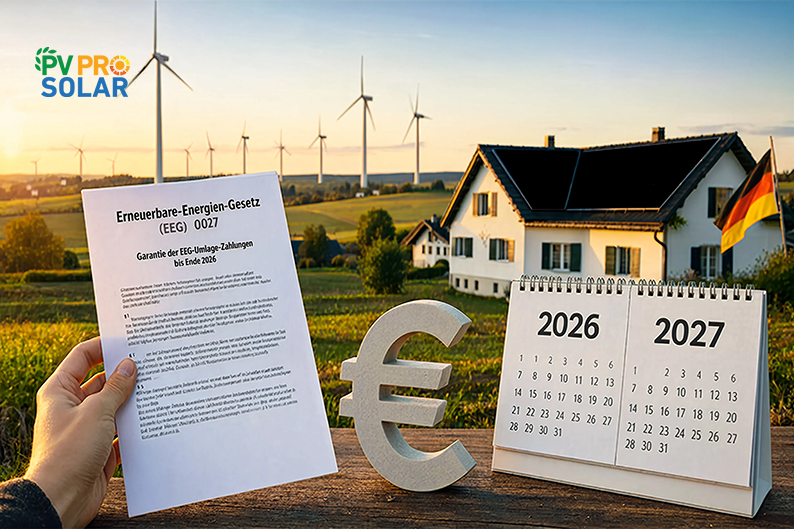
The EEG came into force on 1 April 2000 and serves to systematically promote electricity generation from renewable energy sources. At the core of the law is a statutory payment for operators of systems that generate renewable energy, such as photovoltaic or wind power systems. This payment provides planning certainty and makes investment in renewable energy more attractive, steadily increasing its share of the energy mix. The law also governs the priority given to feeding electricity from renewable sources into the public grid and requires grid operators to connect such systems as a priority and take their power.
Small systems such as a PV system on a single-family home receive a fixed feed-in tariff, paid for 20 years from commissioning. Larger systems receive their support through direct marketing or through tenders held by the Federal Network Agency.
Why Was the EEG Introduced?
The EEG arose from the interest and need to reduce Germany’s dependence on fossil fuels, curb climate change, and expand sustainable energy sources. The law itself sets a clear target: by 2030, at least 80 percent of the electricity consumed in Germany is to come from renewable energy (§ 1 EEG). Under § 2 EEG, the expansion of renewable energy is in the overriding public interest.
What EEG Surcharge Currently Applies to Consumers?
None any more. The EEG surcharge used to be paid through electricity bills and financed the payments to system operators. It has been zero since 1 July 2022 and was abolished completely on 1 January 2023. The support for renewable energy has since been financed from the federal budget. For PV system operators nothing changes: the feed-in tariff is still paid by the grid operator.
How Do Consumers Benefit from the EEG?
Consumers benefit most directly when they generate electricity themselves. The EEG guarantees operators of their own photovoltaic system a grid connection and a payment for the power they feed in. Self-consumption is even more valuable today: every kilowatt hour you use yourself replaces expensive grid electricity. A battery can increase this share considerably; find out more in battery storage for your home.
What Obligations Does the EEG Create for Businesses?
Since the EEG surcharge was abolished, the former reductions for energy-intensive companies on this surcharge no longer play a role. Today, obligations mainly apply to businesses that generate electricity themselves: they must register their system with the grid operator, enter it in the Federal Network Agency’s Marktstammdatenregister and, from a system output of 100 kW, sell the power through direct marketing. What this means for commercial rooftop systems is explained in commercial photovoltaics.
How Does the EEG Influence the Expansion of Photovoltaic Systems?
Photovoltaic systems benefit significantly from the EEG through the statutory feed-in tariff. This has greatly accelerated the expansion of solar energy. For systems up to 10 kWp commissioned since 1 August 2026, the tariff is around 7.70 ct/kWh with partial feed-in and around 12.22 ct/kWh with full feed-in. Since the Solar Peak Act, new systems receive no payment during hours with negative electricity prices.
For new small systems, the federal government’s cabinet draft plans a new model with a shorter payment period from 2027; it has not been passed yet. Systems commissioned by 31 December 2026 keep the fixed tariff for 20 years. All details for system operators can be found in our guide to the EEG law for photovoltaics, and the current status of the reform on our page about the EEG amendment.
The EEG has put Germany on the path toward a sustainable energy future and is continually being adjusted. If you are thinking about generating your own solar power, we will gladly advise you free of charge on the system, battery and registration: Request a free, no-obligation quote now.
Do I still have to pay the EEG surcharge?
No. Since 1 July 2022, consumers no longer pay an EEG surcharge, and since 1 January 2023 it has been abolished completely. The support for renewable energy has since been financed from the federal budget.
Can I Benefit from the EEG with a Photovoltaic System?
Yes. The EEG guarantees you a grid connection and a payment for power fed into the grid, fixed for 20 years if the system is commissioned by 31 December 2026. Today, however, a system pays off most through self-consumption, because the power you use yourself replaces expensive grid electricity.
Who pays the feed-in tariff?
The feed-in tariff is paid by your grid operator, not the state. The requirements are registration with the grid operator and an entry in the Marktstammdatenregister within one month of commissioning.
Note: This article provides a general overview (as of October 2026) and does not replace tax or legal advice.
PVPro Solar GmbH
In 3 Schritten zur PV-Anfrage
Bedarf klären · Daten senden · Angebot erhalten
Jetzt Anfrage sendenBedarf klären
Schritt 1
Daten senden
Schritt 2
Angebot erhalten
Schritt 3