
How Much Solar Power Does a PV System Produce in Hannover in Winter?
Diese Seite ist auch auf Deutsch verfügbar
Artikel auf Deutsch lesen
As the days grow shorter, the sky turns greyer, and the sun barely shows itself, many homeowners in Hannover and the surrounding region start to wonder: is my PV system even still worth it in winter? The honest answer: yes, but differently than in summer. Anyone who understands the seasonal differences plans smarter, expects realistic yields, and won’t be disappointed.
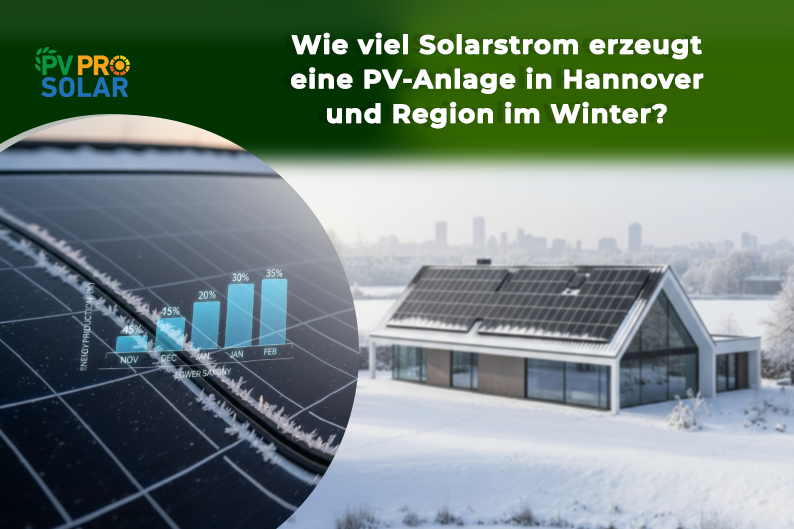
Reference values based on PVGIS data and DWD global radiation figures for the Hannover/Lower Saxony region. Actual yields depend on roof orientation, tilt angle, and system specifics.December is therefore the weakest-yielding month of the year, which also holds true for the rest of Germany. Nationally, December produces only around 17 to 30 kWh per kWp of installed capacity on average. From February onward, yield rises noticeably again.
Reference values based on PVGIS calculations for the Lower Saxony region.The differences within the region are marginal. Roof orientation, tilt angle, and module quality matter more than location – factors that a good specialist company plans correctly from the outset.
PVPro Solar GmbH
In 3 Schritten zur PV-Anfrage
Bedarf klären · Daten senden · Angebot erhalten
Jetzt Anfrage senden1
Bedarf klären
Schritt 1
2
Daten senden
Schritt 2
3
Angebot erhalten
Schritt 3
How Much Sun Does Hannover Actually Get in Winter?
Hannover is located in Lower Saxony and records around 1,720 sunshine hours per year on average. That may sound modest, but it’s a solid figure for northern Germany. The catch: these sunshine hours are distributed extremely unevenly across the year.In the winter months of January to March and October to December, only about 21.6% of the annual global solar radiation falls. The summer months from April to September, by contrast, account for around 78% of the total annual yield.In plain terms: in Hannover, you can’t expect the same output in December and January as in May or June. That’s not a fault in your system – it’s simply physics and geography. Anyone who factors this in from the start is on the safe side.Concrete Yield Expectations for Hannover in Winter
With around 940 kWh per kWp annually on average, Hannover is one of the better-suited locations for solar in northern Germany. In winter, however, the distribution looks quite different.A 10 kWp system produces around 173 kWh in December, about 200 kWh in January, and roughly 363 kWh in February. The entire winter yield contributes around 23% to the annual total.Monthly Reference Values for a 10 kWp System in Hannover
| Month | Approx. Yield (kWh) | Share of Annual Yield |
| October | approx. 450–520 kWh | ~5% |
| November | approx. 230–290 kWh | ~2.5% |
| December | approx. 170–200 kWh | ~1.8% |
| January | approx. 190–220 kWh | ~2.1% |
| February | approx. 340–400 kWh | ~3.7% |
| March | approx. 620–700 kWh | ~6.5% |
Why Is Solar Yield Lower in Winter? The 3 Key Factors
1. Shorter Days and a Flatter Sun Angle
In December, the sun is above the horizon in Hannover for only around 8 hours, and even then it stays low. The angle of incidence of sunlight is significantly less favorable than in summer, which sharply reduces the intensity of global radiation. Less light per surface area automatically means less yield per installed kWp.2. More Cloud Cover and Diffuse Light
Northern Germany is known for overcast skies in winter, and Hannover is no exception. In winter, the daily yield of a 10 kWp system drops to around 5 to 10 kWh per day, compared to 50 to 70 kWh on a good summer day. On overcast days with thick cloud cover, daily yield can even fall below 2 kWh.3. Snow Cover – But With One Advantage
Snow on the modules blocks light absorption completely for as long as it sits there. However, it often slides off smooth solar modules on a sloped roof fairly quickly on its own. And when fresh, white snow surrounds the house, it reflects light back onto the modules – a so-called albedo effect that can slightly boost yield on those days.The Surprising Upside: Cold Increases Efficiency
Here’s an important fact many PV owners don’t know: solar module efficiency increases as temperature drops. In summer, when there’s a lot of sun, the modules heat up accordingly, which reduces their efficiency. In winter, by contrast, when the sun does shine, owners can enjoy a higher solar power yield.In practice, this means a clear winter day in Hannover with bright sunshine and -5°C can deliver surprisingly good yields, because the modules work more efficiently in the cold than in summer heat. A cool, sunny March day can often outperform a hot, hazy August day.Is Solar Worth It in Hannover in Winter Too? An Honest Calculation
Let’s take a realistic 10 kWp system in the Hannover region with a south-facing orientation and a 30° tilt:- Total annual yield: approx. 9,000–9,400 kWh
- Winter yield (October–March): approx. 1,900–2,200 kWh
- Summer yield (April–September): approx. 6,800–7,200 kWh
How to Get More Out of Your PV System in Winter
Optimize Roof Tilt and Orientation
For Hannover, a steeper tilt angle of 35–45° (rather than the summer-optimal 30°) noticeably improves winter yield, since it captures the lower-angled sun more effectively. Anyone planning a new system should discuss this trade-off with their installer.Battery Storage for More Self-Consumption
Battery storage is especially valuable in winter. The system generates electricity during the day, while the household’s demand peaks in the evening and at night. A storage battery bridges this gap, letting you draw significantly less expensive electricity from the public grid.Keep Modules Clean and Snow-Free
Dirty or snow-covered modules perform worse. On shallow tilts, it’s worth carefully removing snow after heavy snowfall – but only with suitable tools and without climbing onto the roof. Many modern systems with monitoring will automatically alert you if a module is underperforming.Match Consumption to Generation
In winter, your system produces most of its power around midday, when the sun is highest. Schedule your washing machine, dryer, or dishwasher for that time. Anyone using a smart energy management system gets this handled automatically – the system controls appliances on its own whenever solar power is available.Winter PV in the Hannover Region: What About Other Cities?
PVPro Solar is active not only in Hannover but across the entire Lower Saxony region. The yield differences between individual locations are minimal:| Location | Annual Yield (approx. per kWp) | Winter Yield (approx.) |
| Hannover | 930–960 kWh | ~210–230 kWh/kWp |
| Wolfsburg | 940–970 kWh | ~215–235 kWh/kWp |
| Braunschweig | 945–975 kWh | ~215–240 kWh/kWp |
| Hildesheim | 935–960 kWh | ~210–230 kWh/kWp |
| Wunstorf / Garbsen | 925–955 kWh | ~205–225 kWh/kWp |
Conclusion: Winter Is Not the Enemy of Your Solar System
Winter noticeably reduces PV yield in Hannover – that’s a fact. But it doesn’t stop it. A well-planned, professionally installed system still generates solar power every day from December through February, creating real value through self-consumption. The right system size, an appropriately sized battery storage, and smart energy management ensure you make full use of winter’s potential instead of simply giving it away to the grid.Anyone planning now also benefits from an important timing advantage: systems that go live in spring work from day one during the year’s strongest-yielding phase.Get a Free Consultation Now – PVPro Solar GmbH in Hannover
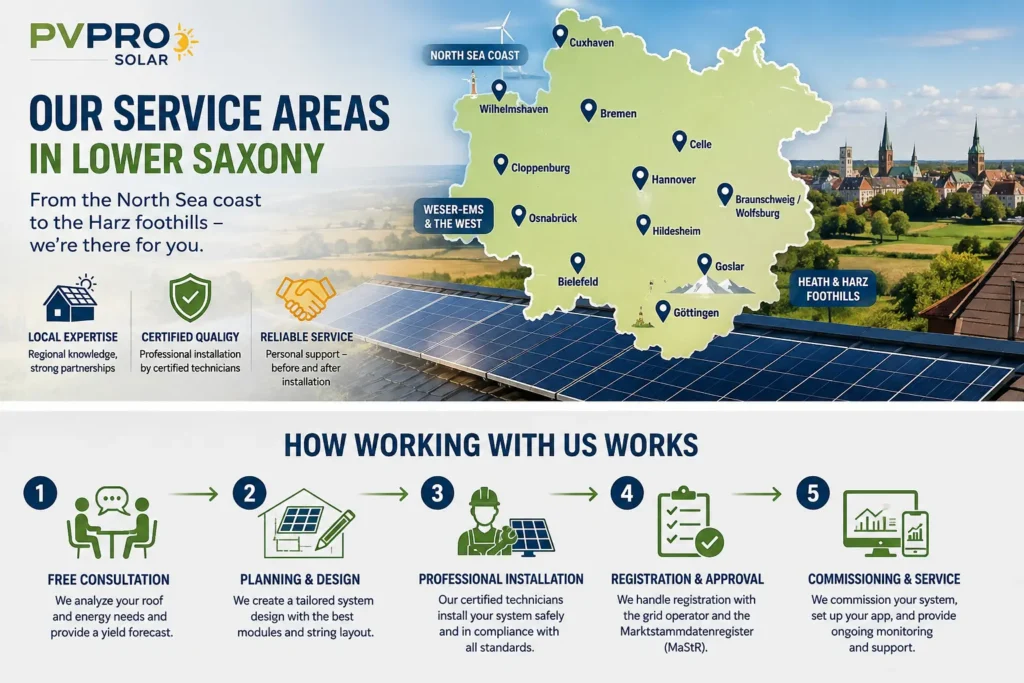
Wondering how much electricity a system would produce for your specific roof situation in Hannover or the region, even in winter? The team at PVPro Solar GmbH will put together an individual yield calculation for you, completely free and without obligation.As a certified regional specialist company based in Hannover, we plan and install PV systems across all of Lower Saxony, including battery storage, wallboxes, and heat pumps. You get concrete figures instead of vague promises.Request a free quote from PVPro Solar GmbH today and find out what your roof can deliver all year round.FAQs
Is Solar Still Worth It in Hannover If Winter Contributes So Little?
Yes, definitely. Lower Saxony reaches global radiation values of around 1,000 to 1,150 kWh per square meter per year – excellent conditions for solar systems. Winter yield may be lower, but it doesn’t fall to zero. Combined with battery storage, up to 70% of self-consumption can still be covered from your own system even during the winter months.How Much Electricity Does a 10 kWp System Produce in Hannover in January?
In January, you can expect a yield of around 190 to 220 kWh for a 10 kWp system in the Hannover region. That corresponds to a daily yield of roughly 6 to 7 kWh on average winter days, with significant variation depending on weather conditions.Why Does My System Produce So Little Electricity in December?
December is the weakest month of the year for any PV system in northern Germany. The sun is above the horizon for only a few hours each day, the angle of incidence is shallow, and frequent cloud cover further reduces global radiation. This is normal and not a sign of a defect. Active monitoring helps you determine whether low yield is due to weather or a system issue.Should I Clean the Modules in Winter?
With heavy snow cover on shallow-tilted roofs, carefully removing snow with a soft brush can improve yield. Dirt and leaves settle on the modules especially in autumn and should be professionally cleaned once a year. Cleaning should always be carried out by a certified specialist company.Does Battery Storage Make Special Sense in Winter?
Yes, battery storage is especially worthwhile in winter. Solar power is generated during the day, but household demand is often highest in the evening or morning. A storage battery bridges this time gap, letting you use significantly more of your self-generated electricity instead of feeding it into the grid at a low compensation rate.Which Roof Orientation Is Ideal for Winter Yield in Hannover?
A south-facing orientation with a tilt angle of 35–45° delivers the best winter yield in Hannover. East-west orientations produce somewhat less overall but distribute power generation more evenly throughout the day, which can also be very efficient when combined with a storage battery.PVPro Solar GmbH
In 3 Schritten zur PV-Anfrage
Bedarf klären · Daten senden · Angebot erhalten
Jetzt Anfrage senden1
Bedarf klären
Schritt 1
2
Daten senden
Schritt 2
3
Angebot erhalten
Schritt 3