
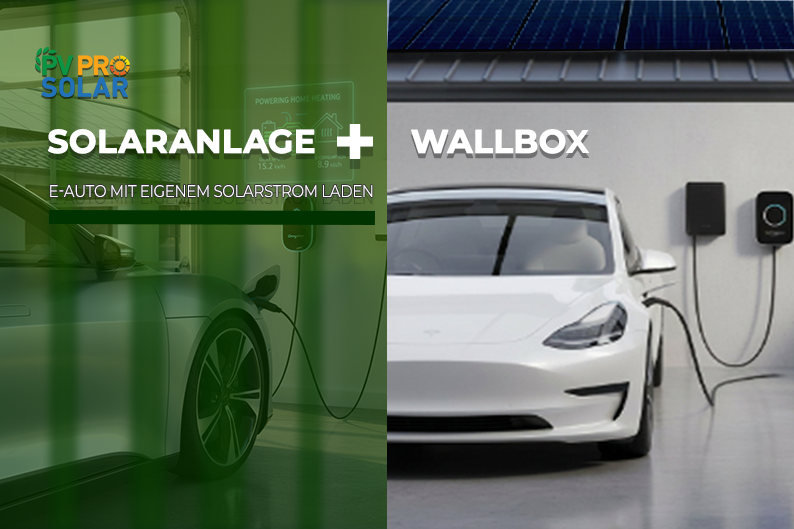
Solar System and Wallbox: Charging Your EV with Your Own Solar Power
Diese Seite ist auch auf Deutsch verfügbar
Artikel auf Deutsch lesen
Anyone driving an electric car today feels the strain of fluctuating grid electricity prices directly in their wallet. Combining your own solar system with a wallbox provides the perfect technological bridge to become independent of expensive public tariffs. Instead of feeding the valuable electricity from your own roof into the public grid for a low feed-in tariff, the clean energy flows directly into the vehicle’s battery. This not only protects the environment but also reduces the car’s ongoing operating costs to an absolute minimum. But how exactly do these components work together, and what should homeowners pay particular attention to when planning in regions like Lower Saxony, Hannover, or Bremen?
PVPro Solar GmbH
Bedarf klären · Daten senden · Angebot erhalten
Jetzt Anfrage sendenBedarf klären
Schritt 1
Daten senden
Schritt 2
Angebot erhalten
Schritt 3
How Does Charging an EV with Your Own Solar Power Work?
The technical principle behind combining a solar system and a wallbox is called intelligent PV surplus charging. A central electricity meter or a smart meter in the utility connection box continuously measures how much electricity the photovoltaic system generates and how much energy the household appliances are consuming at the same moment. If a surplus arises on a sunny midday because the solar system produces more than the washing machine, refrigerator, and other appliances need, the system routes this surplus energy directly to the charging station. The car then charges with one hundred percent clean, self-generated electricity.
Without such intelligent control, the charging station would simply start at maximum power as soon as the cable is plugged in. This often means that expensive grid electricity has to be purchased when clouds suddenly roll in during the afternoon or the solar system isn’t yet producing enough power in the morning. A well-designed system combining a solar system and a wallbox instead adjusts the charging current in real time to match weather conditions.
Why Is Phase Switching So Important for a Charging Station?
One of the biggest technical hurdles when charging with solar power is the minimum charging power of electric vehicles. The European standard states that a charging current of at least 6 amps per phase must flow to start a three-phase charging process. That corresponds to a minimum power of about 4.1 kW. Smaller photovoltaic systems, or even larger systems on cloudy days in the Wolfsburg or Hannover area, often don’t reach this value during transitional periods. Without additional technology, the charging process would constantly interrupt or unintentionally draw expensive electricity from the grid.
This is where automatic phase switching comes in. High-quality charging stations can flexibly switch between single-phase and three-phase charging. If the solar system’s output drops below the 4.1 kW threshold, the charging station automatically switches to single-phase charging. This allows the electric car to be charged continuously and without interruption using pure solar power starting from a surplus of just 1.4 kW. As soon as the sun shines more strongly again, the system seamlessly switches back to fast three-phase mode.
What Role Does a Battery Storage System Play in Solar Charging?
A stationary battery storage system in the basement massively increases the flexibility of the overall system. This buffer is especially beneficial for commuters whose vehicles aren’t at home during the hours of peak sunlight. The home storage system collects the energy from the midday hours and makes it available in the evening or at night when the car is parked in the garage.
However, efficiency needs to be kept in mind here. Every storage cycle in a lithium-ion battery involves chemical and thermal conversion losses of around 10 percent. If electricity is first stored in the home battery and then in the car’s battery, some of the energy is lost. The most economical strategy therefore remains charging the vehicle directly on weekends or while working from home. The home storage system should primarily cover the household’s evening baseline consumption and support the car only with any remaining capacity.
How Large Does the Photovoltaic System Need to Be for an Electric Car?
A simple rule of thumb applies for reliably sizing the system: add your household’s annual electricity demand to your electric car’s calculated driving electricity demand, then divide this figure by the regional PV yield. A typical EV consumes an average of about 20 kWh per 100 kilometers. With a typical annual mileage of 15,000 kilometers, this results in an additional electricity demand of around 3,000 kWh per year.
| Driving Profile | Annual Mileage | Additional Electricity Demand | Recommended Minimum System Size (incl. household) |
| Second Car | 10,000 km | 2,000 kWh | At least 6 to 8 kWp |
| Average Driver | 15,000 km | 3,000 kWh | At least 8 to 10 kWp |
| Commuter | 20,000 km | 4,000 kWh | At least 10 to 12 kWp |
| High-Mileage Driver | 30,000 km | 6,000 kWh | From 14 to 15 kWp |
To have enough buffer for electricity generation even in changeable weather in regions like Bremen or Lower Saxony, it’s advisable to always make maximum use of the available roof area. The greater the installed kWp output of the solar system, the more often and for longer the threshold for pure surplus charging is exceeded throughout the day.
What Legal Regulations Apply to the Installation?
Installing a combination of a solar system and a wallbox must always be carried out by a certified specialist company. In Germany, under the Low Voltage Connection Ordinance (§ 19 NAV), there is a strict obligation to notify the responsible local grid operator. Charging stations with an output of up to 11 kW only need to be registered with the grid operator before commissioning.
If a charging station with an output of 22 kW is to be installed, a simple notification is not sufficient. In this case, official approval from the grid operator must be obtained in advance, since the high load can significantly strain the local power grid at certain points. In addition, specialist companies check in advance whether the existing meter cabinet meets modern requirements or whether a digital electricity meter or a smart meter gateway needs to be retrofitted due to legal requirements (such as § 14a EnWG on the controllability of consumption devices).
Conclusion
The perfect combination of a solar system and a wallbox requires precise planning tailored to your personal driving profile and roof area. Rely on regional expertise and tailor-made solutions right on your doorstep.
Would you also like to charge your electric car as cheaply as possible with clean electricity from your own roof? PVPro Solar GmbH is your experienced partner for photovoltaics, battery storage, and complete solar systems in the Lower Saxony region. Get a free, no-obligation consultation from our experts now and secure your individual quote for a perfectly matched overall system.
Visit PVPro Solar GmbH for a free initial consultation!
FAQs
Can Every Electric Car Use Pure PV Surplus Charging?
Generally yes, since controlling the charging process is primarily handled through communication between the energy management system and the intelligent charging station. The vehicle only needs to support standard charging protocols. However, it’s important that the vehicle can handle low charging currents starting at 6 amps without issue and doesn’t switch into an error mode when the charging station performs automatic phase switching.
Is It Worth Getting a Solar System and Wallbox Without Home Storage?
Yes, absolutely. Anyone who can charge their car primarily on weekends, while working from home, or during flexible afternoon hours achieves excellent self-consumption rates even without expensive battery storage. In this scenario, storage losses are eliminated, so the directly charged kilowatt-hour from the roof achieves maximum economic return.
PVPro Solar GmbH
In 3 Schritten zur PV-Anfrage
Bedarf klären · Daten senden · Angebot erhalten
Jetzt Anfrage sendenBedarf klären
Schritt 1
Daten senden
Schritt 2
Angebot erhalten
Schritt 3