
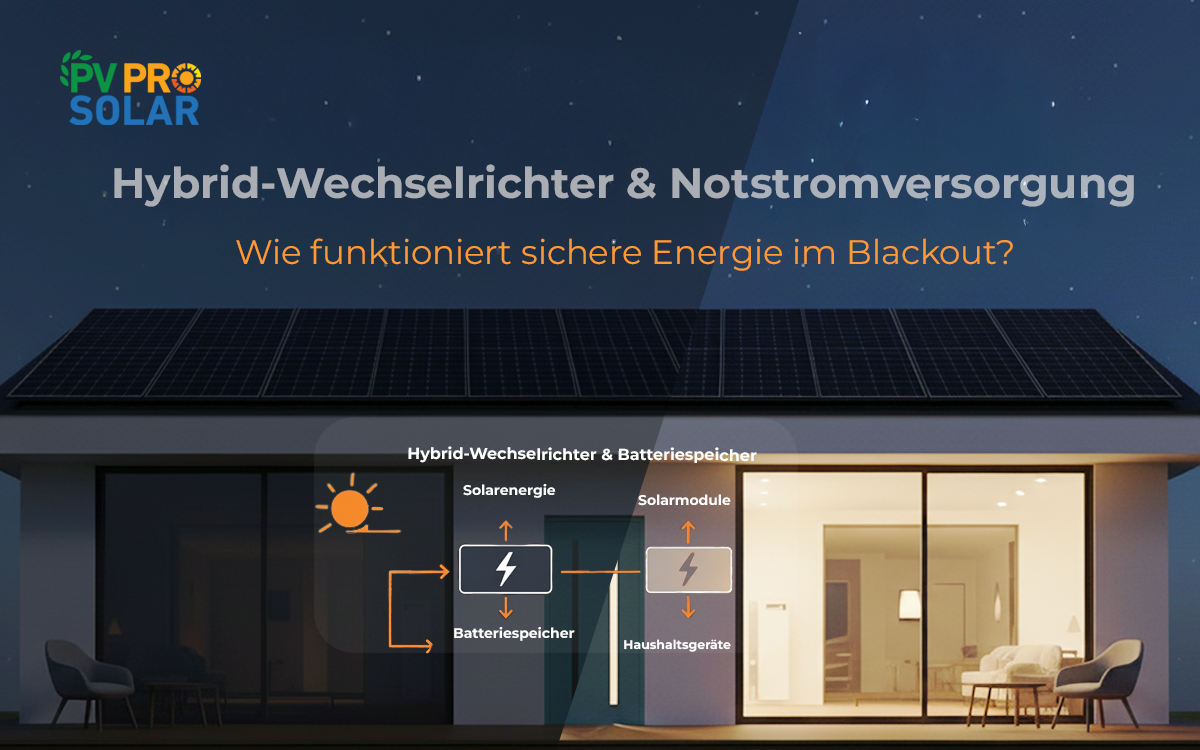
Hybrid Inverter with Backup Power: Stay Powered During an Outage

When the grid goes down, a standard solar system shuts down as well—for safety reasons, it automatically disconnects from the network. A hybrid inverter with backup power capability changes that by continuing to supply your home with electricity from your PV system and battery storage, even when the public grid is unavailable.
However, not all backup solutions are created equal. There is a significant difference between a simple emergency power outlet and a system capable of powering an entire home. As a regional photovoltaic specialist based in Hanover, we explain the key differences, the equipment required, and how battery integration works—so your backup solution performs when it matters most.
PVPro Solar GmbH
In 3 Schritten zur PV-Anfrage
Bedarf klären · Daten senden · Angebot erhalten
Jetzt Anfrage sendenBedarf klären
Schritt 1
Daten senden
Schritt 2
Angebot erhalten
Schritt 3
Backup Power, Emergency Power, and UPS: What’s the Difference?
These terms are often used interchangeably, but they describe very different solutions.
Backup Power (EPS – Emergency Power Supply)
This is the simplest and most common option. During a power outage, the inverter supplies a dedicated backup outlet or a small emergency circuit. There is usually a brief interruption—ranging from milliseconds to a few seconds—during which connected devices temporarily switch off.
This solution is ideal for:
- Refrigerators
- Routers
- Lighting
- Phone charging
- Laptops
Whole-Home Backup
With a whole-home backup system, an Automatic Transfer Switch (ATS) disconnects the entire house from the public grid and continues supplying power from the solar and battery system.
This provides significantly greater comfort but requires more sophisticated technology, including proper isolation of all phases and the neutral conductor.
UPS (Uninterruptible Power Supply)
A UPS transfers power with zero interruption (0 ms) and is designed for highly sensitive equipment such as:
- Servers
- Medical devices
- Critical IT infrastructure
A hybrid inverter is not a UPS in the strict technical sense. If uninterrupted operation is essential, a dedicated UPS system is required.
Quick Rule of Thumb
- Most homes are well served by a quality EPS backup solution.
- Whole-home backup is worthwhile if you want to maintain normal household operation during outages.
- A UPS is only necessary for equipment that cannot tolerate any interruption at all.
Which Solution Is Right for You?
| During a Power Outage, You Want to Run… | Recommended Solution |
|---|---|
| Refrigerator, router, lighting, laptop | EPS backup is usually sufficient |
| Heat pump, electric stove, most of the home | Whole-home backup with a 4-pole ATS |
| Servers, IT systems, medical equipment (0 ms interruption) | Additional UPS required |
The right solution depends on which appliances must remain operational during an outage and how much technology—and budget—you are willing to invest.
We help determine the best option for your household during the consultation process.
Battery Integration: Where Backup Power Comes From
Backup power only works if stored energy is available.
The hybrid inverter combines the photovoltaic system and battery storage into a single integrated system. During normal operation, solar power charges the battery. During an outage, the battery supplies critical loads, and as long as the sun is shining, the PV system can continue recharging the battery even while operating independently from the grid.
Key Practical Considerations
Reserve Capacity
A portion of the battery capacity can be reserved specifically for emergency situations and excluded from daily self-consumption.
Charging During Island Mode
A properly designed system continues using solar energy during an outage, significantly extending runtime during daylight hours.
Starting Currents
Motor-driven loads such as refrigerators, pumps, and heat pumps draw significantly higher power during startup than during normal operation.
The inverter and battery system must be sized accordingly; otherwise, the backup system may shut down when these loads start.
Learn more about battery systems on our Battery Storage page.
How Long Will the Battery Last During an Outage?
The answer depends on both battery capacity and household consumption.
As a general guideline, a battery with approximately 7 kWh of usable capacity can typically support a home’s essential loads—such as refrigeration, lighting, internet connectivity, and communications—for several hours up to roughly one day.
If solar generation continues during daylight hours, the runtime can be extended considerably.
Households wishing to operate large loads such as heat pumps or electric cooking appliances during outages require substantially more storage capacity and careful load prioritization.
Which Hybrid Inverters Are Suitable?
A hybrid inverter with backup functionality is not a plug-and-play product.
The inverter, battery storage system, and backup concept must be properly matched and installed in accordance with applicable standards.
When selecting a backup-capable system, we focus on:
- Genuine backup functionality rather than merely being “backup-ready”
- Adequate continuous and peak power output for critical loads
- Seamless integration between inverter and battery storage
- Standards-compliant protection and switching technology
You can learn more about inverter selection on our Solar Inverters page.
Safe Installation: Standards and Protection Systems
Backup power systems are deeply integrated into the home’s electrical infrastructure, making professional installation essential.
As a regional photovoltaic specialist, we design and install backup-capable hybrid systems in full compliance with applicable regulations.
Proper Neutral Conductor Management
For whole-home backup systems, a 4-pole ATS disconnects all phases and the neutral conductor from the grid.
This ensures:
- Correct operation of protective devices in island mode
- Prevention of unintended power export to the public grid
- Compliance with applicable electrical standards
Surge and Residual Current Protection
Appropriate surge protection and residual current protection devices are installed in accordance with current VDE requirements.
Battery Safety
Battery location, fire protection, and installation conditions are designed according to all relevant safety standards.
Registration and Documentation
We handle:
- Grid operator registration
- Market Master Data Register (MaStR) registration
- Documentation and system handover
Many existing homes also require upgrades to the meter cabinet. We assess and implement any necessary modifications as part of the project.
Backup Power as Part of Your Blackout Protection Strategy
Many homeowners ask: What happens during a prolonged blackout?
A hybrid inverter with backup capability is the technical answer.
It allows you to remain supplied with electricity while the surrounding grid is down.
You can learn more about comprehensive blackout protection on our Solar Backup Power Solutions page.
Request a Consultation for Your Backup Power Solution
Would you like to know which backup solution is best suited to your home and which equipment is appropriate for your requirements?
We design and install backup-capable hybrid systems professionally, safely, and from a single source.
- Phone: 0511 3360603
- Email: hallo@pvprosolar.de
- Request a Free Quote – we’ll get back to you promptly.
Backup power (EPS) supplies a dedicated outlet or emergency circuit during an outage, while whole-home backup automatically powers the entire household electrical system.
Yes, devices that cannot tolerate even a brief interruption, such as servers or certain medical equipment, require a dedicated UPS.
Yes, provided a properly sized whole-home backup system with a 4-pole transfer switch and sufficient battery capacity is installed.
Depending on battery size and energy consumption, most systems can power essential household loads for several hours up to approximately one day.
Yes, a properly configured system can continue charging the battery from solar generation while operating in island mode.
Yes, battery storage systems must be registered separately in the Market Master Data Register (MaStR).
Often yes, provided the existing inverter supports backup functionality or can be replaced with a suitable hybrid inverter. What is the difference between backup power and whole-home backup?
Do I need a UPS for sensitive equipment?
Can an entire household be powered during a blackout?
How long will the battery last during a power outage?
Does the solar system continue charging during backup operation?
Does the battery need to be registered?
Can backup power be added to an existing solar system?
PVPro Solar GmbH
In 3 Schritten zur PV-Anfrage
Bedarf klären · Daten senden · Angebot erhalten
Jetzt Anfrage sendenBedarf klären
Schritt 1
Daten senden
Schritt 2
Angebot erhalten
Schritt 3