
How Do Photovoltaics, Heat Pumps, and Wallboxes Work in the Home of the Future?

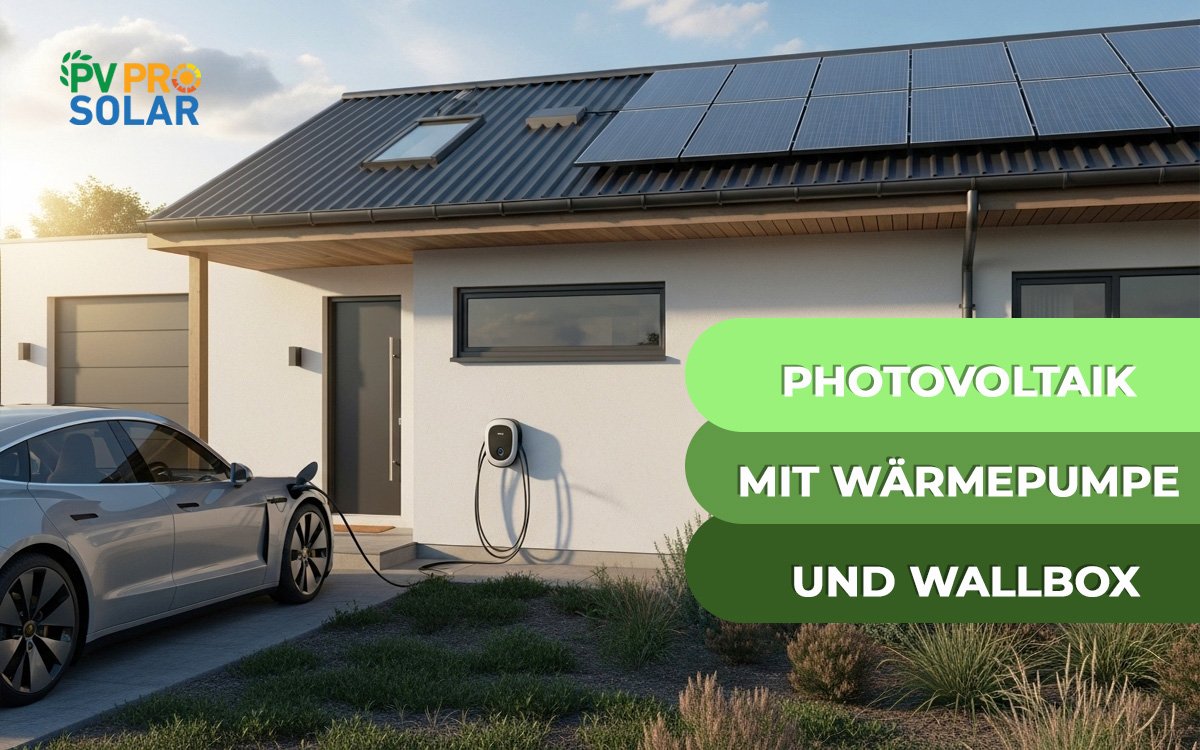
Modern homes are increasingly evolving into intelligent energy systems. More and more households are adopting photovoltaics with heat pumps and wallboxes to generate their own electricity, heat efficiently, and charge electric vehicles sustainably.
By combining these technologies, an integrated system is created that connects energy production, heating supply, and mobility.
Anyone who chooses photovoltaics with a heat pump and wallbox uses solar energy not only for household appliances, but also for heating, hot water, and electric mobility. As a result, a large share of daily energy demand can be covered directly with self-generated electricity.
PVPro Solar GmbH
In 3 Schritten zur PV-Anfrage
Bedarf klären · Daten senden · Angebot erhalten
Jetzt Anfrage sendenBedarf klären
Schritt 1
Daten senden
Schritt 2
Angebot erhalten
Schritt 3
Why Are Modern Homes Adopting Intelligent Energy Systems?
Energy supply in buildings is undergoing major changes. Rising energy prices, new environmental requirements, and technological innovations are leading more households to adopt an intelligent home energy system.
Such a system connects several technologies:
- Photovoltaic system
- Heat pump
- Wallbox for electric vehicles
- Energy management system
- Optional battery storage
The foundation is always electricity generation from solar energy. This is where the combination of photovoltaics with heat pumps and wallboxes plays a central role.
A major advantage of this setup is that homeowners can increase their photovoltaic self-consumption. The electricity generated is used not only in the household but also for heating and mobility.
To make this work efficiently, an intelligent photovoltaic energy management system is used. This system analyzes energy production and consumption in real time and automatically distributes solar power to the appropriate devices.
These technologies form the basis of modern Smart Energy Management for PV, combining energy efficiency with sustainability.
Why Is Photovoltaic Energy the Power Source of the Future Home?
Photovoltaic systems generate electricity from sunlight. This electricity can be used immediately within the home, stored in a battery, or fed into the public grid.
In a modern energy system, photovoltaics form the foundation for photovoltaics combined with heat pumps and wallboxes.
The generated solar power can be used for many applications in the home:
- Household appliances
- Lighting
- Hot water
- Heat pumps
- Air conditioning
- Charging an electric vehicle
Using solar power for electric vehicles is particularly attractive, as the vehicle can be charged directly with renewable energy.
A well-planned complete photovoltaic system for a single-family home connects multiple energy consumers. This significantly increases the proportion of electricity used directly within the household.
For this reason, many homeowners aim to maximize the self-consumption of their PV system by combining multiple technologies. This is precisely where the advantages of photovoltaics with heat pumps and wallboxes become evident.
Why Is the Combination of Photovoltaics and Heat Pumps So Efficient?
The photovoltaic–heat pump combination is considered one of the most efficient solutions for sustainable heating.
How Does a Heat Pump Work?
A heat pump uses environmental energy from air, ground, or groundwater and converts it into heat for buildings. Electricity is required to run this process.
If this electricity comes from a PV system, the result is a particularly sustainable solution. This is why more households are choosing photovoltaics with heat pumps and wallboxes.
Why Does Solar Power Fit Perfectly with Heat Pumps?
Heat pumps require electrical energy to convert environmental heat into usable heating energy. When this electricity comes directly from a photovoltaic system, the need for grid electricity is significantly reduced.
A PV system combined with a heat pump makes it possible to run the heating system using self-generated energy.
Many homeowners deliberately choose to operate their heat pump with photovoltaic power, creating a heating system that works independently of fossil fuels.
When photovoltaics and heat pumps are intelligently combined, several advantages emerge:
- Sustainable heat supply
- Higher self-consumption of solar electricity
- Reduced dependence on the electricity grid
- More efficient use of generated energy
This combination is a central component of modern photovoltaic systems with heat pumps and wallboxes.
How Can Hot Water Be Efficiently Generated with Photovoltaics?
In many households, surplus solar power is used for hot water generation.
A common solution is a photovoltaic heating element system for hot water. In this setup, surplus electricity is directly converted into heat and stored in a hot water tank.
The system works automatically:
- The photovoltaic system generates electricity.
- The household uses part of it.
- Surplus electricity is used to produce hot water.
This approach helps maximize PV self-consumption.
Especially in summer, when heating systems require less energy, excess solar electricity can be used efficiently. In combination with photovoltaics, heat pumps, and wallboxes, nearly every kilowatt-hour produced can be utilized effectively.
How Does an Air Conditioning System Work with Solar Power?
Another advantage of modern energy systems is the ability to run air conditioning using solar power.
Interestingly, the energy demand of air conditioning systems aligns perfectly with photovoltaic electricity production. On hot summer days, PV systems produce the most electricity.
This means:
- Plenty of solar power available
- High cooling demand in the home
- Optimal energy utilization
In a modern photovoltaic home energy system, heating, cooling, and electricity supply can therefore be interconnected.
This again demonstrates the versatility of photovoltaics combined with heat pumps and wallboxes.
How Can an Electric Car Be Charged with Solar Power?
Electric mobility is becoming an increasingly important part of modern energy systems. As a result, the photovoltaic wallbox combination is now a common feature in many PV installations.
What Is a Wallbox?
A wallbox is a specially designed charging station for electric vehicles. It enables fast, safe, and efficient charging at home.
When combined with photovoltaics, heat pumps, and wallboxes, it creates a particularly sustainable mobility solution.
What Are the Advantages of Solar Power for Electric Vehicles?
Charging an electric vehicle with solar power offers several benefits:
- Use of renewable energy
- Greater energy independence
- Optimal use of solar electricity
A modern wallbox connected to a PV system can be intelligently controlled. It charges the vehicle preferably when the photovoltaic system is producing large amounts of electricity.
This allows a PV system to charge an electric car without additional grid electricity.
For this reason, many households deliberately use solar power for heat pumps and wallboxes to make the best possible use of energy within the home.
How Does Intelligent Energy Management Work in the Home?
A modern energy system requires intelligent control. This is where Smart Energy Management for PV comes into play.
The system continuously monitors:
- Electricity production of the photovoltaic system
- Household energy consumption
- Heat pump energy demand
- Battery storage charge level
- Wallbox charging requirements
With this photovoltaic energy management, the generated electricity can be distributed optimally.
A typical scenario looks like this:
- The photovoltaic system generates electricity.
- The household uses part of it.
- The heat pump uses surplus electricity.
- The wallbox charges the electric car.
- Remaining energy is stored.
Through this intelligent control, photovoltaic self-consumption increases, while the efficiency of the entire system improves.
In systems combining photovoltaics, heat pumps, and wallboxes, such energy management unlocks the full potential of the technology.
How Can Homeowners Transition to an Energy-Efficient Home?
Building a modern energy system usually takes place in several steps.
1. Analyze Energy Demand
First, the household’s electricity and heating demand is analyzed. Future needs such as electric mobility are also considered.
2. Plan the Photovoltaic System
The PV system size is planned so that as much electricity as possible can be used within the home.
3. Integrate a Heat Pump
A PV system combined with a heat pump enables sustainable heating with self-generated electricity.
4. Install a Wallbox
With a wallbox connected to photovoltaics, households can charge their electric vehicle using solar power.
5. Set Up an Energy Management System
An intelligent system connects all components and ensures energy is used efficiently.
This creates a modern photovoltaic home energy system that combines electricity, heating, and mobility.
Why Are Photovoltaics with Heat Pumps and Wallboxes Becoming Increasingly Important?
An integrated energy system combining photovoltaics, heat pumps, and wallboxes allows homeowners to design their energy supply sustainably.
Photovoltaic systems generate electricity, heat pumps use that electricity for heating, and wallboxes enable electric vehicles to be charged using solar energy.
Through intelligent energy management, the electricity produced is used optimally. This increases self-consumption and significantly improves the energy efficiency of the home.
Anyone planning such a system should rely on professional planning. PVPro Solar GmbH supports homeowners in developing customized solutions for modern energy systems.
Visit PVPro Solar GmbH to learn how your home can become an energy-efficient home of the future with photovoltaics, heat pumps, and wallboxes.
How does the combination of photovoltaics and a heat pump work?
In a photovoltaic–heat pump system, the PV installation generates electricity that is used directly to operate the heat pump. This increases self-consumption and uses renewable energy efficiently for heating.
Can I charge my electric car entirely with solar power?
Yes. With a wallbox connected to a photovoltaic system, a PV installation can charge an electric vehicle. Intelligent energy management ensures that self-generated solar electricity is used whenever possible.
PVPro Solar GmbH
In 3 Schritten zur PV-Anfrage
Bedarf klären · Daten senden · Angebot erhalten
Jetzt Anfrage sendenBedarf klären
Schritt 1
Daten senden
Schritt 2
Angebot erhalten
Schritt 3