
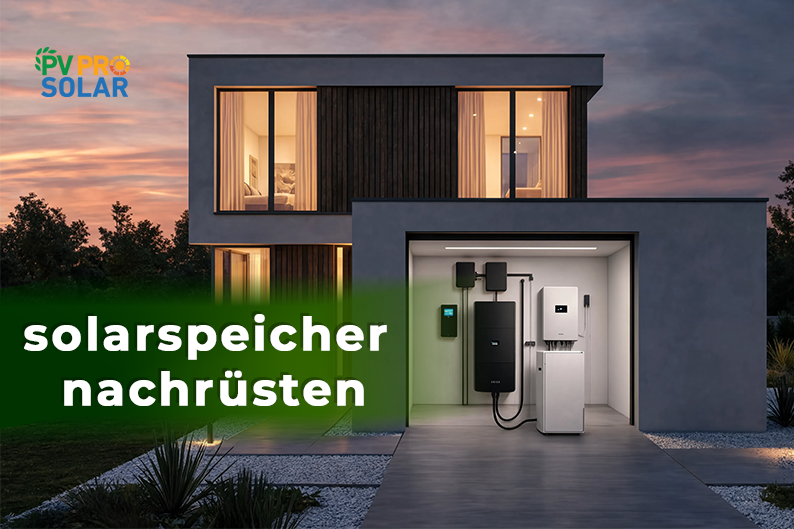
Retrofitting a Solar Battery: Costs & Benefits in 2026

Many homeowners in Hanover and the surrounding area already have a photovoltaic system on their roof, yet they feed a large portion of their solar energy into the grid for relatively little compensation instead of using it themselves. This raises an important question: Should I retrofit a solar battery storage system?
In this guide, you’ll learn, honestly and without sales pressure, what retrofitting a battery storage system costs, which technologies are available, and whether the investment makes financial sense for you.
PVPro Solar GmbH
In 3 Schritten zur PV-Anfrage
Bedarf klären · Daten senden · Angebot erhalten
Jetzt Anfrage sendenBedarf klären
Schritt 1
Daten senden
Schritt 2
Angebot erhalten
Schritt 3
Why Retrofit a Battery Storage System?
Anyone who only uses electricity when the sun is shining is leaving potential untapped.
During the day, when a PV system generates the most electricity, many homeowners are away from home. The surplus electricity is exported to the grid, and the feed-in tariff for new systems is now only around €0.08 per kilowatt-hour, while electricity purchased from the grid in the evening costs significantly more.
A battery storage system reverses this equation. It stores surplus energy generated at midday and makes it available again during the evening and at night. This allows you to consume a much larger share of your self-generated electricity, making battery retrofitting an attractive option for many system owners.
Is It Technically Possible to Retrofit a Solar Battery?
The good news is that, in the vast majority of cases, a battery storage system can be added without difficulty.
PVPro Solar explicitly points out that battery storage systems, wallboxes, and heat pumps can all be retrofitted at any time. The key factor is the type of inverter already installed.
If you already have a modern hybrid inverter, the battery can often be connected directly.
If you have a standard PV system without battery preparation, an AC-coupled storage system with its own battery inverter is typically used instead.
Both approaches are reliable. The right solution depends on your existing setup.
Photovoltaic Battery Storage Costs at a Glance
Let’s address the central question: How much does it cost?
Battery storage costs depend primarily on storage capacity, measured in kilowatt-hours (kWh), and the technology selected.
The following table provides a useful guideline for a typical battery retrofit in a single-family home:
| Storage Capacity | Typical Application | Approximate Price (including installation) |
| Approx. 5 kWh | Small household, basic demand | €4,000–€6,000 |
| Approx. 8–10 kWh | Average single-family home | €6,000–€9,000 |
| Approx. 12–15 kWh | High consumption, heat pump and/or EV charger | €9,000–€13,000 |
| Backup power function | Optional upgrade | +€500–€1,500 |
These figures are intended as guidelines only.
The exact price depends on the coupling method, installation complexity, and the components selected.
One clear advantage is that Germany’s 0% VAT rate for photovoltaic systems and associated battery storage systems remains in effect, meaning no value-added tax applies.
Increasing Self-Consumption: The Real Objective
The primary reason for retrofitting battery storage is simple: to increase self-consumption.
Without storage, the self-consumption rate of a typical PV system is often only 25–35%. With a properly sized battery, this figure frequently rises to 60–80%.
What does this mean in practice?
Every kilowatt-hour you consume yourself replaces expensive grid electricity. Instead of receiving approximately €0.08 in feed-in compensation, you avoid paying electricity prices that often exceed €0.30 per kilowatt-hour.
Over the battery’s lifespan, this difference adds up substantially.
An AI-controlled storage system, such as those offered by PVPro Solar, can optimize this effect even further by automatically adjusting charging and discharging times according to consumption patterns and electricity tariffs.
AC or DC: Which Coupling Method Is Right for You?
There are two fundamental approaches to retrofitting battery storage:
AC Coupling
The battery is equipped with its own battery inverter and integrated on the AC side of the system.
Advantages:
- Ideal for existing PV systems
- The current inverter can remain in place
- Often simpler to retrofit
DC Coupling
The battery is connected directly to the DC circuit, usually via a hybrid inverter.
Advantages:
- Slightly higher efficiency
- More integrated system architecture
Consideration:
- Frequently requires replacement of the existing inverter
For most retrofits on existing systems, AC coupling is often the simpler and more cost-effective solution.
A site-specific assessment will determine which option best suits your situation.
When Is Retrofitting Worthwhile, and When Isn’t It?
A battery storage system does not provide the same financial benefit in every case.
Retrofitting tends to make sense if the following apply:
- High electricity consumption, particularly during evenings and nights
- A planned or existing EV charger (wallbox) or heat pump that further increases self-consumption
- High grid electricity prices
- Significant amounts of surplus solar energy currently being exported to the grid
Retrofitting may be less attractive if most of your electricity consumption already occurs during daylight hours and your self-consumption rate is already high.
A reputable advisor will tell you this openly rather than trying to sell you a battery at any cost.
How to Approach a Battery Retrofit Properly
To ensure the investment pays off, three steps are essential.
1. Consumption Analysis
How much electricity do you use, and when do you use it?
The answers determine the appropriate battery size.
2. Technical Assessment
Your existing PV system and inverter must be evaluated to identify the most suitable retrofit solution.
3. Professional Installation
The installation should be carried out by certified technicians in compliance with VDE standards and local utility requirements, including registration with the grid operator and Germany’s Market Master Data Register.
PVPro Solar provides this complete service from a single source, from energy analysis and installation to ongoing support and monitoring of your upgraded system.
Conclusion
Retrofitting a solar battery is, in many cases, a sensible decision, provided the battery capacity and technology match your individual requirements.
The key is honest advice and professional installation by an experienced local partner who can realistically assess the financial viability of the investment.
Would you like to find out whether adding battery storage makes sense for your existing system?
As a master-certified solar company based in Hanover, we evaluate your current installation and provide honest, pressure-free advice.
Request your free quotation today or call us directly on +49 511 3360603.
Yes. In most cases, retrofitting battery storage is straightforward. If you already have a hybrid inverter, the battery can often be connected directly. Otherwise, an AC-coupled battery system with its own inverter is typically installed.
Depending on capacity, battery storage retrofits generally cost between €4,000 for smaller systems and €13,000 for larger systems with 12–15 kWh of storage, including installation. Backup power functionality usually involves additional costs.
As a general guideline, battery capacity should roughly correspond to your daily electricity consumption. For many single-family homes, 5–10 kWh is sufficient. Larger capacities may be appropriate if you have a heat pump or EV charger. Your actual consumption profile remains the deciding factor.
Without storage, self-consumption rates are often around 25–35%. With a properly sized battery system, self-consumption can frequently increase to 60–80%.
Not necessarily. With AC coupling, the existing inverter remains in use while the battery receives its own inverter. Only DC-coupled systems often require inverter replacement.
No. Germany's 0% VAT rate continues to apply to photovoltaic systems and associated battery storage systems, meaning no VAT is charged on purchase and installation.
Precisely because feed-in tariffs for new systems are now only around €0.08 per kilowatt-hour, self-consumed electricity is significantly more valuable. Battery storage helps maximize that self-consumption.
Yes. As a master-certified company based in Hanover, we assess your existing system, determine the optimal battery size, and handle installation, grid registration, and monitoring as a complete service package. Can I add a solar battery to an existing PV system?
How much does it cost to retrofit a battery storage system?
How much battery capacity do I need?
How much can battery storage increase self-consumption?
Do I need to replace my inverter?
Is VAT charged on battery storage systems?
Is battery storage worthwhile despite low feed-in tariffs?
Does PVPro Solar provide battery retrofits in the Hanover region?
PVPro Solar GmbH
In 3 Schritten zur PV-Anfrage
Bedarf klären · Daten senden · Angebot erhalten
Jetzt Anfrage sendenBedarf klären
Schritt 1
Daten senden
Schritt 2
Angebot erhalten
Schritt 3