

The Best Battery Storage Systems in 2026: Comparison, Top Performers and Buying Guide

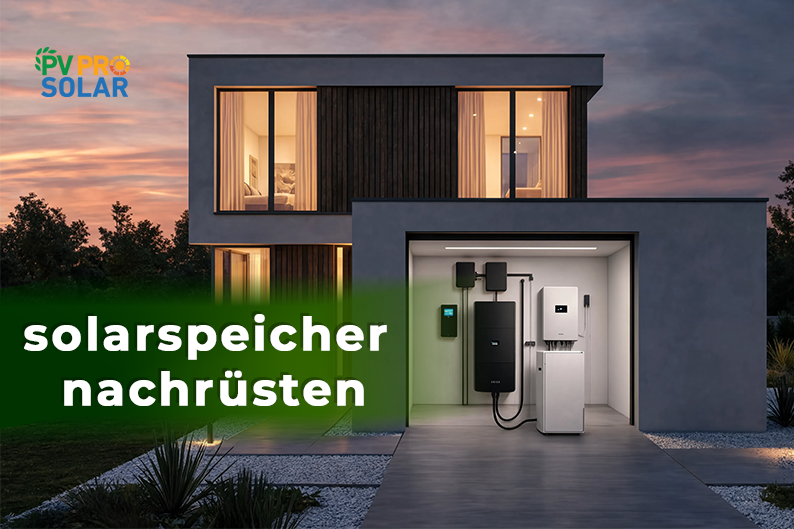
With electricity prices well above 30 cents per kilowatt-hour and photovoltaic systems generating most of their power during the day while nobody is at home, valuable solar energy is often fed back into the grid for only a few cents per kilowatt-hour—only to be bought back at a much higher price in the evening. A battery storage system solves precisely this problem.
But which battery storage system is truly the best choice in 2026?
This comparison provides a clear answer: the top-performing systems, the most important purchasing criteria, realistic price expectations, and guidance on selecting the right size for your home, concise and practical.
PVPro Solar GmbH
In 3 Schritten zur PV-Anfrage
Bedarf klären · Daten senden · Angebot erhalten
Jetzt Anfrage sendenBedarf klären
Schritt 1
Daten senden
Schritt 2
Angebot erhalten
Schritt 3
The Most Important Facts at a Glance
- Best all-rounder in 2026: High-voltage hybrid systems such as the Sungrow SBR/SBH stand out thanks to their high efficiency, excellent scalability, and strong value for money.
- Highest efficiency: In the independent HTW Berlin Energy Storage Inspection, the best-performing systems achieve a System Performance Index (SPI) of more than 97%.
- Rule of thumb for sizing: Approximately 1 kWh of storage capacity per 1,000 kWh of annual electricity consumption. For a typical single-family home, this usually equates to 8–12 kWh.
- Realistic pricing: A high-quality 10 kWh battery storage system costs approximately €5,000–€10,000 including installation in 2026, depending on the technology and manufacturer.
- Most important criterion: Size alone does not determine quality. Economic viability is key, a storage system that is too large often delivers a poorer return on investment.
What Makes a Battery Storage System the “Best”?
There is no single battery storage solution that is ideal for every household. The right choice depends on your PV system and your consumption profile.
The following six criteria are particularly important when selecting a storage system:
Usable Capacity
Usable capacity is typically around 5–10% lower than the nominal capacity. It determines how much solar electricity can be stored for use during the evening and overnight.
Efficiency (SPI)
The System Performance Index (SPI) developed by HTW Berlin enables complete storage systems to be compared by accounting for real-world energy losses. The best systems achieve values above 97%.
Charging and Discharging Power
Specified in kilowatts (kW), this determines how many electrical loads can be supplied simultaneously. At least 5 kW is recommended if backup power capability or integration with a heat pump is desired.
Expandability
Modular systems can be expanded later. Homeowners planning to add an electric vehicle or heat pump should pay particular attention to scalability.
Warranty
A product warranty of approximately 10 years is standard. In addition, pay attention to the guaranteed remaining battery capacity at the end of the warranty period.
Emergency Power or Whole-Home Backup
This is an often-overlooked criterion. Only a limited number of systems provide true backup power capable of supplying the entire household electrical network.
Modern storage systems now operate almost exclusively with LiFePO4 (lithium iron phosphate) cells. These batteries are considered particularly robust and durable, frequently achieving 6,000 or more charge cycles, equivalent to many years of daily use.
Battery Storage Comparison 2026: The Top Performers
The following overview summarizes leading battery storage systems for single-family homes. The assessments are based on independent testing data, including the HTW Berlin Energy Storage Inspection, as well as the key purchasing criteria outlined above.
| Storage System | Capacity (kWh) | Expandable Up To | Efficiency | Warranty | Price Segment |
| Sungrow SBR/SBH | 9.6–25.6 | Approx. 40 kWh (SBH) | Very high (~97.9%) | 10 years | Budget–mid-range |
| BYD HVS/HVM + SMA | 5.1–22.1 | 8 modules | High (~97.5%) | 10 years | Mid-range |
| RCT Power | 3.8–11.5 | Modular | Top performer in the 10 kW class | 10 years | Mid-range |
| Fox ESS | Depending on model | Modular | SPI up to 97% | 10 years | Budget–mid-range |
| E3/DC Hauskraftwerk | Up to 11.2 | Limited | Solid | 10 years | Premium |
A Brief Assessment
Sungrow currently offers one of the best combinations of capacity, efficiency, and price, making it a strong all-rounder and frequent winner in value-for-money comparisons.
BYD combined with SMA represents a proven partnership between two market leaders known for high compatibility and reliability.
RCT Power has received multiple distinctions in the HTW Berlin inspection, including recognition as a top performer in the 10 kW output category.
Fox ESS stands out for its very high efficiencies and low standby consumption.
E3/DC delivers premium all-in-one home energy systems manufactured in Germany but occupies the upper end of the price spectrum.
Please note: Product ranges and pricing change continuously. The most suitable storage solution depends on your inverter, energy consumption, and long-term objectives. Professional advice is therefore worthwhile.
What Size Battery Storage System Is Right for My Home?
The appropriate size depends on your annual electricity consumption, the output of your PV system, and your evening and nighttime electricity demand.
Two general rules of thumb can serve as a starting point:
- Approximately 1 kWh of storage capacity per 1,000 kWh of annual electricity consumption.
- Approximately 1 kWh of storage capacity per 1 kWp of installed PV capacity.
For most single-family homes, this results in 8–12 kWh of usable capacity.
However, bigger is not automatically better. An oversized storage system is rarely fully charged and generally offers poorer economic performance.
Practical Example
A four-person household consuming 5,000 kWh of electricity annually and operating an 8 kWp PV system is generally well served by a 10 kWh battery storage system.
Such a system can increase self-consumption from a typical 30–40% to a realistic 60–80%.
If you also plan to install a heat pump or purchase an electric vehicle, your electricity demand will increase significantly. In that case, opting for a larger, expandable solution from the outset is advisable.
How Much Does a Good Battery Storage System Cost in 2026?
Battery storage prices have fallen substantially in recent years. This is one of the main reasons why around 80% of all newly installed PV systems are now paired with battery storage.
As a realistic guide for 2026:
- High-quality 10 kWh storage system including installation: approximately €5,000–€10,000
- Cost per kilowatt-hour: decreases as capacity increases; larger systems are often more cost-effective per kWh.
- Battery modules only (excluding installation): approximately €2,000–€4,000 for 10 kWh, depending on manufacturer and technology.
The decisive factor is not merely the purchase price but the levelized cost of stored electricity over the system’s lifetime. A slightly more expensive yet more durable and efficient system may prove more economical in the long term than the cheapest option.
Emergency Power or Whole-Home Backup: What Is the Difference?
This important purchasing criterion is often misunderstood.
Emergency Power
During a power outage, emergency power systems supply only selected circuits—such as lighting or a refrigerator—often through a dedicated socket and with a brief switching interruption.
Whole-Home Backup
Whole-home backup systems can supply the entire household electrical network, typically automatically and without manual intervention.
Only a limited number of systems currently provide genuine whole-home backup capability. If maintaining electricity supply during outages is important to you, pay close attention to which backup functions are supported and how much power (in kW) the system can deliver during an outage.
The Most Common Mistakes When Buying a Battery Storage System
Many problems arise during the purchasing phase. The following mistakes should be avoided:
Planning in the Wrong Order
First analyze your roof’s solar potential and your future electricity demand. Then size the PV system and derive the storage requirements afterward—not the other way around.
Oversizing the Storage System
An oversized battery is rarely fully utilized and generally provides poorer financial returns.
Ignoring Inverter Compatibility
Not every battery storage system is compatible with every inverter. Solutions within the same manufacturer’s ecosystem often offer the highest degree of reliability.
Focusing Solely on Price
A low purchase price may come at the expense of service life and cycle life. Consider the complete package, including efficiency, warranty, and durability.
Forgetting Future Demand
If you intend to install a heat pump or purchase an electric vehicle, these future requirements should already be taken into account when selecting your storage system.
Conclusion: Which Battery Storage System Is the Best?
The best battery storage system in 2026 is the one that matches your electricity consumption, your PV system installation, and your objectives.
Independent testing consistently highlights high-voltage hybrid systems with excellent efficiency and scalability. Manufacturers such as Sungrow, BYD (in combination with SMA), RCT Power, and Fox ESS rank among the strongest options currently available.
Ultimately, the deciding factors are usable capacity, efficiency, expandability, warranty coverage, and the appropriate backup functionality, combined with correct sizing.
Homeowners who plan carefully can significantly increase self-consumption and reduce their dependence on rising electricity prices.
If you would like to determine which battery storage system is best suited to your PV installation, contact us for a no-obligation consultation. Together, we will identify the most economical solution for your home.
Which battery storage system is the best in 2026?
There is no universally best storage system. Independent evaluations such as the HTW Berlin Energy Storage Inspection consistently rank high-voltage hybrid systems with efficiencies exceeding 97% among the top performers. For most single-family homes, systems from Sungrow, BYD (combined with SMA), RCT Power, and Fox ESS offer an excellent balance of performance, expandability, and price. The ideal choice ultimately depends on your electricity consumption, PV system, and inverter.
How large should my battery storage system be?
A general rule of thumb is approximately 1 kWh of storage capacity per 1,000 kWh of annual electricity consumption, or alternatively 1 kWh per 1 kWp of installed PV capacity. For a typical single-family home, this usually corresponds to 8–12 kWh. Oversized systems are rarely fully charged and often fail to deliver optimal economic performance. Storage capacity should therefore be planned according to actual consumption patterns.
How much does a 10 kWh battery storage system cost?
A high-quality 10 kWh battery storage system costs approximately €5,000–€10,000 including installation in 2026, depending on the manufacturer and technology. Battery modules alone are available from around €2,000–€4,000, depending on the supplier. More important than the initial purchase price, however, is the levelized cost of stored electricity over the entire service life of the system.
Is a battery storage system worth it?
In most cases, yes. Without battery storage, households typically consume only 30–40% of the solar electricity they generate themselves. With a storage system, this figure can increase to 60–80%. As a result, expensive electricity imports from the grid can be significantly reduced, and homeowners become less vulnerable to rising electricity prices. How quickly a battery storage system pays for itself depends on electricity prices, self-consumption rates, and acquisition costs
PVPro Solar GmbH
In 3 Schritten zur PV-Anfrage
Bedarf klären · Daten senden · Angebot erhalten
Jetzt Anfrage sendenBedarf klären
Schritt 1
Daten senden
Schritt 2
Angebot erhalten
Schritt 3