
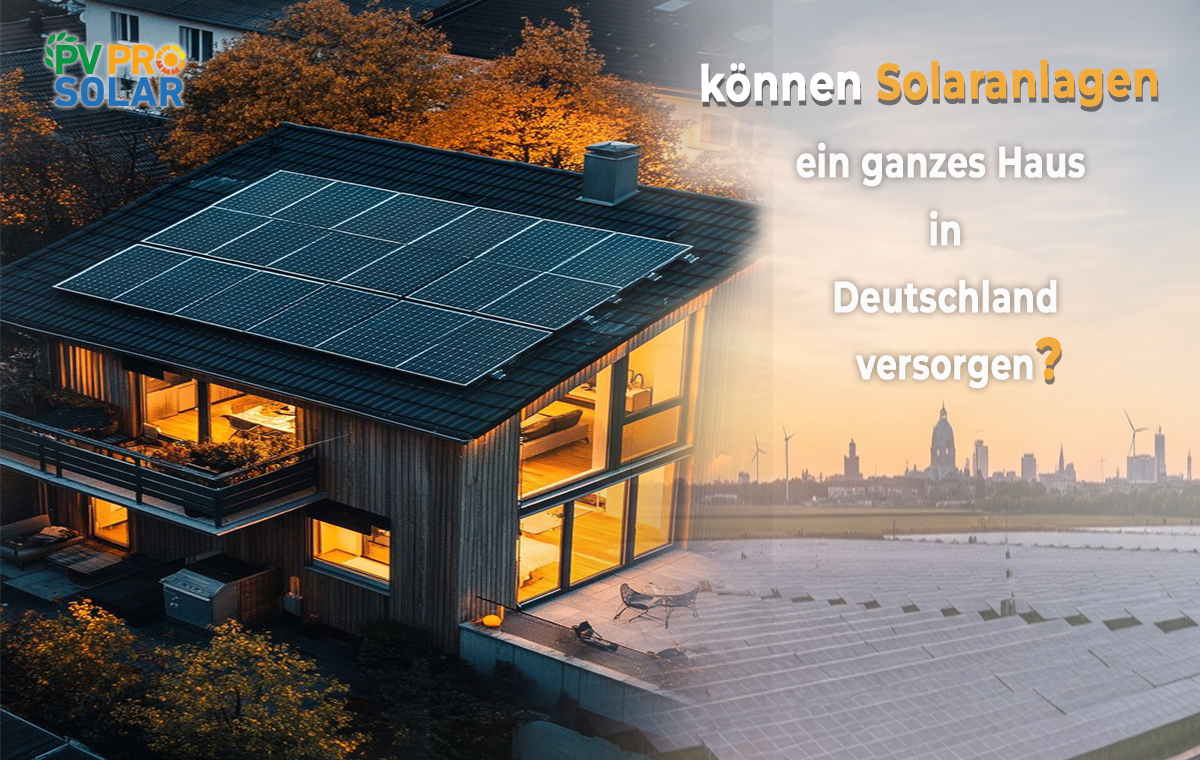
Can Solar Panels Power a Whole House in Germany?
Diese Seite ist auch auf Deutsch verfügbar
Artikel auf Deutsch lesen
Can solar panels power a whole house in Germany? The honest answer has two parts. Over the year, yes: a system with enough roof space produces more kilowatt hours than a detached house uses. Getting through every hour of the day, and through winter, without the grid is something a normal home system cannot do, not even with a large battery. We are a photovoltaic installer from Hannover, and this guide uses real figures to show how much of your demand solar panels actually cover, what a heat pump and an electric car change, and where the limits are.
PVPro Solar GmbH
Bedarf klären · Daten senden · Angebot erhalten
Send request nowBedarf klären
Step 1
Send details
Step 2
Get your quote
Step 3
Can Solar Panels Power a Whole House? Key Facts
| Annual balance | Yes: 10 kWp produce around 8,900 kWh a year in the Hannover region; a four-person detached house uses around 3,800 kWh according to the German Stromspiegel |
| Self-sufficiency without storage | around 25–30 % of demand (Verbraucherzentrale NRW) |
| Self-sufficiency with storage | up to about 70 %, but never 100 % (Verbraucherzentrale NRW) |
| Summer vs. winter | 10 kWp on a south roof in Hannover: July approx. 1,244 kWh, December approx. 278 kWh (PVGIS); October to March only around 30 % of the annual yield |
| What a battery can do | It balances day and night, not summer and winter |
| Heat pump and electric car | raise demand considerably, so the system has to be larger |
| Without the grid | legally possible in principle, rarely economical for a home in practice |
Balance or Autarky: What Does «Power a Whole House» Mean?
When people ask whether solar panels can power a whole house, they usually mean one of two things, and the answer differs a lot.
- Annual balance: the system produces at least as many kilowatt hours per year as the house uses. A normal-sized rooftop system can reach this. In summer the surplus goes to the grid; in winter and at night, power comes back from the grid.
- Full self-sufficiency (autarky): the house covers its own electricity in every hour of the year. A PV system with a battery cannot do that in Germany. The Verbraucherzentrale NRW (consumer advice centre) states that under local weather conditions a PV system with a battery, however large, cannot reach 100 % self-sufficiency (Verbraucherzentrale NRW, as of 2 July 2026).
Self-Sufficiency and Self-Consumption: Two Different Ratios
Two figures are often mixed up. The self-consumption rate is the share of the solar power you produce that you use yourself. For detached houses we calculate with around 25–35 % without storage and 55–70 % with storage. The self-sufficiency rate (Autarkiegrad) is the share of your demand that comes from your own system. According to the Verbraucherzentrale NRW, a battery raises it in a typical detached house from around 25–30 % to up to 70 %. For the question of whether the system powers your house, self-sufficiency is the figure that matters.
How Much Electricity Does an Average Home in Germany Use?
The German Stromspiegel (co2online, page as of May 2025) gives these average values for household electricity in detached houses, without heating:
| Household in a detached house | without electric water heating | with electric water heating |
|---|---|---|
| 1 person | 1,800 kWh | 2,100 kWh |
| 2 people | 2,700 kWh | 3,200 kWh |
| 3 people | 3,500 kWh | 4,100 kWh |
| 4 people | 3,800 kWh | 4,700 kWh |
| 5 people | 4,500 kWh | 6,000 kWh |
Source: Stromspiegel für Deutschland (co2online), values per year. Your own consumption is on your last annual bill, and it is the most important figure for planning.
Consumption is not spread evenly over the day: it peaks in the morning and evening, while the system produces mostly around midday. That is exactly why the annual balance alone is not enough to power a house.
Heat Pump and Electric Car: How Much Extra Power You Need
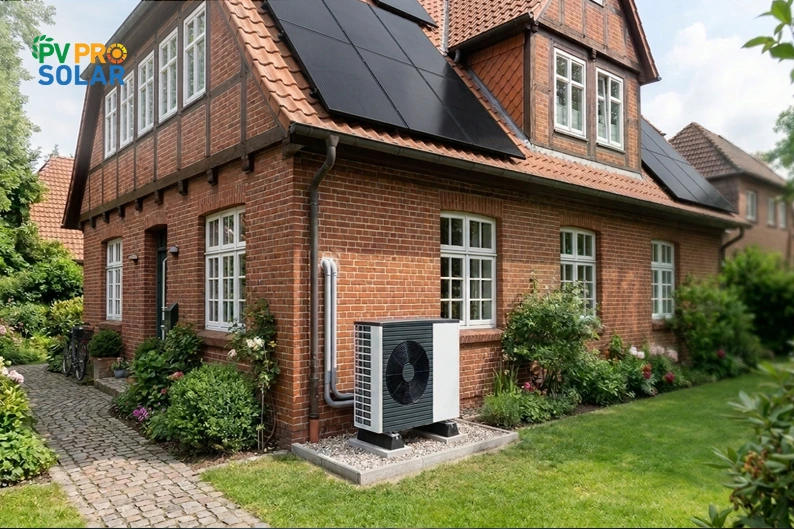
- Heat pump: an air-to-water heat pump in a detached house typically needs 3,000 to 6,000 kWh of electricity a year, most of it during the heating season. How well solar power and a heat pump work together is explained in our guide Combining a PV system with a heat pump.
- Electric car: at around 20 kWh per 100 km, 15,000 km a year means around 3,000 kWh. Charging with solar surplus works best when the car is at home during the day. Details in Photovoltaics with heat pumps and wallboxes.
A household using 3,800 kWh can quickly become a house needing 8,000 to more than 11,000 kWh a year. That changes the system size you need.
What Factors Influence the Performance of a Solar System in Germany?
How much power your roof delivers depends mainly on location, orientation, tilt and shading:
- Location: for the Hannover region we calculate with around 893 kWh per kWp per year, a cautious average across real roofs. An optimal south roof at 35° reaches around 1,000 kWh/kWp according to PVGIS. Southern Germany yields only about 12–15 % more. More in How much sun does Germany get for solar panels?.
- Modules: modern monocrystalline modules convert more than 20 % of the light into electricity. We install modules from AIKO, JA Solar and Longi.
- Inverter and losses: cables, heat, soiling and the inverter together cost part of the yield. In our PVGIS calculations we assume 14 % system losses.
What Determines the Right Size of a Solar System for a Home?
What matters is your annual consumption, the usable roof area and how much power you use during the day. Sizing the system for the darkest months is not a good idea: in December a south roof delivers only just over a fifth of its July yield, so the system would have to be many times larger and would feed almost everything into the grid in summer.
How Big Must Solar Panels Be to Power a Whole House?
For the annual balance alone, this rule of thumb works (annual demand divided by 893 kWh/kWp, Hannover region):
| House | Annual demand | System for the annual balance |
|---|---|---|
| 4 people, no electric water heating | approx. 3,800 kWh | approx. 4.5 kWp |
| 4 people, with electric water heating | approx. 4,700 kWh | approx. 5.5 kWp |
| Household 3,500 kWh + heat pump 4,500 kWh | approx. 8,000 kWh | approx. 9 kWp |
| plus electric car, 15,000 km | approx. 11,000 kWh | approx. 12–13 kWp |
In practice we usually plan larger than the pure balance if the roof allows it: more capacity also means more of your own power in spring, autumn and on dull days. Our reference system in Rethen, for example, has 10.2 kWp from 24 modules. How many modules fit on your roof is explained in How many solar panels does a house need?.
Summer and Winter: When Solar Panels Power a Whole House and When They Don’t
The biggest gap is not between day and night but between summer and winter. This is how the yield of a 10 kWp system on a south roof (35°) in Hannover is spread across the year according to PVGIS:
| Month | Yield 10 kWp | Month | Yield 10 kWp |
|---|---|---|---|
| January | approx. 306 kWh | July | approx. 1,244 kWh |
| February | approx. 510 kWh | August | approx. 1,148 kWh |
| March | approx. 871 kWh | September | approx. 974 kWh |
| April | approx. 1,183 kWh | October | approx. 674 kWh |
| May | approx. 1,280 kWh | November | approx. 371 kWh |
| June | approx. 1,269 kWh | December | approx. 278 kWh |
Source: PVGIS (European Commission), irradiation data 2005–2023, 14 % system losses, annual total approx. 10,100 kWh. Around 70 % of the yield comes from April to September, only around 30 % from October to March.
What this means: from April to September the system produces several times what a four-person household needs. In December, 278 kWh is not even enough for the average monthly demand of just over 300 kWh, and that power arrives in a few bright hours around midday. With a heat pump the winter gap is even larger, because it needs the most power exactly then. How snow, cold and short days affect a system is explained in Can solar panels work in winter in Germany?.
Can a House Be Fully Powered by Solar Panels Without Battery Storage?
No. Without a battery you only use the power that is produced at the same moment. In the evening, at night and on dull days, power comes from the grid. According to the Verbraucherzentrale NRW, a typical detached house covers around 25–30 % of its demand this way.
- Raise self-consumption: run the washing machine, dishwasher and dryer at midday, use timers and an energy management system that shifts the heat pump or wallbox into sunny hours.
- Still worth it: every kilowatt hour you use yourself replaces expensive grid power. The rest is fed in and paid for.
How Do Battery Storage Systems Help Power a Home Around the Clock?
A battery stores midday solar power for the evening and night. According to the Verbraucherzentrale NRW, this raises the self-sufficiency of a typical detached house to up to about 70 %.
- Size: as a guideline, the Verbraucherzentrale NRW recommends about 1.5 kWh of storage capacity per 1,000 kWh of annual consumption. For 3,800 kWh that is around 6 kWh. A much larger battery mostly stays half empty in winter.
- Losses: charging, discharging and standby cost energy. In one example the Verbraucherzentrale assumes around 20 % losses: of 1,500 kWh going into the battery, about 1,200 kWh reach the house.
- Limit: a battery balances day and night, not summer and winter. Storing July power for December is not possible with home batteries.
We install BYD batteries. Which size suits your house is explained in our guide Power storage for your home.
How Do Roof Orientation and Tilt Angle Affect Solar Power Generation?
- South: highest annual yield.
- East-west: around 80 % of the south yield (PVGIS Hannover, 35° tilt), but with power in the morning and evening, when many households need it.
- Tilt: about 30–35° is optimal in Germany. On flat roofs the modules are mounted on tilted frames.
- Shading: trees, dormers, chimneys or neighbouring buildings reduce the yield. A shading analysis is part of every good plan.
Specific values for every orientation are in our guide to the best direction for solar panels.
Backup Power: Do Solar Panels Power the House During a Blackout?
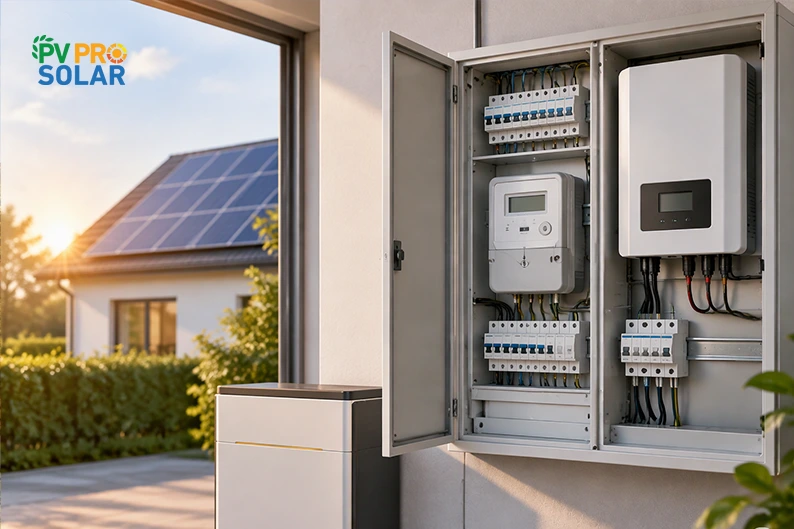
Not automatically. A normal grid-connected system switches off during a power cut for safety reasons, even when the sun is shining. To keep supplying your house during a grid failure you need a backup-capable inverter, a suitable battery and, for the whole house, a transfer switch in the meter cabinet that disconnects the house from the grid.
The Fronius GEN24 Plus we install has a built-in emergency socket (PV Point). Whole-house backup also needs a battery and a transfer switch. All options, costs and switchover times are explained in our guide Solar backup power systems.
Completely Off-Grid: Does an Autarkic House Make Sense in Germany?
Legally, an off-grid system without a grid connection is possible in principle. The Energy Industry Act obliges the grid operator to connect you (Section 18 EnWG), but it does not oblige you to use the connection. Check with the local building authority beforehand whether special rules apply where you build.
Economically it is a different story. To get through winter, an off-grid house would have to store power for weeks or rely on a generator. According to the Verbraucherzentrale NRW, seasonal storage from summer to winter cannot be achieved even with a very large, uneconomical battery. In addition, summer surpluses earn nothing without the grid. For a home that already has a grid connection, we therefore recommend a grid-connected system with storage and, if supply security matters to you, a backup function.
How Much Does a Full Solar System Cost?
For the annual balance of a detached house, 6 to 10 kWp is often enough; with a heat pump and an electric car, 10 to 13 kWp is more realistic. Our modelled guide prices for a fully installed system:
| System | Guide price |
|---|---|
| 6 kWp without storage | approx. €8,700–10,500 |
| 8 kWp without storage | approx. €11,600–14,000 |
| 10 kWp without storage | approx. €14,500–17,500 |
| BYD HVS 10.2 battery in addition | approx. €7,700–9,200 |
| 10 kWp with storage | approx. €22,200–26,700 |
The basis is €1,450–1,750 per kWp. Scale larger systems with this value, for example 12 kWp at around €17,400–21,000 without storage. A fixed-price quote gives you the exact price for your roof. All cost factors are explained on our page Solar panel costs.
What Incentives and Subsidies Are Available in Germany?
- 0 % VAT: since 1 January 2023, no VAT is charged on the supply and installation of PV systems and batteries on or near residential buildings (Section 12 (3) UStG). More in Photovoltaic system VAT.
- Income tax: income from systems up to 30 kWp per residential or commercial unit is tax-free (Section 3 No. 72 EStG).
- Feed-in tariff: systems up to 10 kWp commissioned from 1 August 2026 receive around 7.70 ct/kWh with partial feed-in and 12.22 ct/kWh with full feed-in. For systems from 2027, the federal government’s draft bill plans a restructuring. Systems commissioned by 31 December 2026 keep the fixed tariff for 20 years. Details on our page about how the feed-in tariff works.
- KfW 270: a low-interest loan, not a grant. There is no federal grant for private PV systems or batteries.
- Regional: in the Hannover region, proKlima supports rooftop systems with €100 per kWp, up to €2,000, only while funds last and only if you apply before placing the order.
An overview of all programmes is in our subsidy guide.
Is Investing in Solar Panels for a Whole House Worth It?
Yes. Solar panels that power a whole house over the year pay off, even though they will not make it fully self-sufficient. The gain comes from every kilowatt hour you no longer buy from the grid. An example from our own projects:
- Reference system Rethen (Hannover district): 10.2 kWp, Fronius GEN24 Plus, BYD HVS 10.2, total investment €21,400.
- Forecast for this roof: around 9,800 kWh a year.
- Payback: calculated at around 9.7 years, at an assumed electricity price of €0.32/kWh.
After that, the system keeps delivering low-cost power for many years. How the numbers change for other sizes and electricity prices is shown in Are photovoltaics worth it?. You can make a first forecast of your savings and self-sufficiency with our solar calculator.
What Common Mistakes Should Homeowners Avoid?
- Expecting autarky that does not exist: if you plan for 100 %, you will be disappointed. Plan with the self-sufficiency rate, not the annual balance.
- Forgetting future demand: a heat pump or electric car in a few years? Then cover the roof fully now and prepare the meter cabinet.
- Choosing a battery that is too big: an oversized battery costs a lot and stays half empty in winter.
- Assuming backup power: without a backup-capable inverter and a transfer switch, the house goes dark in a power cut.
- Applying for funding too late: proKlima and KfW 270 must be applied for before you place the order.
Conclusion: How Solar Panels Power Your Whole House as Far as Possible
Solar panels can power a whole house in Germany over the year if the roof has enough space. A home cannot do without the grid, though: without storage you cover around a quarter to just under a third of your demand yourself, with storage up to about 70 %. Winter remains the limit. A heat pump and an electric car raise demand, so it pays to plan the right size from the start. We plan and install the PV system, BYD battery, wallbox and, if you wish, the heat pump for your detached house with our own electricians, at a fixed price and with the 30/70 payment model. More about our complete systems at Buy a photovoltaic system in Hannover.
Want to know how much of your demand your roof can cover? Request a free, no-obligation quote now, with a free roof analysis and yield forecast. Or call us on 0511 3360603 or message us on WhatsApp: +49 176 2399 8536.
Frequently Asked Questions
Can I make my home 100% solar-powered?
Not with a normal PV system and a battery. According to the Verbraucherzentrale NRW, 100 % self-sufficiency cannot be reached under German weather conditions, however large the battery. Realistic values are around 25–30 % without and up to about 70 % with storage. Over the year, however, the system can produce more power than the house uses.
How long does it take for a solar system to pay off?
It depends on price, self-consumption and the electricity price. Our reference system in Rethen (10.2 kWp with a BYD battery, €21,400) pays for itself after around 9.7 years by calculation, at an assumed electricity price of €0.32/kWh.
How many kWp do I need to power my house over the year?
Divide your annual consumption by around 893 kWh per kWp (Hannover region). A four-person household using 3,800 kWh needs around 4.5 kWp for the annual balance, around 9 kWp with a heat pump, and 12 to 13 kWp with a heat pump and an electric car.
Is a solar system enough for the whole house in winter?
Usually not. A 10 kWp system on a south roof in Hannover produces only about 278 kWh in December, compared with about 1,244 kWh in July. Only around 30 % of the annual yield comes from October to March, so in winter a large part of the power comes from the grid.
Can a battery store summer solar power for winter?
No. A home battery balances day and night, not summer and winter. According to the Verbraucherzentrale NRW, seasonal storage is not possible even with a very large, uneconomical battery.
Does my solar system work during a power cut?
Only with a backup function. A normal system switches off when the grid fails. An emergency socket on the inverter is enough for individual devices; for the whole house you need a backup-capable inverter, a suitable battery and a transfer switch.
Can I disconnect my house from the grid completely in Germany?
In principle yes: the law obliges the grid operator to connect you, not you to use the connection. Check with the local building authority whether special rules apply. Economically, an off-grid house rarely makes sense, because you would have to bridge winter with very large batteries or a generator.
Note: This article gives a general overview (as of November 2026) and does not replace tax or legal advice.
PVPro Solar GmbH
Your PV quote in 3 steps
Bedarf klären · Daten senden · Angebot erhalten
Send request nowBedarf klären
Step 1
Send details
Step 2
Get your quote
Step 3