
BYD Battery Storage: Experience, Benefits, and Costs

Anyone who owns or is planning a photovoltaic (PV) system will eventually face the question of choosing the right battery storage solution. One name consistently comes up in this context: BYD. BYD battery storage systems are among the most widely installed energy storage solutions in German households and stand out thanks to their modular design, durable cell technology, and extensive product range. In this guide, you’ll find a clear overview of user experiences, key advantages, and costs to help you determine whether a BYD battery storage system is the right choice for your home.
PVPro Solar GmbH
In 3 Schritten zur PV-Anfrage
Bedarf klären · Daten senden · Angebot erhalten
Jetzt Anfrage sendenBedarf klären
Schritt 1
Daten senden
Schritt 2
Angebot erhalten
Schritt 3
What Is a BYD Battery Storage System?
BYD is a global manufacturer of battery technology and one of the world’s largest producers of lithium iron phosphate (LFP) cells. The storage systems in the Battery-Box Premium series are specifically designed for residential properties and small commercial applications.
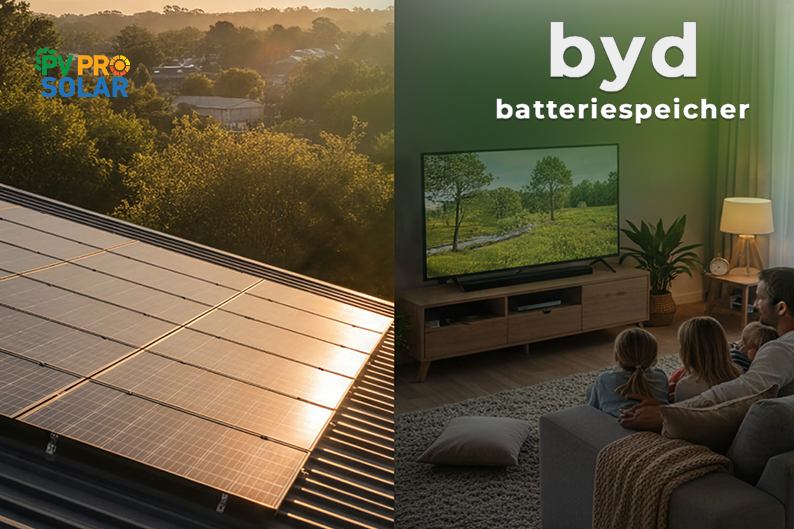
A BYD battery storage system stores the surplus solar power generated by your photovoltaic system that is not consumed directly during the day. This energy can then be used in the evening and at night instead of being fed into the grid for a relatively low compensation rate. At the heart of the system is LFP cell chemistry, which is widely regarded as particularly safe and durable.
At PVPro Solar, BYD is one of the premium components used alongside brands such as AIKO, JA Solar, Fronius, and K2 Systems. This means the battery storage system is not sold as a standalone product but is planned and installed as part of a well-designed, integrated energy solution.
Why Invest in a Battery Storage System?
A solar system generates most of its energy around midday, while household electricity consumption typically peaks in the morning and evening. Without a storage system, this creates a gap: inexpensive solar power is fed into the grid, while expensive grid electricity must be purchased later.
A battery storage system closes this gap. Key benefits include:
- Higher self-consumption: Instead of using only about one-third of your generated solar energy directly, significantly higher self-consumption rates can often be achieved with battery storage.
- Lower electricity costs: Every kilowatt-hour of self-consumed energy replaces expensive grid electricity.
- Greater independence: You become less vulnerable to rising electricity prices.
- Optional backup power: When combined with the appropriate technology, emergency power supply functionality is also possible.
The Main Product Series: BYD HVS and BYD HVM
BYD offers its Battery-Box Premium in two main high-voltage variants, which primarily differ in capacity and performance.
BYD HVS – Compact and Powerful
The BYD HVS (High Voltage Small) is the more compact option, offering a higher discharge rate relative to its capacity. It is well suited for households with moderate storage requirements where high power output may be needed over short periods. Its modular design allows capacity to be increased by adding additional battery modules.
BYD HVM – Greater Capacity for Higher Demand
The BYD HVM (High Voltage Moderate) provides greater storage capacity per module while maintaining the same module height and can be expanded to larger overall capacities. It is an ideal choice for households with high electricity consumption, such as those using heat pumps and EV charging stations (wallboxes), as well as for small commercial properties.
Both product lines are based on the same LFP cell chemistry and follow the same modular concept. The table below summarizes the key differences:
| Feature | BYD HVS | BYD HVM |
| Focus | Compact, high performance | High capacity |
| Typical Application | Small to medium demand | Medium to high demand |
| Design | Modular, stackable | Modular, stackable |
| Cell Chemistry | Lithium Iron Phosphate (LFP) | Lithium Iron Phosphate (LFP) |
| Expandable | Yes, through additional modules | Yes, through additional modules |
The exact number of modules, storage capacity in kWh, and compatibility with your inverter should always be determined as part of a professional system design.
Advantages of a BYD Battery Storage System
Why do so many households choose a BYD battery storage system? The main reasons include:
- Safe LFP Technology: Lithium iron phosphate is considered thermally stable and robust, enhancing overall safety.
- Modularity: You can start with the capacity you need today and expand the system later if required.
- High-Voltage Technology: The high-voltage architecture enables high efficiency and minimizes energy losses.
- Wide Compatibility: BYD storage systems are compatible with many popular hybrid inverters.
- Durability: LFP cells are designed for a high number of charge and discharge cycles.
This modular approach aligns perfectly with PVPro Solar’s philosophy that energy systems should be expandable at any time to include battery storage, EV charging stations, and heat pumps.
Real-World Experience
Reports from users and industry professionals have painted a largely positive picture of BYD battery systems over the years. Commonly mentioned strengths include easy expandability, reliable day-to-day performance, and good component availability.
In practice, however, customer satisfaction depends heavily on proper system sizing and installation. A battery that is too small will not fully unlock the potential savings, while an oversized system may unnecessarily extend the payback period. This highlights the value of a thorough energy analysis, which PVPro Solar conducts at the start of every project.
Equally important is the seamless integration of the battery into the overall energy system. A VDE- and TAB-compliant installation carried out by certified technicians is essential for safe and trouble-free operation, a standard that PVPro Solar, as a certified master electrical company, guarantees.
How Much Does a BYD Battery Storage System Cost?
The cost of a BYD battery storage system cannot be summarized with a single figure, as pricing depends on several factors:
- Storage Capacity: More kWh means higher costs but also more usable energy.
- Product Series: HVS and HVM differ in price per kilowatt-hour.
- Inverter Requirements: Whether a compatible hybrid inverter is already installed affects total costs.
- Installation Complexity: Building conditions and wiring requirements also play a role.
As a general guideline, the cost per kilowatt-hour of storage capacity tends to decrease as system size increases. However, only a customized quotation based on your consumption profile and PV system can provide an accurate cost estimate.
PVPro Solar also offers a fixed-price guarantee and a transparent 30/70 payment model, providing planning certainty from the very beginning.
BYD Battery Storage Reviews and Testing: What Matters Most
When comparing reviews and battery storage tests, pay particular attention to the following criteria:
- Usable Capacity: How much of the total gross capacity is actually available for use?
- Efficiency: How much of the stored energy can be recovered?
- Cycle Life and Warranty: How many charging and discharging cycles are covered by the manufacturer?
- Safety: Which battery chemistry and protective mechanisms are used?
- Expandability: Can the system be expanded easily at a later stage?
- Compatibility: Is the storage system compatible with your existing or planned inverter?
These criteria help put test results into perspective and ensure you look beyond the initial purchase price alone.
Who Benefits Most from a BYD Battery Storage System?
A BYD battery storage system is particularly worthwhile if:
- You want to maximize the value of an existing or planned PV system.
- Your electricity consumption is spread throughout the day and increases during the evening.
- You intend to add a heat pump or EV charging station in the future.
- Expandability and future-proofing are important to you.
- You value safe and durable battery technology.
A storage system may be less cost-effective if your electricity consumption is very low or if you already consume most of your electricity directly during the day. A professional needs assessment can clarify this in advance.
Conclusion
A BYD battery storage system is a mature, modular, and safe solution for increasing the self-consumption of solar energy and reducing electricity costs. With the BYD HVS and BYD HVM product lines, the manufacturer offers solutions for a wide range of requirements—from compact systems for single-family homes to high-capacity installations for households with heat pumps and EV charging stations, as well as small commercial properties.
The key factors for long-term satisfaction are correct system sizing, seamless integration into the overall energy system, and professional installation. This is where the value of an experienced specialist company becomes clear, providing planning, installation, and ongoing support from a single source.
Are you considering whether a BYD battery storage system is right for your home? The experts at PVPro Solar in Hanover offer free consultations, analyze your energy needs, and design a customized storage solution tailored to your requirements.
Request your free quote today or call directly on 0511 3360603.
What is a BYD battery storage system?
A BYD battery storage system is an energy storage solution based on lithium iron phosphate (LFP) cells that stores excess solar energy generated by your PV system, allowing you to use it in the evening and at night. The systems are modular and expandable.
What is the difference between BYD HVS and BYD HVM?
The BYD HVS is the more compact option, offering a higher discharge rate relative to its capacity, while the BYD HVM provides more storage capacity per module at the same module height. HVS is ideal for small to medium demand, whereas HVM is better suited for higher energy consumption.
How much does a BYD battery storage system cost?
Costs depend on storage capacity, product series, existing inverter compatibility, and installation requirements. Generally, the price per kilowatt-hour decreases as storage capacity increases. An accurate price can only be provided through an individual quotation.
How long does a BYD battery storage system last?
Thanks to LFP cell chemistry, BYD storage systems are designed for a high number of charging and discharging cycles and a long service life. The manufacturer also provides a warranty, the terms of which vary by product.
Is a BYD battery storage system compatible with my PV system?
BYD storage systems work with many common hybrid inverters. Compatibility with your specific inverter should be verified during the planning stage.
Can I expand a BYD battery storage system later?
Yes. Thanks to the modular design, both the HVS and HVM series can be expanded by adding additional battery modules.
Does a BYD battery storage system provide backup power?
A battery storage system alone does not supply electricity during a grid outage. Backup power is only possible when combined with a backup-capable inverter or dedicated backup system.
PVPro Solar GmbH
In 3 Schritten zur PV-Anfrage
Bedarf klären · Daten senden · Angebot erhalten
Jetzt Anfrage sendenBedarf klären
Schritt 1
Daten senden
Schritt 2
Angebot erhalten
Schritt 3